Incisura groove depth is associated with reduced rotational fibular displacement after syndesmotic injury: cadaveric validation of an automated three-dimensional incisura morphometric pipeline - Scorecard - MDSpire
Advertisement
Incisura groove depth is associated with reduced rotational fibular displacement after syndesmotic injury: cadaveric validation of an automated three-dimensional incisura morphometric pipeline
Clinical Scorecard: Association of Incisura Groove Depth with Decreased Rotational Displacement of the Fibula Following Syndesmotic Injury: Validation of an Automated 3D Morphometric Analysis in Cadaveric Specimens
At a Glance
Category
Detail
Condition
Syndesmotic Injury
Key Mechanisms
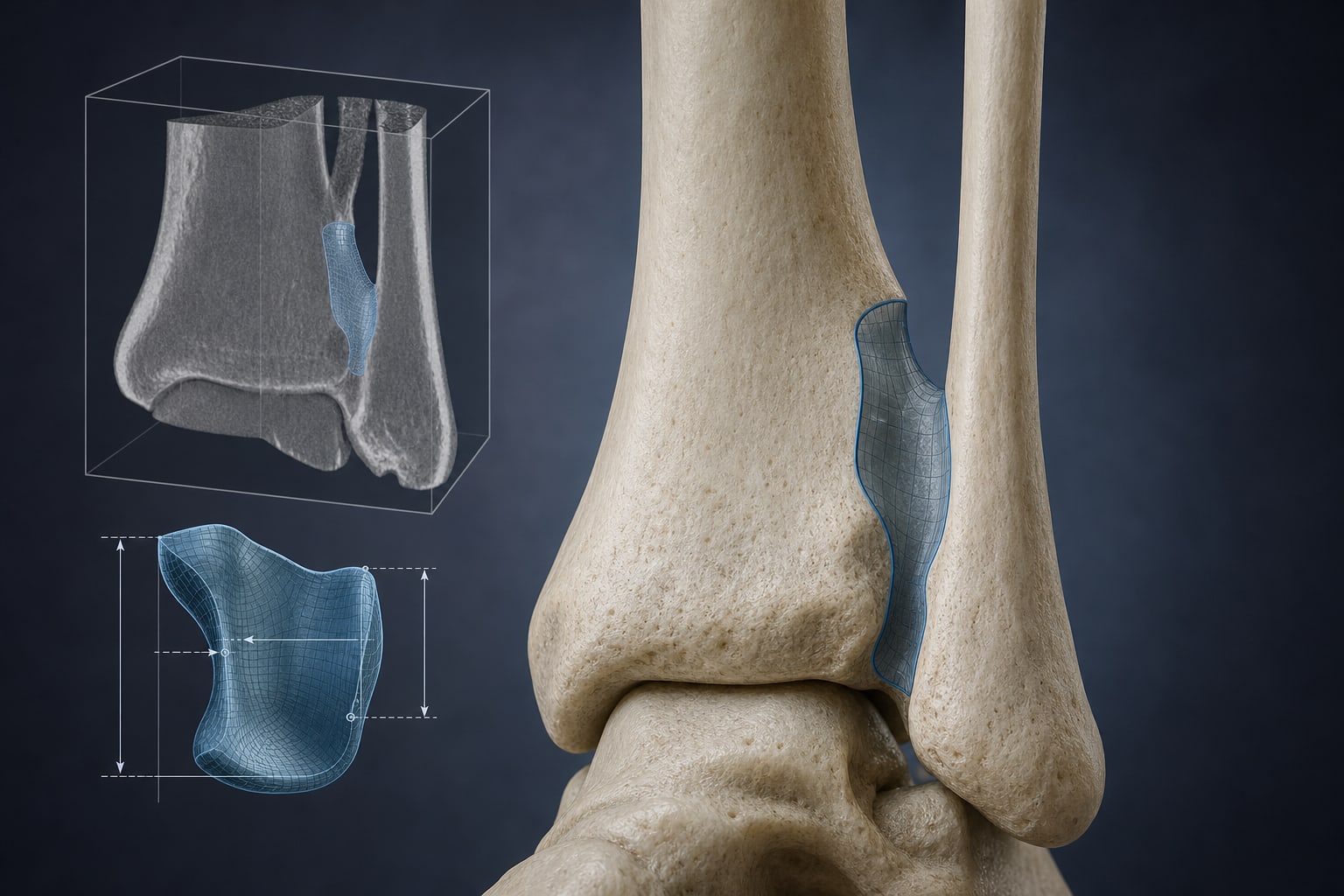
Morphology of the tibial incisura affects fibular displacement during injury.
Target Population
Individuals with syndesmotic injuries, particularly in athletic populations.
Care Setting
Clinical assessment and surgical planning for syndesmotic injuries.
Key Highlights
Automated 3D morphometric analysis of the tibial incisura was developed and validated.
Significant negative associations were found between incisura depth metrics and fibular displacement.
The study utilized a controlled cadaveric model to assess the relationship between morphology and injury outcomes.
Reproducibility and bilateral reliability of the morphometric outputs were confirmed.
Larger osseous constraint envelopes correlated with reduced rotational fibular displacement.
Guideline-Based Recommendations
Diagnosis
Consider preoperative morphometric assessment of the tibial incisura for surgical planning.
Management
Aim to restore native fibular position within the incisura during surgical intervention.
Monitoring & Follow-up
Evaluate reduction quality post-surgery to minimize risks of chronic pain and disability.
Risks
Malreduction of the distal fibula is linked to chronic pain, post-traumatic arthritis, and persistent disability.
Patient & Prescribing Data
Patients with syndesmotic injuries, especially in contact and cutting sports.
Morphological assessment may refine individualized surgical planning.
Clinical Best Practices
Utilize automated 3D morphometric analysis for accurate assessment of incisura morphology.
Incorporate findings from morphometric analysis into surgical decision-making.
Preoperative use was associated with fewer revisions and no increase in short-term complications among patients with obesity, although benefits appeared concentrated in select subgroups.