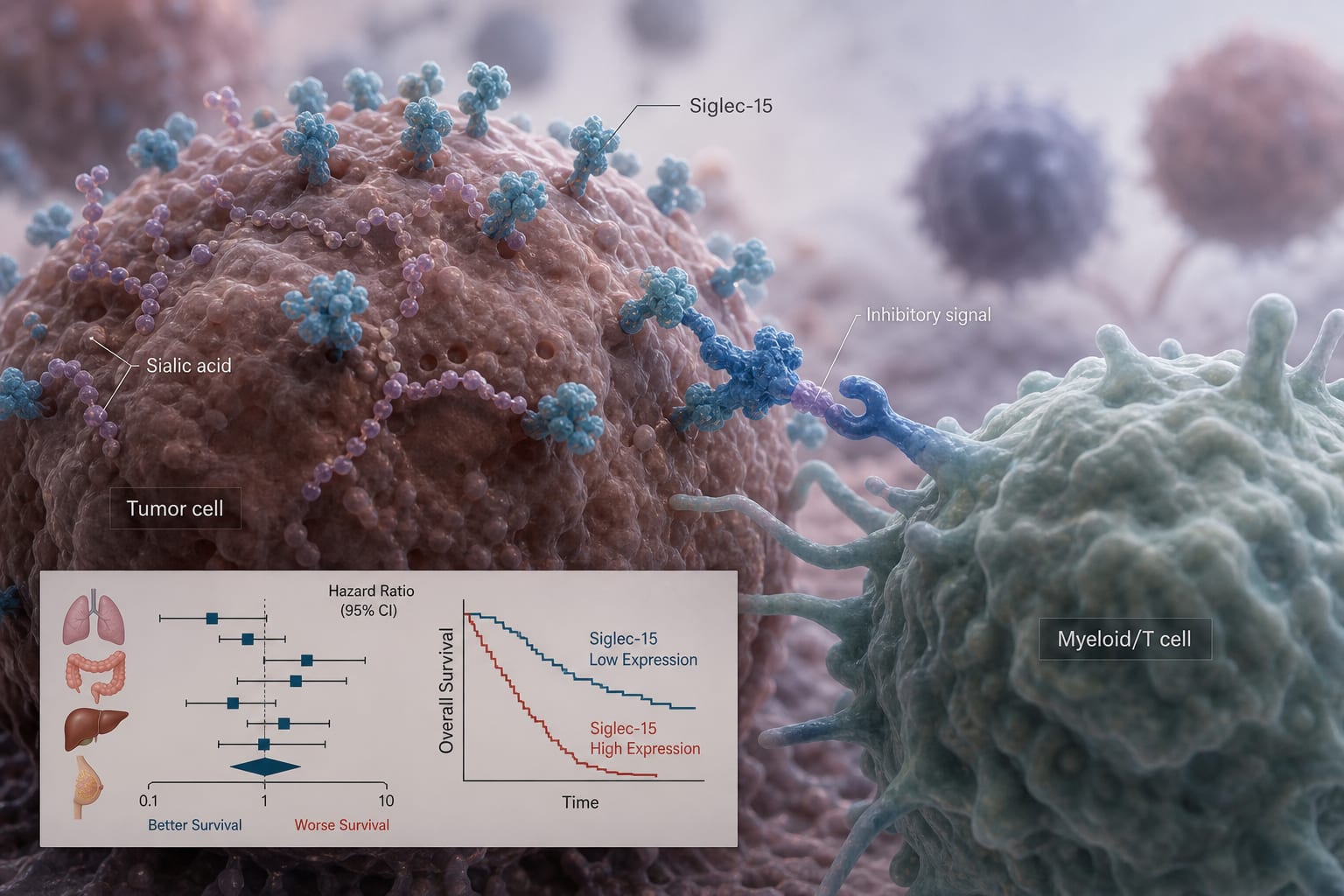
The Prognostic Role of Tumor Siglec-15 Expression in Solid Tumors: A Comprehensive Meta-Analysis and Systematic Review
-
By
-
Ningning Zhang
-
Yuan He
-
Zemin Qin
-
Junyan Yu
-
Wei Guo
-
July 21, 2026
Clinical Scorecard: The Prognostic Role of Tumor Siglec-15 Expression in Solid Tumors: A Comprehensive Meta-Analysis and Systematic Review
At a Glance
| Category | Detail |
|---|
| Condition | Solid tumors |
| Key Mechanisms | Siglec-15 promotes immune escape and tumor progression through various oncogenic signaling pathways. |
| Target Population | Patients with solid tumors exhibiting varying levels of Siglec-15 expression. |
| Care Setting | Oncology |
Key Highlights
- High Siglec-15 expression is associated with poorer overall survival (OS) and disease-free/recurrence-free survival (DFS/RFS).
- No significant association found for progression-free survival.
- Siglec-15 expression inversely correlates with PD-L1 positivity.
- Tumor-specific analyses show worse OS in colorectal cancer, gastric cancer, and osteosarcoma.
- Further prospective studies are needed to validate findings and develop standardized assessment strategies.
Guideline-Based Recommendations
Diagnosis
- Evaluate tumoral Siglec-15 expression in patients with solid tumors.
Management
- Consider Siglec-15 as a potential therapeutic target in immunotherapy.
Monitoring & Follow-up
- Monitor overall survival and disease-free survival in relation to Siglec-15 expression levels.
Risks
- High Siglec-15 expression may indicate poorer prognosis in certain cancer types.
Patient & Prescribing Data
Patients with solid tumors, particularly those with high Siglec-15 expression.
Anti-Siglec-15 antibodies are under clinical evaluation, showing potential for patients unlikely to respond to PD-1/PD-L1 blockade.
Clinical Best Practices
- Utilize standardized assessment strategies for Siglec-15 expression.
- Incorporate Siglec-15 evaluation in treatment planning for solid tumors.
Related Resources & Content