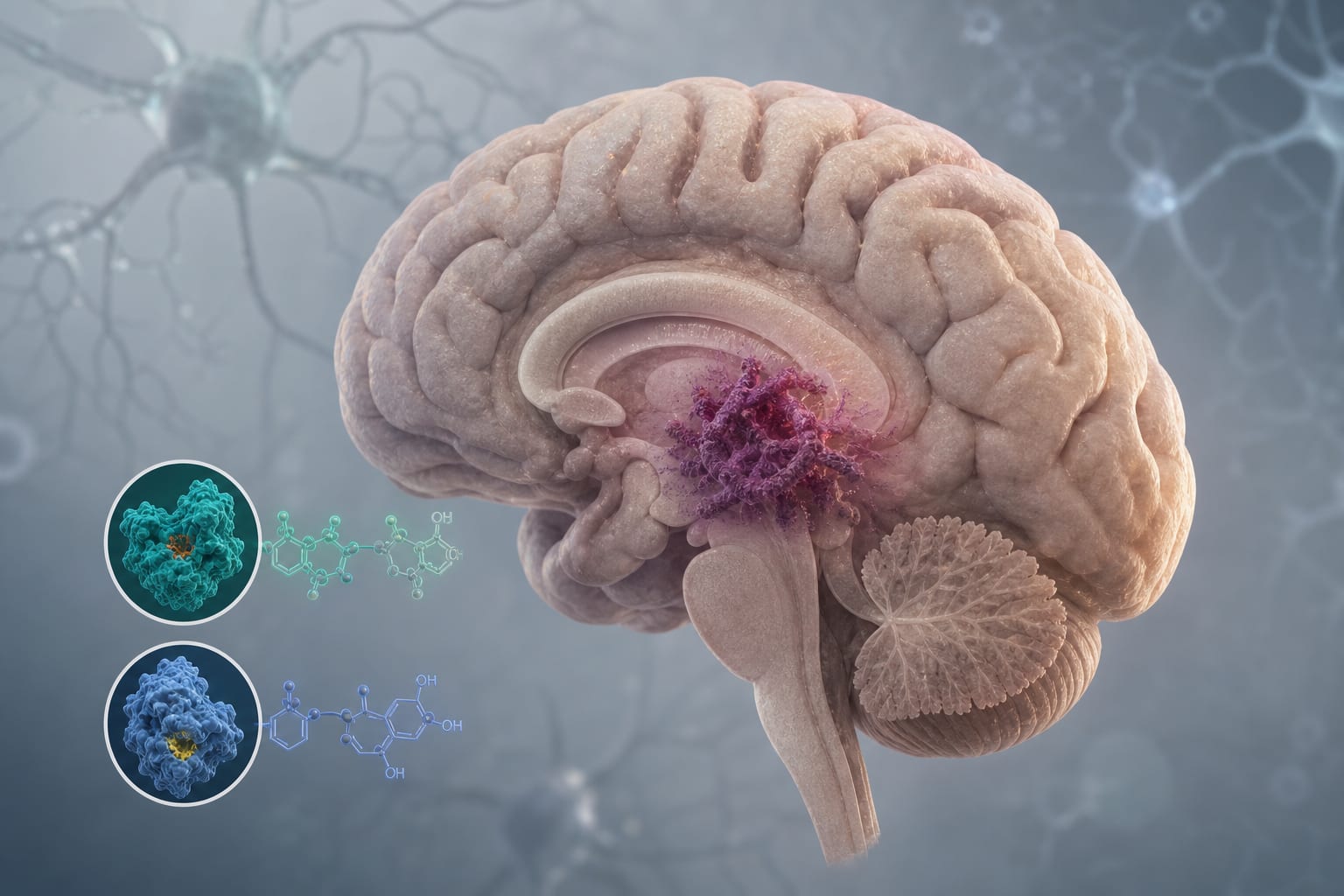
Clinical Scorecard: Serotonin System Impairment in Parkinson's Disease Patients with Impulse Control Disorders
At a Glance
Category
Detail
Condition
Impulse Control Disorders (ICDs) in Parkinson’s Disease
Key Mechanisms
Dysregulated dopaminergic tone and serotonergic dysfunction within cortico-striato-pallido-thalamic circuits affecting inhibitory control
Target Population
Parkinson’s disease patients with impulse control disorders (PDICD+)
Care Setting
Neurology and neuropsychiatry clinical settings with PET imaging capabilities
Key Highlights
PDICD+ patients exhibit greater presynaptic serotonin transporter (SERT) availability in posterior putamen and pallidum compared to PDICD− patients.
Increased cortical 5-HT2A receptor binding in sensorimotor and associative networks involved in behavioural inhibition is observed in PDICD+ patients.
Serotonergic dysfunction in PDICD+ specifically involves sensorimotor and associative cortico-striato-pallido-thalamic circuits, contributing to impaired inhibitory control beyond dopaminergic abnormalities.
Guideline-Based Recommendations
Diagnosis
Consider clinical assessment of ICD symptoms including hypersexuality, compulsive eating, shopping, and gambling in PD patients.
Use PET imaging with 11C-DASB and 18F-altanserin tracers to evaluate serotonergic system involvement in research or specialized centers.
Management
Individualize management of ICDs in PD, addressing dopaminergic treatment exposure and comorbid neuropsychiatric conditions such as anxiety and depression.
Employ cognitive behavioural therapy and involve patient care partners to mitigate social repercussions.
Avoid abrupt dopaminergic drug withdrawal to prevent withdrawal syndrome with motor and non-motor worsening.
Monitoring & Follow-up
Regularly monitor for emergence or worsening of ICD symptoms in PD patients, especially those on dopamine agonists.
Assess neuropsychiatric symptoms including depressive and anxious features that may exacerbate ICDs.
Risks
Dopaminergic treatments, particularly dopamine agonists, increase risk of ICD development and persistence.
Reduction or cessation of dopaminergic drugs may lead to withdrawal syndrome with apathy and anxiety.
ICDs can cause significant distress and negative social and personal consequences.
Patient & Prescribing Data
Parkinson’s disease patients with and without impulse control disorders
Dopaminergic therapies contribute to ICD risk; serotonergic dysfunction represents a potential therapeutic target beyond dopaminergic modulation.
Clinical Best Practices
Adopt a comprehensive, graded approach to ICD management incorporating pharmacological, psychological, and social interventions.
Screen for and address comorbid neuropsychiatric symptoms that may influence ICD severity.
Consider serotonergic system involvement when evaluating ICD pathophysiology and potential novel treatments.
Use PET imaging selectively in research or specialized clinical contexts to understand serotonergic contributions.