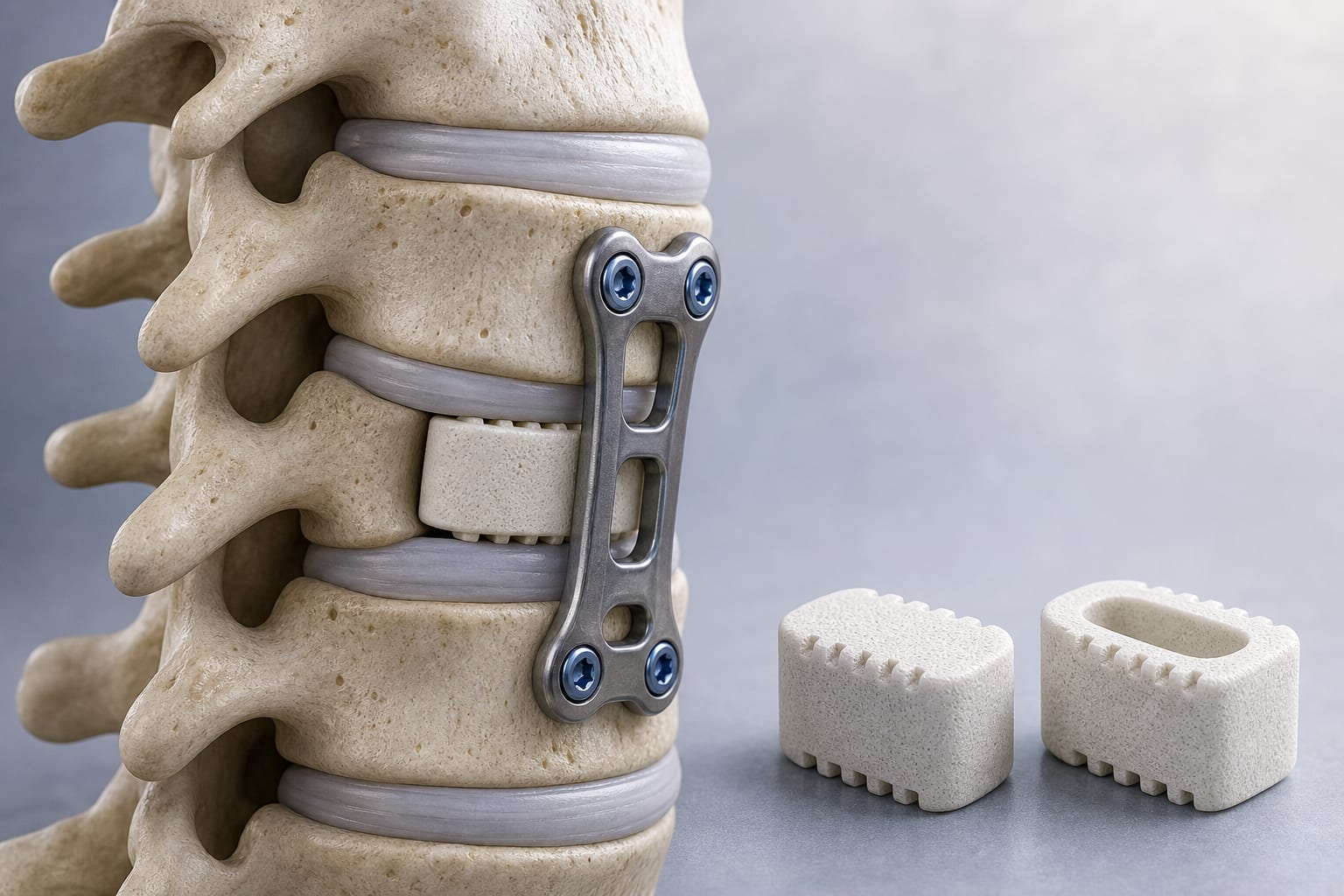
Is a central cavity necessary for bioactive glass-ceramic spacers in plated ACDF? A retrospective comparison of solid versus cavity designs - Scorecard - MDSpire
Advertisement
Is a central cavity necessary for bioactive glass-ceramic spacers in plated ACDF? A retrospective comparison of solid versus cavity designs
Clinical Scorecard: Is the Presence of a Central Cavity Essential for Bioactive Glass-Ceramic Spacers in Plated Anterior Cervical Discectomy and Fusion? A Retrospective Analysis of Solid Versus Cavity Designs
At a Glance
Category
Detail
Condition
Anterior Cervical Discectomy and Fusion (ACDF)
Key Mechanisms
Use of bioactive glass-ceramic (BGS) spacers for osteoconduction and fusion.
Target Population
Adults aged 18 and older undergoing ACDF for radiculopathy or myelopathy.
Care Setting
Retrospective single-center study.
Key Highlights
BGS-7 spacers show fusion rates comparable to autologous bone grafts.
Non-cavity BGS-7 spacers maintain mechanical strength better than central-cavity designs.
No prior clinical evidence supports the superiority of central-cavity spacers.
Guideline-Based Recommendations
Diagnosis
Evaluate patients for ACDF based on clinical symptoms of radiculopathy or myelopathy.
Management
Consider using BGS-7 spacers for interbody fusion in ACDF procedures.
Monitoring & Follow-up
Assess segmental stability using dynamic radiographs postoperatively.
Risks
Central-cavity design may increase risk of cage subsidence or structural failure.
Patient & Prescribing Data
Patients undergoing ACDF with BGS-7 spacers.
Non-cavity spacers may provide better mechanical stability.
Clinical Best Practices
Utilize appropriate imaging to evaluate fusion and stability post-ACDF.
Avoid unnecessary use of additional graft materials with non-cavity spacers.