Baseline 18F-FDG PET/CT habitat radiomics versus dual-channel deep learning for predicting interim PET early metabolic response in diffuse large B-cell lymphoma: a comparative study - Scorecard - MDSpire
Advertisement
Baseline 18F-FDG PET/CT habitat radiomics versus dual-channel deep learning for predicting interim PET early metabolic response in diffuse large B-cell lymphoma: a comparative study
Clinical Scorecard: Comparative Analysis of Baseline 18F-FDG PET/CT Radiomics and Dual-Channel Deep Learning for Predicting Early Metabolic Response in Interim PET of Diffuse Large B-Cell Lymphoma
At a Glance
Category
Detail
Condition
Diffuse Large B-Cell Lymphoma (DLBCL)
Key Mechanisms
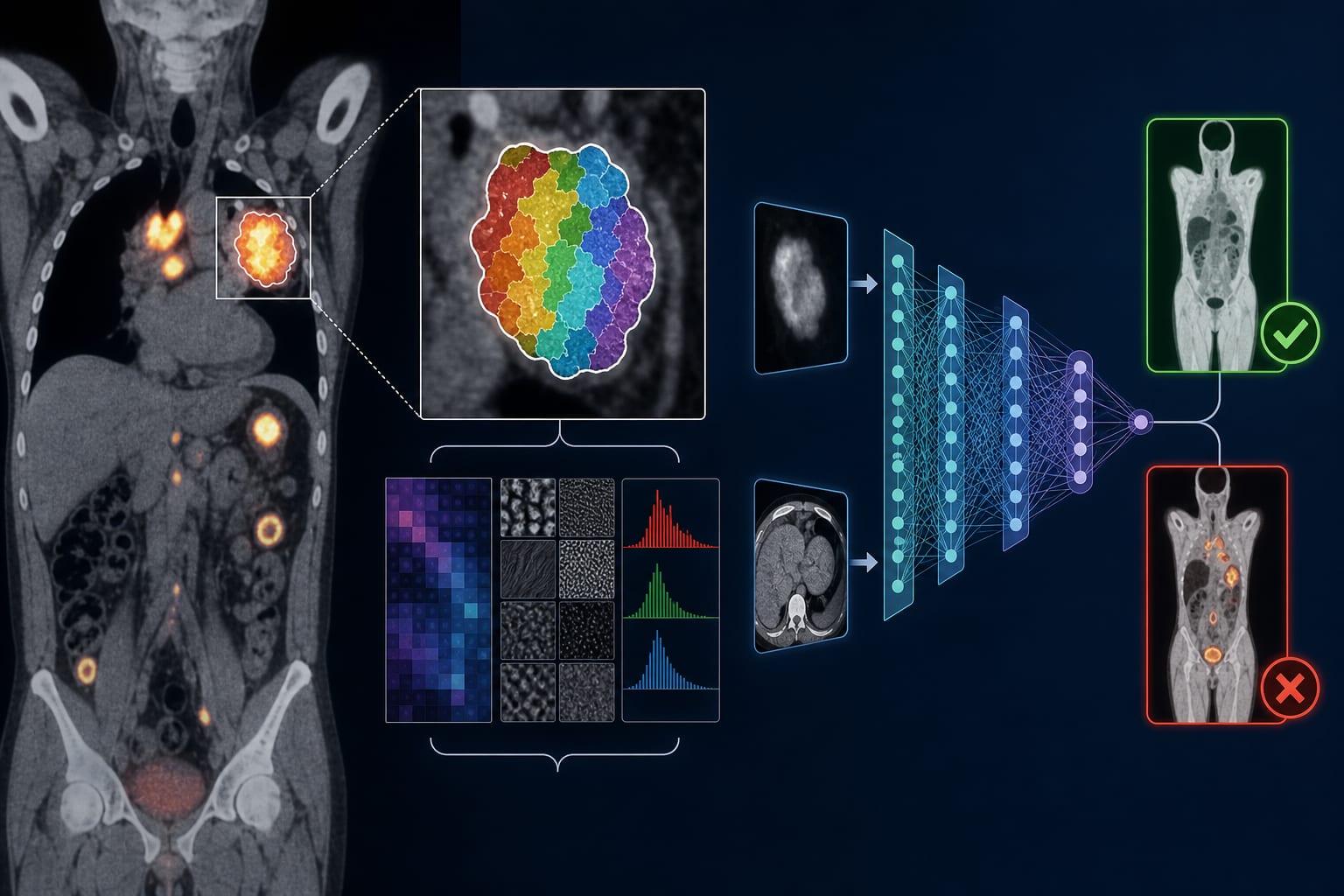
Baseline 18F-FDG PET/CT habitat radiomics and dual-channel deep learning models
Target Population
Patients with DLBCL undergoing R-CHOP or R-CHOP-like chemotherapy
Care Setting
Retrospective single-center study
Key Highlights
Habitat radiomics model (Habitat_MLP) achieved an AUC of 0.871 with high specificity and accuracy.
Dual-channel deep learning model (DL_DenseNet161) achieved an AUC of 0.793.
Habitat radiomics model showed superior calibration and net benefit in decision curve analysis.
Study included 148 patients, with 101 classified as early metabolic responders (EMR).
Interim PET (iPET) evaluated using Deauville scores for response classification.
Guideline-Based Recommendations
Diagnosis
Use baseline 18F-FDG PET/CT for staging and prognostic evaluation in DLBCL.
Management
Consider early metabolic response (EMR) assessment using iPET for treatment adaptation.
Monitoring & Follow-up
Utilize Deauville 5-point scale for interim PET response evaluation.
Risks
Approximately 30%-40% of patients may experience inadequate response or early disease progression.
Patient & Prescribing Data
Patients with pathologically confirmed DLBCL undergoing chemotherapy.
Rituximab-based regimens (R-CHOP) are standard first-line treatments.
Clinical Best Practices
Implement habitat radiomics for improved prediction of treatment response.
Utilize dual-channel deep learning for enhanced imaging analysis.