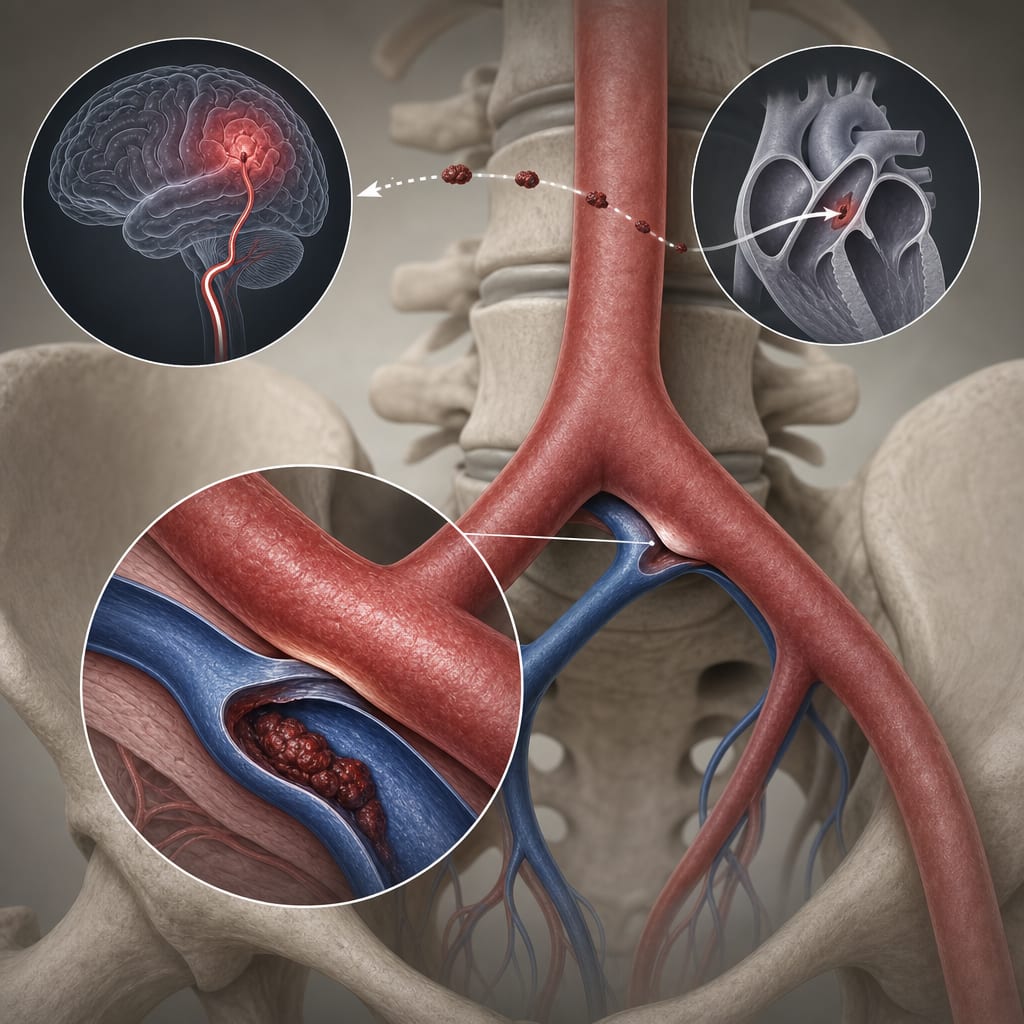
May-Thurner Syndrome as a Hidden Etiology of Ischemic Stroke in Young Adults
-
By
-
Christine Robbie
-
Yasmeen Nabhani
-
Evan Multala
-
Max Tran
-
Robert Miller
-
May 4, 2026
-
Clinical Scorecard: May-Thurner Syndrome: An Underlying Cause of Ischemic Stroke in Younger Adults
At a Glance
| Category | Detail |
|---|
| Condition | May-Thurner Syndrome (MTS) |
| Key Mechanisms | Compression of the left iliac vein by the right iliac artery leading to venous stasis and potential thrombus formation. |
| Target Population | Young adults, particularly those presenting with ischemic stroke and without traditional risk factors. |
| Care Setting | Emergency department and interdisciplinary inpatient care. |
Key Highlights
- MTS can lead to ischemic stroke via paradoxical embolism, especially in the presence of an atrial septal defect (ASD).
- Significant left common iliac vein compression is common, with 24% showing >50% compression.
- Patients may remain asymptomatic until thrombotic complications arise.
- A comprehensive workup is essential for young stroke patients to identify uncommon etiologies.
- Management includes anticoagulation and monitoring for arrhythmias.
Guideline-Based Recommendations
Diagnosis
- Utilize imaging studies such as MRI, CT, and echocardiography to evaluate for MTS and associated conditions.
Management
- Initiate anticoagulation therapy and consider closure of ASD in patients with paradoxical embolism.
Monitoring & Follow-up
- Implement telemetry monitoring for arrhythmias and follow-up imaging to assess venous patency.
Risks
- Consider risks associated with triptan use in patients with MTS and potential for thromboembolic events.
Patient & Prescribing Data
Young adults with ischemic stroke and anatomical variants.
Antithrombotic therapy may include apixaban and aspirin, with careful monitoring for arrhythmias.
Clinical Best Practices
- Conduct a thorough cardiovascular and neurological evaluation in young stroke patients.
- Collaborate across specialties for comprehensive management of MTS and associated conditions.
- Educate patients on the importance of follow-up and monitoring for potential complications.
References