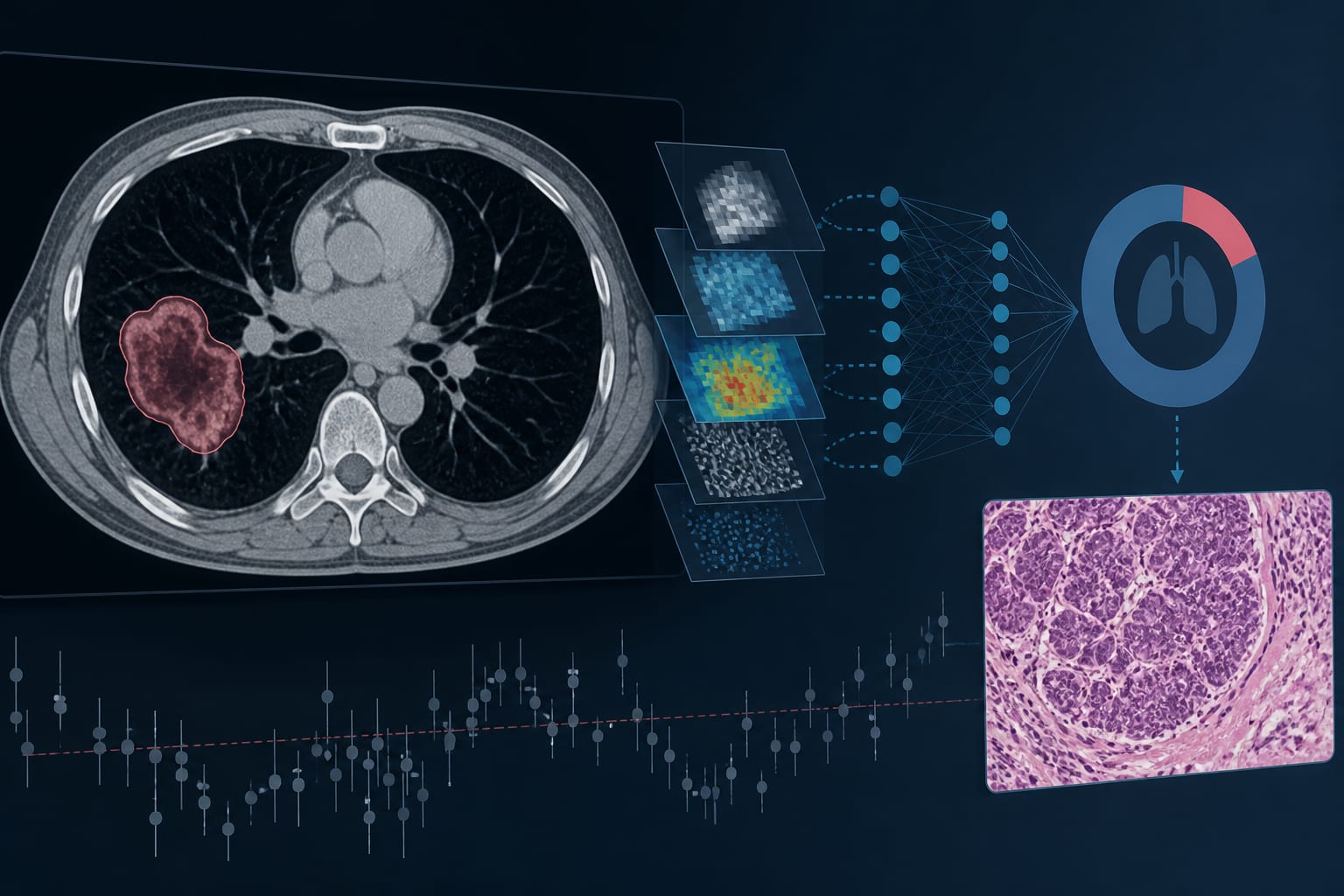
Concurrent Patient Evidence for Benchmarking in Radiomics
-
By
-
Wenze Kan
-
Haoliang Pei
-
Mingxin Zhang
-
October 6, 2026
Clinical Scorecard: Concurrent Patient Evidence for Benchmarking in Radiomics
At a Glance
| Category | Detail |
|---|
| Condition | Non-small cell lung cancer |
| Key Mechanisms | Radiomics-based AI for predicting pathological response to neoadjuvant immunochemotherapy |
| Target Population | Patients receiving neoadjuvant therapy and undergoing radical resection |
| Care Setting | Clinical evaluation of decision support systems |
Key Highlights
- Pooled discrimination for AI predictions is encouraging but limited in interpretation.
- AI sensitivity was higher (0.77) compared to conventional criteria (0.42), but specificity was lower (0.79 vs 0.97).
- Study population excluded patients who failed to reach surgery due to progression, toxicity, or unresectability.
- Misinterpretation of imaging criteria can lead to false negatives in pathological response assessment.
- Future studies should incorporate explicit imaging time and thresholds for better comparison.
Guideline-Based Recommendations
Diagnosis
- Use of RECIST 1.1 and PERCIST for imaging assessment.
Management
- Consideration of AI alongside traditional imaging criteria for decision-making.
Monitoring & Follow-up
- Evaluate calibration and net benefit at prespecified surgical thresholds.
Risks
- Potential for misclassification of treatment response due to imaging interpretation errors.
Patient & Prescribing Data
Patients with resectable non-small cell lung cancer receiving neoadjuvant immunochemotherapy.
AI models analyzed imaging at various treatment stages, affecting applicability.
Clinical Best Practices
- Ensure accurate interpretation of imaging criteria to avoid misclassification.
- Incorporate patient outcomes in AI model evaluations.
Related Resources & Content