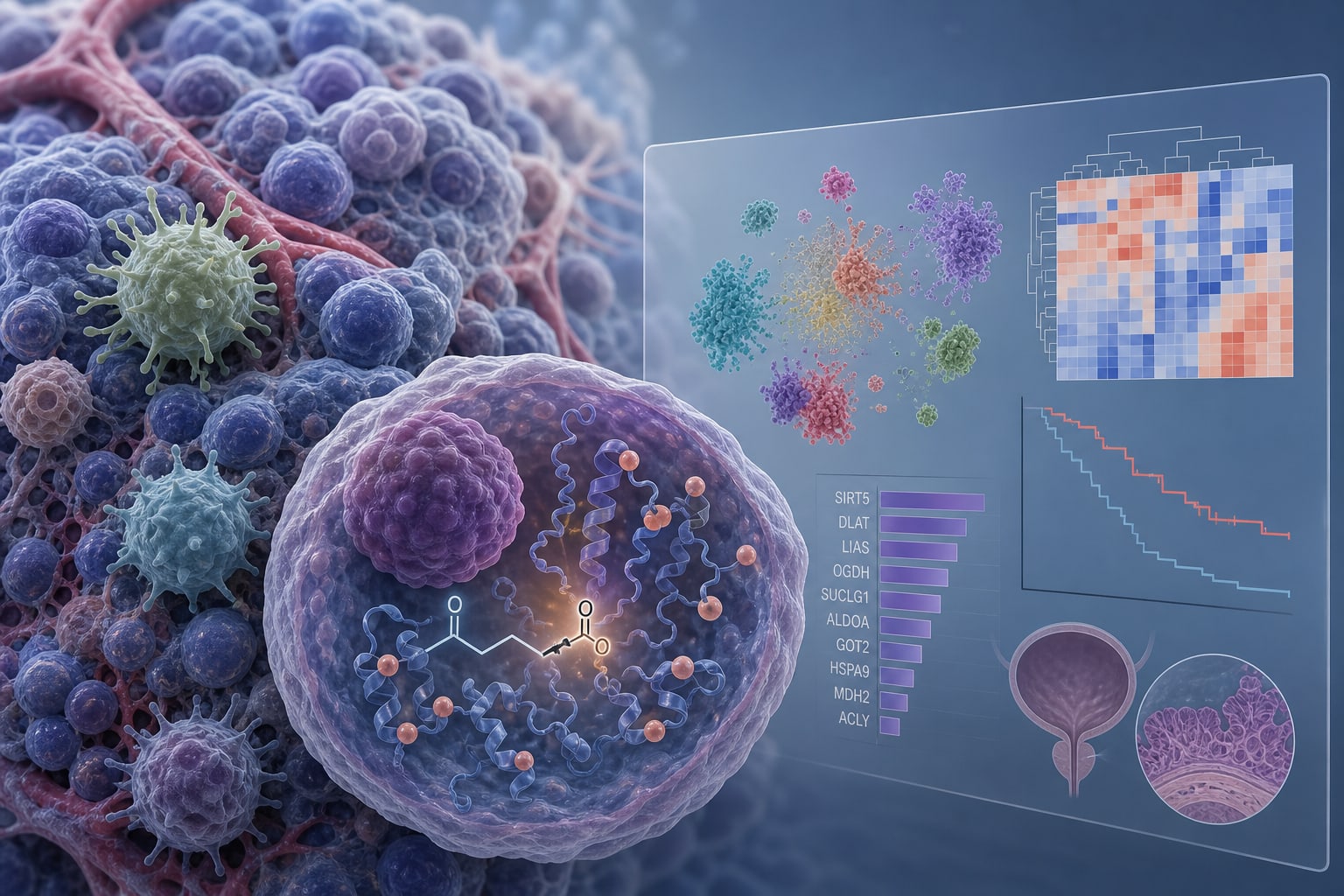
Identification of succinylation-related genes in bladder cancer: integration of single-cell and transcriptomic data
-
By
-
Jiajian Yang
-
Zhengyao You
-
Haojie Mo
-
Jinxian Pu
-
Gang Shen
-
Zhijun Miao
-
May 15, 2026
-
Clinical Scorecard: Discovery of Genes Associated with Succinylation in Bladder Cancer: A Combined Analysis of Single-Cell and Transcriptomic Data
At a Glance
| Category | Detail |
|---|
| Condition | Bladder Cancer (BLCA) |
| Key Mechanisms | Succinylation-related genes (SRGs) linked to tumor progression and immune evasion. |
| Target Population | Patients with bladder cancer, particularly those with non-muscle-invasive and muscle-invasive subtypes. |
| Care Setting | Oncology clinics and research settings focusing on bladder cancer. |
Key Highlights
- Identification of KCTD16, CD3D, and GSDMB as prognostic genes.
- Development of a risk model with predictive accuracy (AUC > 0.7).
- High-risk group shows enhanced immune evasion and altered tumor microenvironment.
- Single-cell analysis reveals key epithelial cell subpopulations.
- Functional assays confirm tumor-suppressive roles of GSDMB and KCTD16.
Guideline-Based Recommendations
Diagnosis
- Utilize transcriptomic sequencing for identifying prognostic SRGs.
Management
- Incorporate SRGs into risk models for personalized therapy.
Monitoring & Follow-up
- Assess expression profiles of identified SRGs for prognostic evaluation.
Risks
- Consider high recurrence and progression rates in NMIBC and low survival rates in MIBC.
Patient & Prescribing Data
Bladder cancer patients, especially those with varying stages of disease.
Targeting succinylation-related pathways may enhance therapeutic outcomes.
Clinical Best Practices
- Integrate single-cell RNA sequencing with transcriptomic data for comprehensive analysis.
- Focus on immune profiling to understand tumor microenvironment dynamics.
- Validate prognostic genes through functional assays.
Related Resources & Content