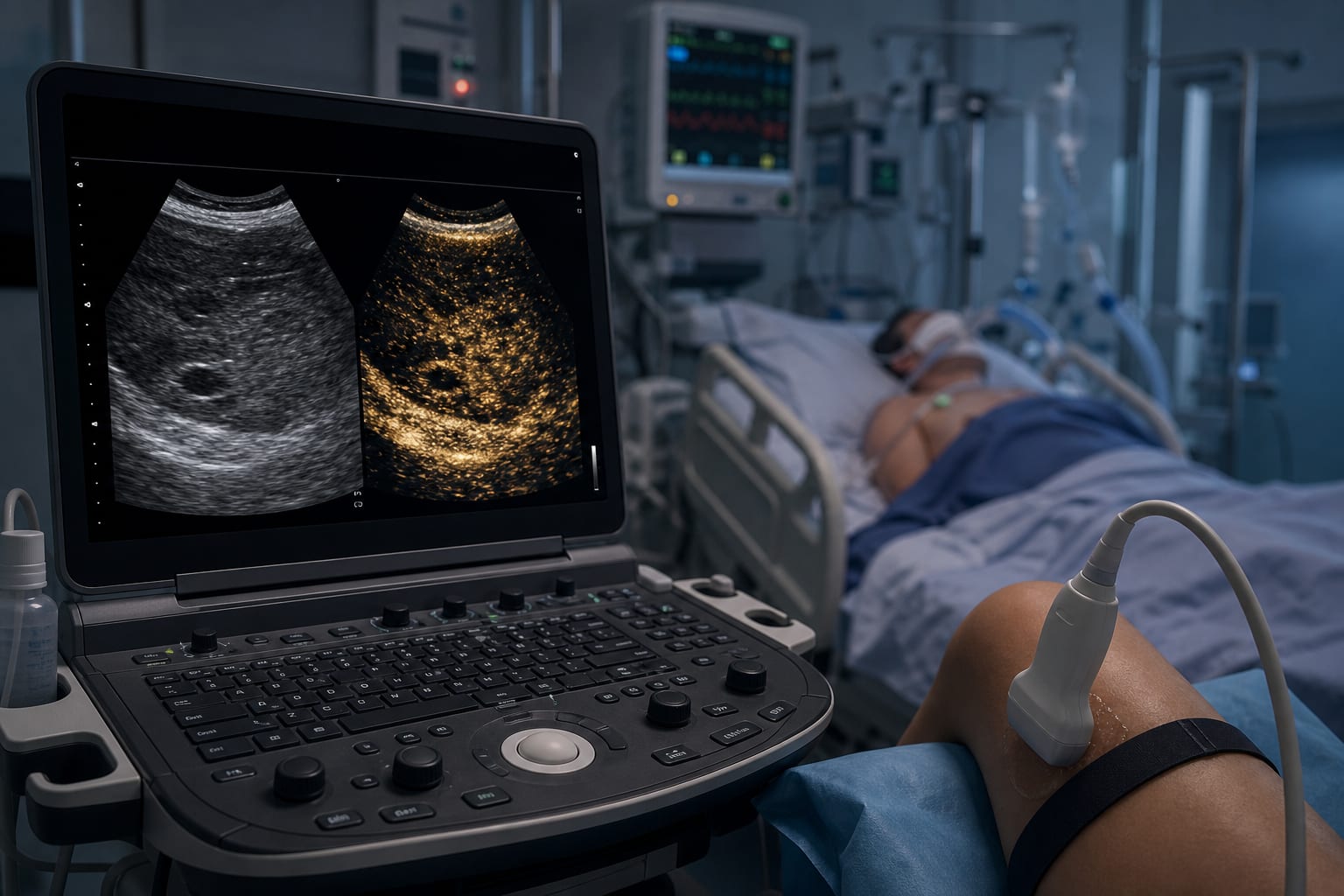
Contrast-enhanced ultrasound in critical care: a problem-solving approach
-
By
-
Lyu Yang
-
Wanhong Yin
-
Tongjuan Zou
-
Ran Zhou
-
Jun Li
-
June 29, 2026
-
Clinical Scorecard: Utilizing Contrast-Enhanced Ultrasound for Problem Solving in Critical Care Settings
At a Glance
| Category | Detail |
|---|
| Condition | Critical Illness |
| Key Mechanisms | Utilizes microbubble contrast agents for enhanced visualization of microvascular and macrovascular images. |
| Target Population | Critically ill patients in intensive care units (ICUs). |
| Care Setting | Critical care settings, particularly in ICUs. |
Key Highlights
- CEUS enables sensitive detection of tissue-level perfusion changes.
- Non-invasive and bedside-applicable imaging modality.
- Supports early identification of organ dysfunction and disease progression.
- Facilitates CEUS-guided percutaneous interventions.
- Optimizes thrombus-related therapeutic decision-making.
Guideline-Based Recommendations
Diagnosis
- Use CEUS for real-time assessment of organ microcirculation.
Management
- Apply CEUS to guide interventional procedures and monitor treatment response.
Monitoring & Follow-up
- Utilize CEUS for serial evaluation of perfusion changes over time.
Risks
- Low incidence of fatal allergic reactions (0.001%) compared to CT or MRI UCAs.
Patient & Prescribing Data
Patients experiencing critical illness with hemodynamic instability.
CEUS can be performed repeatedly without ionizing radiation or nephrotoxic contrast exposure.
Clinical Best Practices
- Integrate CEUS into routine assessments for critically ill patients.
- Utilize TIC analysis for semi-quantitative assessment of tissue perfusion characteristics.
- Combine CEUS with ultrasound for thrombus-targeted therapy insights.
Related Resources & Content