Preoperative Cobb angle-guided surgical decision-making between percutaneous kyphoplasty and short-segment fixation with vertebroplasty in stage III Kümmell disease without neurological deficits: a two-center retrospective study - Scorecard - MDSpire
Conexiant’s news site is now MDSpire News. Learn more
Advertisement
Guiding Surgical Choices in Stage III Kümmell Disease Without Neurological Deficits: A Retrospective Analysis of Preoperative Cobb Angle in Comparing Percutaneous Kyphoplasty and Short-Segment Fixation with Vertebroplasty Across Two Centers
Clinical Scorecard: Guiding Surgical Choices in Stage III Kümmell Disease Without Neurological Deficits: A Retrospective Analysis of Preoperative Cobb Angle in Comparing Percutaneous Kyphoplasty and Short-Segment Fixation with Vertebroplasty Across Two Centers
At a Glance
Category
Detail
Condition
Stage III Kümmell Disease
Key Mechanisms
Comparison of percutaneous kyphoplasty (PKP) and short-segment fixation with vertebroplasty (SSF+VP) for surgical outcomes.
Target Population
Patients with stage III Kümmell disease without neurological deficits.
Care Setting
Clinical spine surgery.
Key Highlights
PKP associated with shorter operative time and less blood loss compared to SSF+VP.
SSF+VP showed lower VAS scores at final follow-up despite comparable ODI.
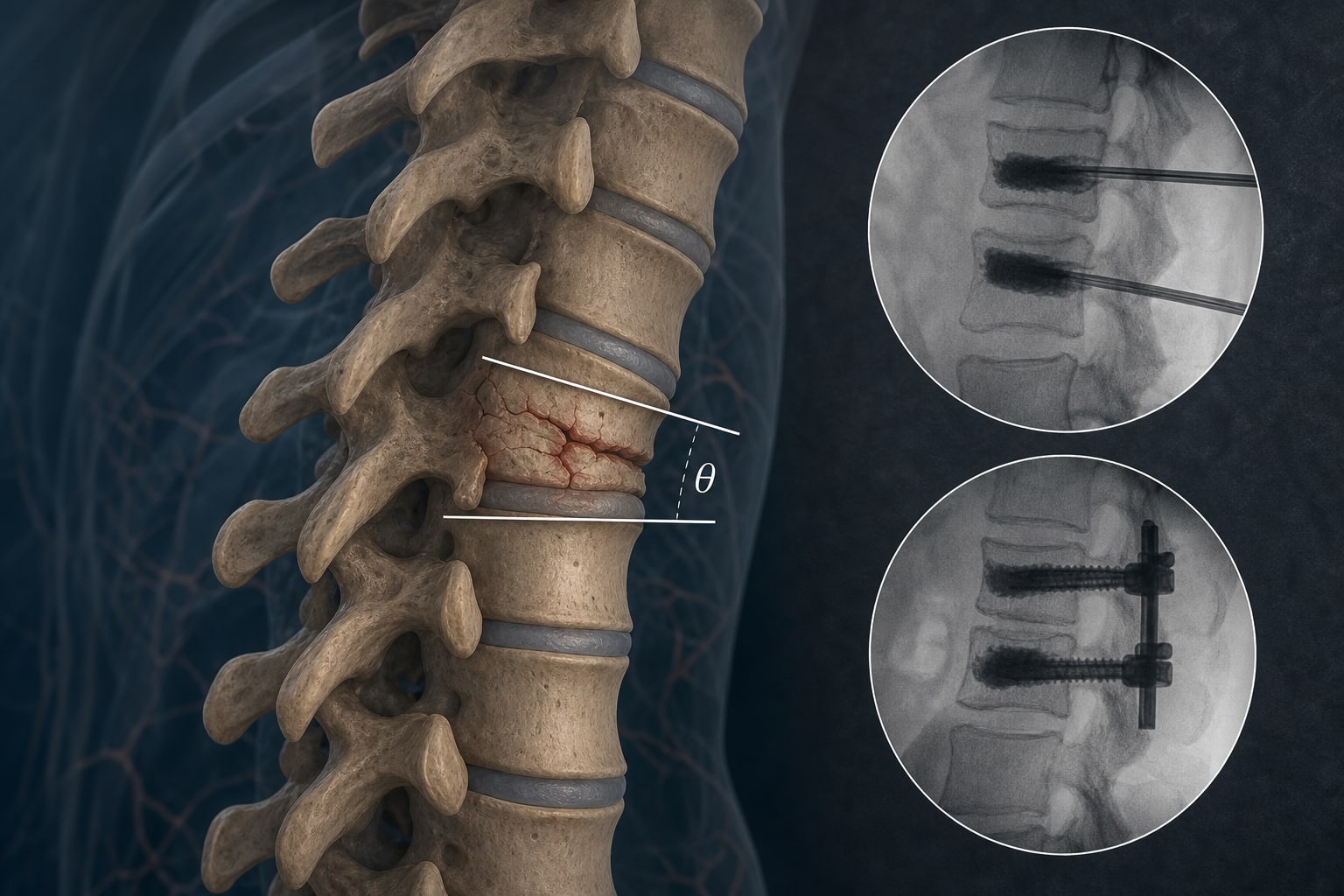
Preoperative Cobb angle predicts residual pain after PKP with an optimal cut-off of 25.95°.
Cobb angle loss correlated positively with final VAS in the PKP group.
Bootstrap validation supported the risk-stratified findings.
Guideline-Based Recommendations
Diagnosis
Stage III Kümmell disease characterized by vertebral collapse and kyphotic deformity.
Management
Consider PKP for mild preoperative kyphosis and SSF+VP for severe kyphosis.
Monitoring & Follow-up
Assess VAS and ODI scores postoperatively to evaluate pain and function.
Risks
Potential for cement leakage and loss of kyphosis correction with PKP.
Patient & Prescribing Data
117 patients with stage III Kümmell disease without neurological deficits.
Both PKP and SSF+VP improve pain and function, with differing advantages based on preoperative kyphosis severity.
Clinical Best Practices
Utilize preoperative Cobb angle for surgical decision-making.
Balance early recovery and long-term stability in surgical choices.