Clinical Scorecard: Large-Scale Analysis of Menopause Reveals a Sharp Physiological Shift at the Final Menstrual Period
At a Glance
Category
Detail
Condition
Menopause and physiological changes around the final menstrual period (FMP)
Key Mechanisms
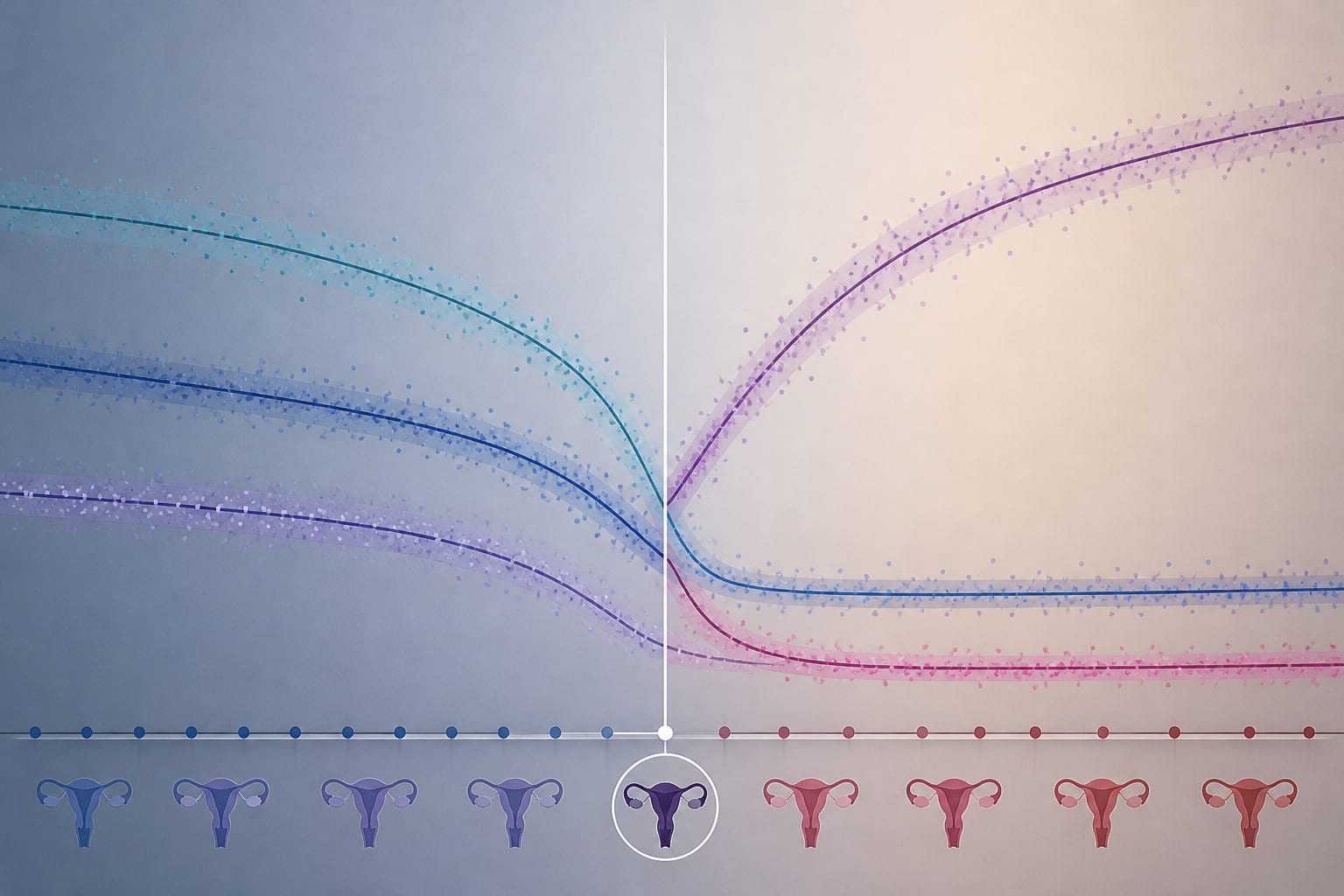
Ovarian follicle exhaustion is associated with declining estrogen and progesterone and increasing FSH; the analysis identifies step-like changes in multiple laboratory measures around the FMP.
Target Population
Nonpregnant female individuals represented in NHANES and Clalit datasets; male individuals were analyzed for comparison.
Care Setting
Cross-sectional analysis of population health and laboratory datasets; the article does not describe a clinical care setting.
Key Highlights
The method analyzed more than 300 million laboratory tests involving over 1 million female individuals.
A significant menopause-associated jump was detected in 52 of 90 laboratory tests in female individuals, with magnitudes of 0.1–1.4 standard deviations.
Changes spanned multiple physiological systems, including hepatic, hematologic, renal, skeletal, lipid, serum chemistry and osmolality measures.
No corresponding jumps around the assigned time point were observed in male individuals; their mean test values changed gradually.
The article reports that hormonal alterations precede menopause by approximately 7 years, as described in prior cohort studies. Confirm any claim about normalization by hormone replacement therapy against the complete source.
Guideline-Based Recommendations
Diagnosis
The article defines menopause as the permanent cessation of menstruation.
The analysis estimates population mean laboratory trajectories relative to time from FMP; it does not estimate an individual’s FMP timing.
Management
The article does not provide clinical management recommendations.
Monitoring & Follow-up
The article does not specify clinical monitoring recommendations.
Risks
The article describes menopause-associated changes across multiple physiological systems but does not provide individual risk estimates.
Patient & Prescribing Data
The datasets included nonpregnant individuals. NHANES covered the United States from 1999 to 2022; Clalit included approximately 1.3 million female individuals aged 30–70 years in Israel during 2004–2024.
The article reports that menopause-associated jumps appear normalized by hormone replacement therapy; it provides no prescribing regimen or treatment guidance.
Clinical Best Practices
Interpret the reported trajectories as cross-sectional population estimates, not individual predictions of FMP timing.
The analysis excluded individuals using medications or carrying ICD-9 codes considered statistically likely to affect each test.
In a target-trial emulation of more than 600,000 veterans, GLP-1 RA initiators saw fewer new substance use disorders—and patients with existing SUDs had fewer overdoses, hospitalizations, and deaths.