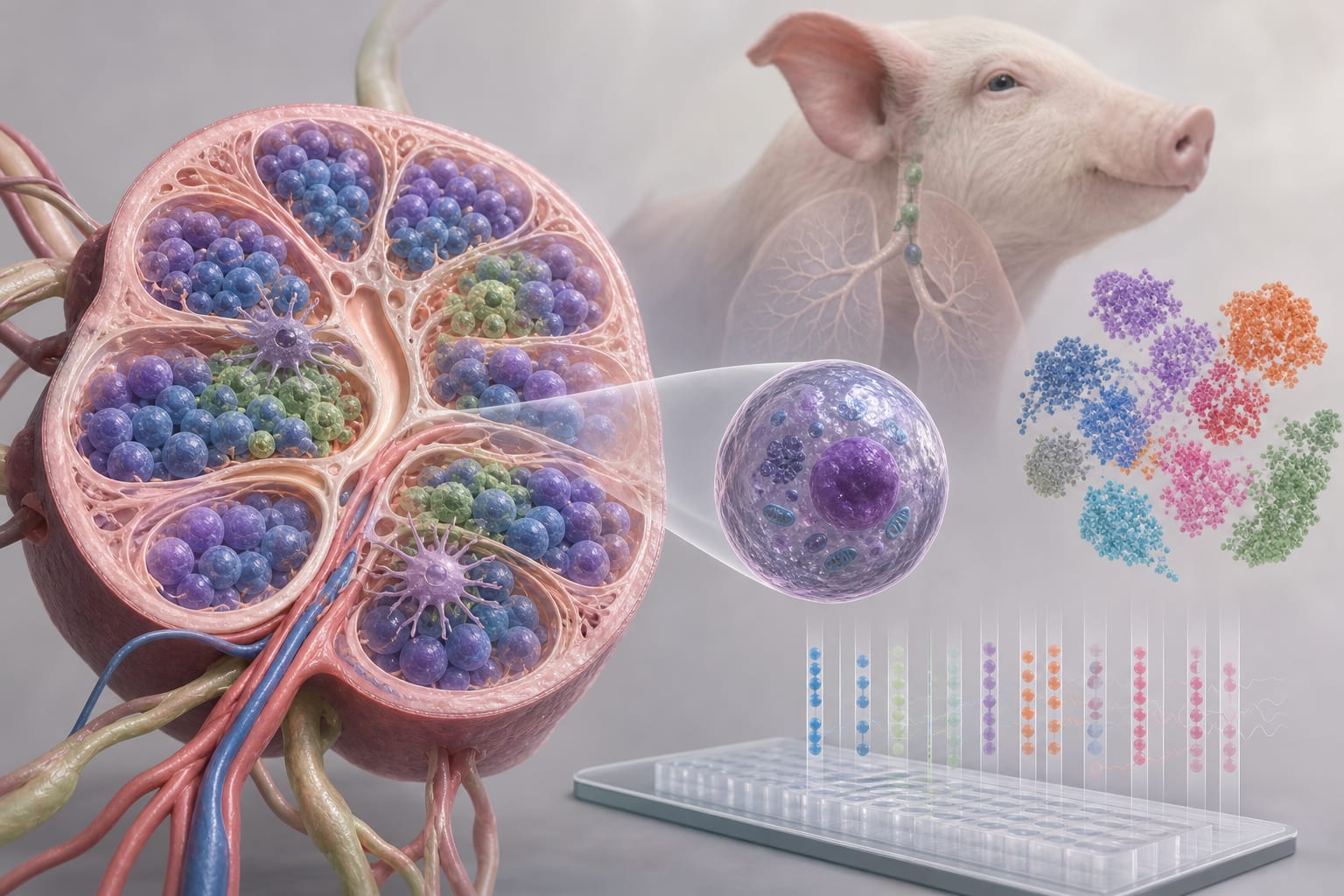
Single-cell transcriptomic profiling of bronchial lymph nodes reveals mechanisms of PRRSV escape from host adaptive immunity
-
By
-
Shu-yuan Guo
-
Xuan Wang
-
Jiaying Zhu
-
Chang Liu
-
Hao Zhou
-
Yaqi Chen
-
Yu Bai
-
Haoran Liu
-
Wen-hai Feng
-
July 15, 2026
Clinical Scorecard: Single-cell RNA sequencing of bronchial lymph nodes uncovers strategies used by PRRSV to evade host adaptive immune responses
At a Glance
| Category | Detail |
|---|
| Condition | Porcine reproductive and respiratory syndrome (PRRS) |
| Key Mechanisms | Impaired adaptive immune responses, including delayed neutralizing antibody development and defective T-cell responses. |
| Target Population | Piglets infected with highly pathogenic PRRSV (HP-PRRSV). |
| Care Setting | Veterinary clinical research. |
Key Highlights
- HP-PRRSV infection reduces multiple T-cell subsets while increasing B cells in bronchial lymph nodes.
- Infection disrupts T-cell egress, leading to accumulation of cytotoxic T lymphocytes.
- Impaired crosstalk between T follicular helper cells and germinal center B cells may suppress neutralizing antibody production.
- Identification of a novel RAG1+ CD4+CD8+ double-positive T-cell subset associated with PRRSV.
- Study provides insights into mechanisms of PRRSV-induced adaptive immunosuppression.
Guideline-Based Recommendations
Diagnosis
- Single-cell RNA sequencing can be utilized to analyze immune responses in PRRSV infection.
Management
- Further research is needed to develop effective vaccines and antiviral strategies against PRRSV.
Monitoring & Follow-up
- Monitor T-cell and B-cell responses in infected populations to assess immune status.
Risks
- Delayed neutralizing antibody production may lead to prolonged viral replication and persistence.
Patient & Prescribing Data
Piglets infected with HP-PRRSV.
Currently, no broad-spectrum, highly effective, and safe vaccine is available for PRRSV.
Clinical Best Practices
- Utilize single-cell transcriptomic analysis to understand immune landscape changes in PRRSV infection.
- Focus on enhancing T-cell and B-cell interactions to improve vaccine efficacy.
Related Resources & Content