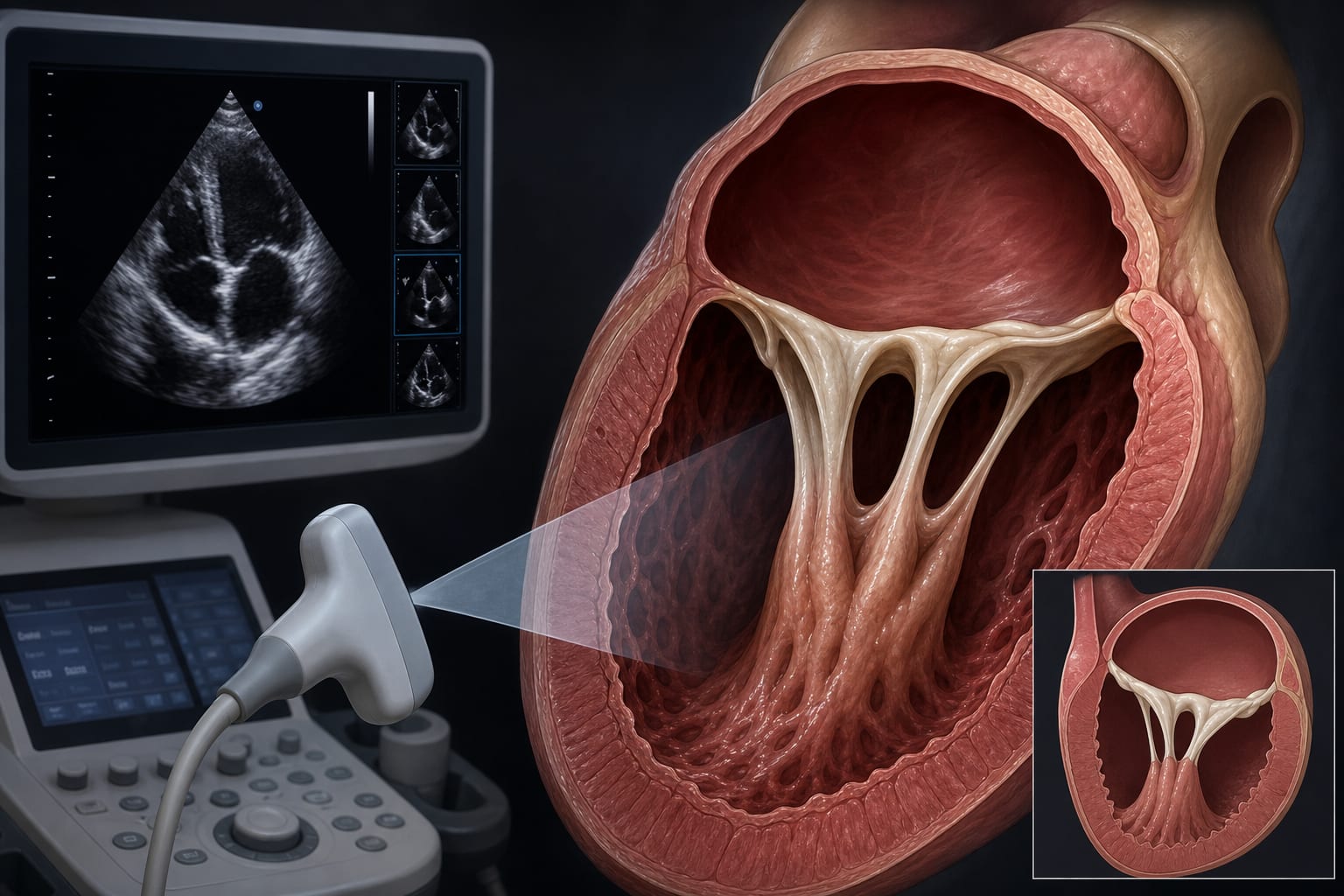
Clinical Scorecard: Transthoracic Echocardiography Reveals Congenital Absence of Mitral Chordae Tendineae Accompanied by Papillary Muscle Fusion: A Case Study
At a Glance
Category
Detail
Condition
Congenital Absence of Mitral Chordae Tendineae with Papillary Muscle Fusion
Key Mechanisms
Absence of chordae tendineae leading to mitral valve dysfunction and structural anomalies.
Target Population
Adults with congenital heart defects, specifically those presenting with mitral valve dysfunction.
Care Setting
Cardiology and surgical settings.
Key Highlights
Total absence of mitral chordae tendineae is a rare congenital defect.
Transthoracic echocardiography (TTE) is crucial for diagnosis.
Surgical intervention included mechanical mitral valve replacement and tricuspid annuloplasty.
Postoperative recovery was smooth with improved hemodynamics.
This case enhances understanding of congenital mitral valve anomalies.
Guideline-Based Recommendations
Diagnosis
Utilize transthoracic echocardiography for detailed assessment of mitral valve structure.
Management
Consider surgical intervention for severe mitral stenosis and regurgitation.
Monitoring & Follow-up
Postoperative echocardiography to assess valve function and hemodynamics.
Risks
Potential for misdiagnosis due to rarity and imaging challenges.
Patient & Prescribing Data
Adult male with congenital mitral valve dysplasia.
Mechanical valve replacement and tricuspid annuloplasty effectively managed severe symptoms.
Clinical Best Practices
Early identification of congenital anomalies through echocardiography.
Comprehensive preoperative assessment to guide surgical planning.
Postoperative monitoring for valve function and complications.
Researchers compare personalized versus standard prehabilitation and examine functional, immune, and postoperative outcomes before major elective surgery.