Clinical Scorecard: Enhanced Recovery Protocols for Children Undergoing Complex Lower Urinary Tract Surgery in Pediatric Urology
At a Glance
Category
Detail
Condition
Perioperative care for complex lower urinary tract reconstructive surgery
Key Mechanisms
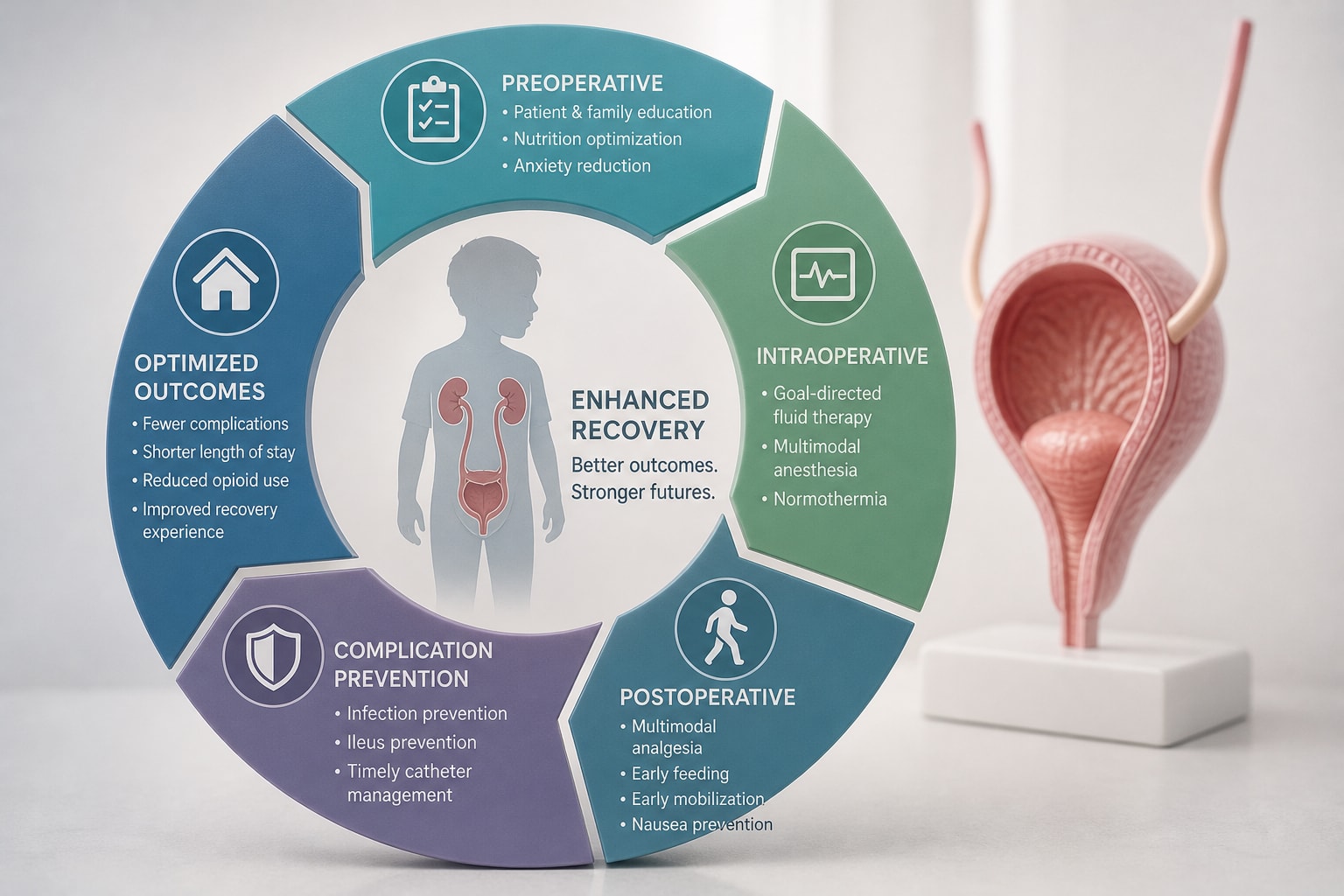
The multidisciplinary ERAS protocol included standardized preoperative education, omission of formal bowel preparation, preoperative carbohydrate loading, multimodal analgesia, early feeding, and opioid minimization.
Target Population
Patients aged 4 to 24 years undergoing augmentation enterocystoplasty, continent urinary or antegrade continence channel formation, or bowel-based incontinent urinary diversion.
Care Setting
Eight participating centers, each required to perform at least five eligible operations annually; prospectively enrolled ERAS patients were compared with retrospectively collected historical controls.
Key Highlights
The multicenter PURSUE initiative developed and implemented a 20-element pediatric urology ERAS protocol.
The study used a prospective cohort design with historical controls; the planned propensity-matching ratio was revised from 1:2 to 1:1.
Implementation was measured by the number of ERAS elements completed per patient.
Clinical outcomes assessed included length of stay, 90-day readmission, reoperation, emergency department utilization, complications, inpatient pain ratings, and intravenous morphine-equivalent use.
The supplied excerpt describes the study design and protocol but does not provide clinical outcome results.
Guideline-Based Recommendations
Diagnosis
Management
The study protocol included standardized preoperative education, omission of formal preoperative bowel preparation, and preoperative carbohydrate loading.
Protocol measures included multimodal analgesia incorporating regional catheter-based blocks, avoidance of intraperitoneal and subcutaneous drains, and no nasogastric tube.
The protocol specified clear liquids by postoperative day 0, a regular diet by day 1, discontinuation of intravenous fluids by day 2, and opioid minimization.
Monitoring & Follow-up
Implementation was assessed by counting completed protocol elements out of 20; a centralized audit committee reviewed implementation after the first five patients at each center.
Outcomes assessed included length of stay, 90-day readmission, reoperation, emergency department utilization, Clavien-Dindo–graded complications, complications at one year, inpatient pain ratings, and daily weight-normalized intravenous morphine-equivalent use during postoperative days 1 through 3.
Risks
The source lists potential postoperative complications including nausea and vomiting, ileus, wound infection, urinary tract infection, and pyelonephritis.
The study excluded patients with specified severe constipation indicators: Bristol type 1 or 2 stools more than once weekly, bowel movements less frequent than every other day, or palpable stool involving over 50% of the colon.
Patient & Prescribing Data
Eligible participants were 4 to 24 years old and undergoing complex lower urinary tract reconstruction. The age range included young adults with congenital urologic abnormalities treated at pediatric centers.
The 20-element ERAS protocol was implemented as standard of care. The supplied excerpt provides no medication doses or comparative treatment-effect results.
Clinical Best Practices
The study implementation involved perioperative leadership, anesthesiology, nursing, and local clinical champions.
Centers developed local implementation tools, including patient handouts and electronic order sets, and audited protocol adherence.
by Kyle O. Rove, Andrew C. Strine, David I. Chu, Duncan T. Wilcox, Darren Ha, Gino J. Vricella, Douglas E. Coplen, Erica J. Traxel, Austin R. Acks, Rajeev Chaudhry, Brian VanderBrink, Elizabeth B. Yerkes, Yvonne Y. Chan, Nicholas E. Burjek, Rebecca S. Zee, C.D. Anthony Herndon, Jennifer J. Ahn, Paul A. Merguerian, Bhalaajee Meenakshi-Sundaram, Adam J. Rensing, Dominic Frimberger, Megan A. Brockel