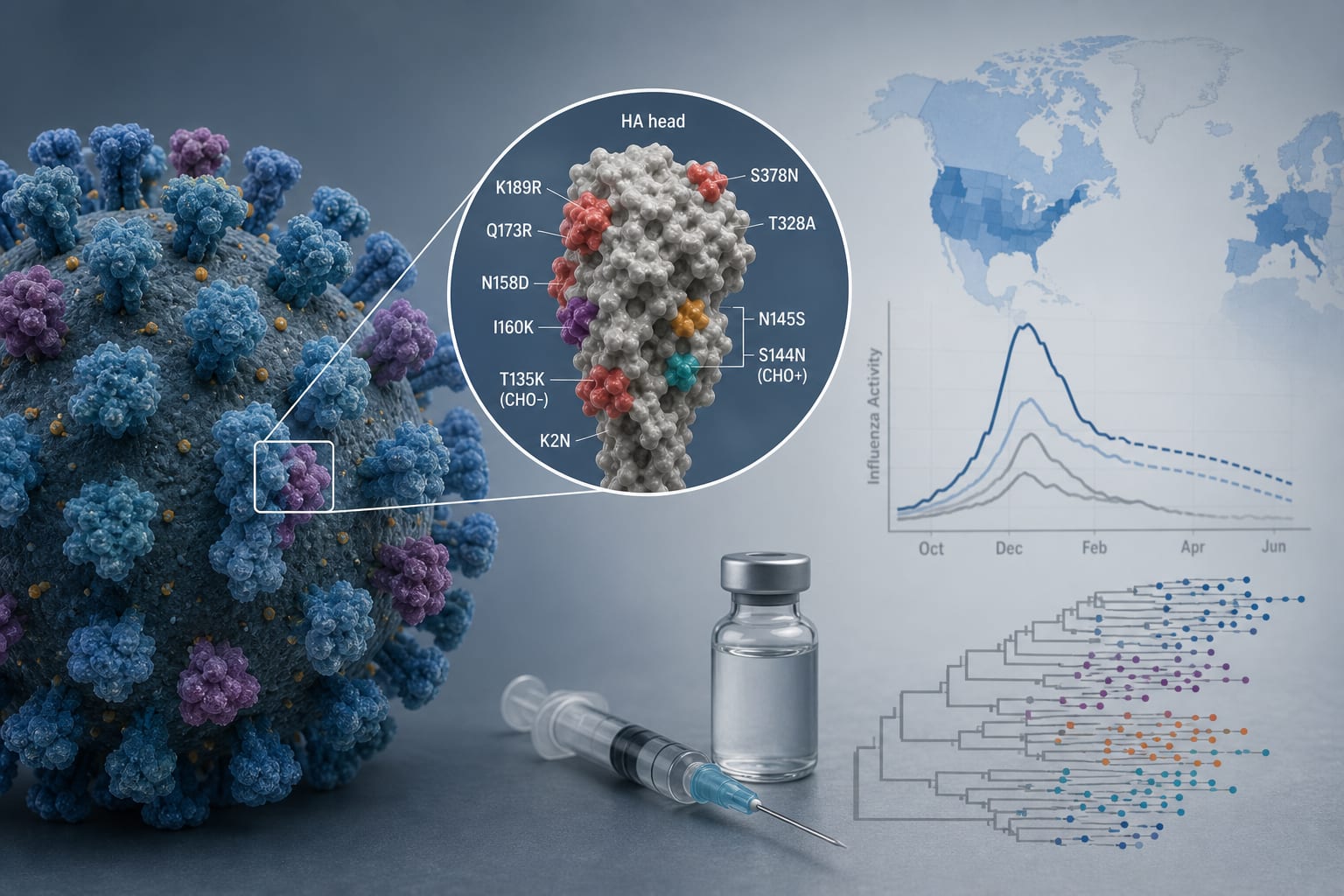
Clinical Scorecard: Evaluation of Cross-Reactive Neutralizing Antibody Response to H5N1 Clade 2.3.4.4b Following Seasonal Influenza Vaccination in Retail Employees
Assessment of cross-reactive neutralizing antibodies induced by seasonal influenza vaccination against H5N1 clade 2.3.4.4b
Target Population
Retail workers with prior seasonal influenza vaccination or infection
Care Setting
Public health and occupational health settings, including biosafety level 2 and 3 laboratories
Key Highlights
No cross-reactive neutralizing antibody response against H5N1 clade 2.3.4.4b detected despite strong immunity to seasonal influenza strains.
H5N1 clade 2.3.4.4b has expanded geographically and hosts, including recent spillover into dairy cattle and humans with severe clinical outcomes.
Seasonal influenza vaccines do not confer protection against H5N1 but remain important to prevent coinfections and potential viral reassortment.
Guideline-Based Recommendations
Diagnosis
Use microneutralization assays to evaluate neutralizing antibody titers against seasonal and H5N1 influenza strains.
Conduct testing in appropriate biosafety level laboratories (BSL-2 for seasonal strains, BSL-3 for H5N1).
Management
Continue seasonal influenza vaccination to reduce risk of coinfections and potential viral reassortment.
Develop targeted vaccines for H5N1 clade 2.3.4.4b due to lack of cross-protection from seasonal vaccines.
Monitoring & Follow-up
Monitor serological responses in high-risk populations such as retail workers and farm workers exposed to avian influenza.
Surveillance of emerging H5N1 clade 2.3.4.4b infections in humans and animals to assess zoonotic and pandemic potential.
Risks
High fatality rate (~50%) associated with human H5N1 infections.
Risk of viral reassortment and emergence of variants with increased zoonotic and pandemic potential in high-exposure settings.
Patient & Prescribing Data
Adult retail workers with documented seasonal influenza vaccination status
Seasonal influenza vaccination induces strong neutralizing antibodies against seasonal strains but does not elicit cross-reactive antibodies against H5N1 clade 2.3.4.4b.
Clinical Best Practices
Maintain seasonal influenza vaccination programs to reduce coinfection risks.
Implement enhanced biosafety measures when handling H5N1 viruses in laboratory and occupational settings.
Prioritize development and evaluation of vaccines specifically targeting H5N1 clade 2.3.4.4b.
Conduct ongoing serological surveillance in populations at risk of exposure to avian influenza viruses.