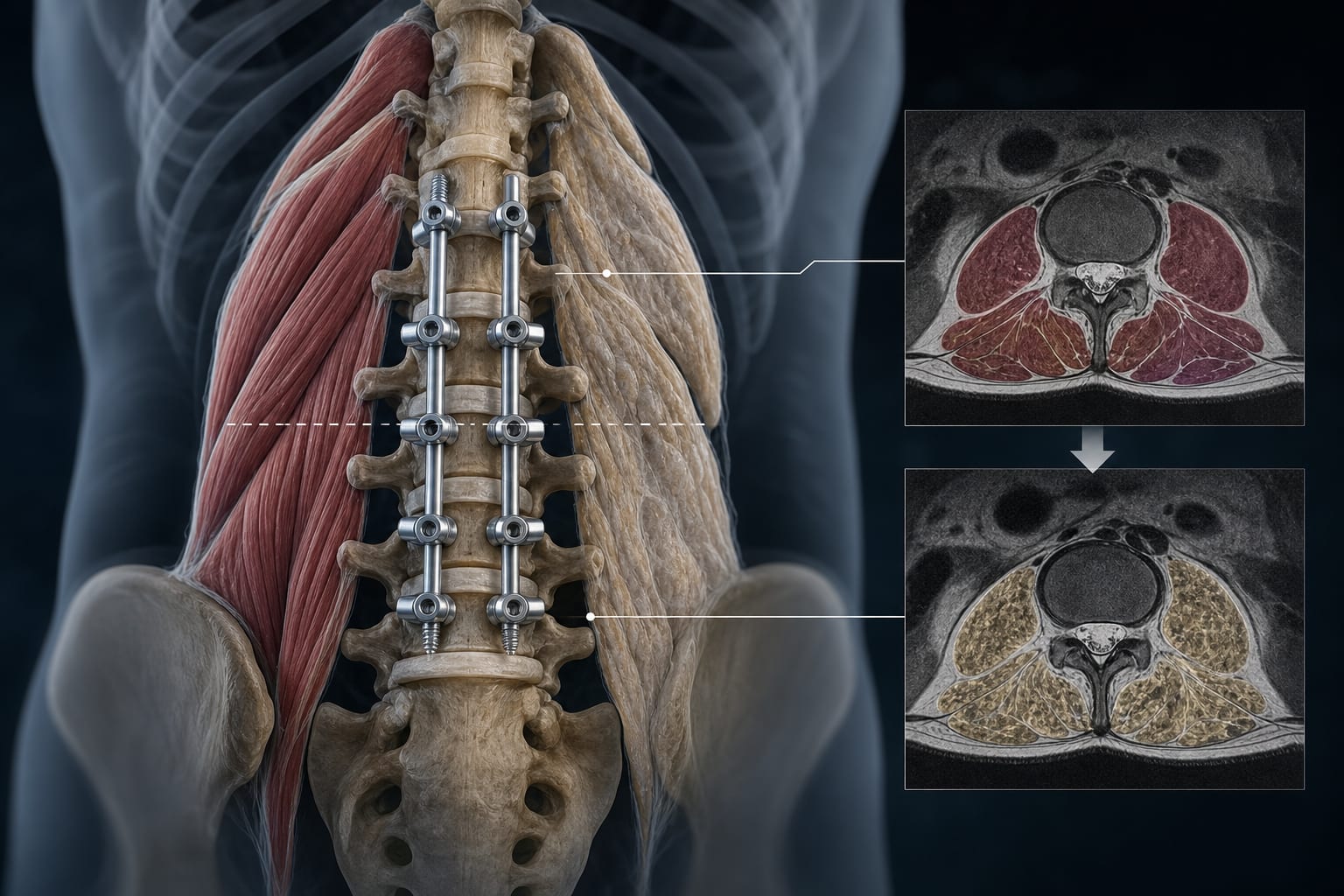
Paravertebral muscle degeneration-guided selective fusion strategy for degenerative lumbar scoliosis: a novel approach to minimize surgical invasiveness while optimizing clinical outcomes
By
Qi Guo
Jianliang Chen
Huahai Yao
Zhe Wu
Jixin Chen
Yong Xu
Jiafeng Zhang
Yingzhou Li
June 2, 2026
Clinical Scorecard: A Selective Fusion Strategy Based on Paravertebral Muscle Degeneration for Degenerative Lumbar Scoliosis: A New Method to Reduce Surgical Invasiveness and Enhance Clinical Results
At a Glance
Category Detail
Condition Degenerative Lumbar Scoliosis (DLS) Key Mechanisms Paravertebral muscle degeneration patterns guide selective fusion levels. Target Population Patients with degenerative lumbar scoliosis undergoing surgery. Care Setting Retrospective cohort study in a single institution.
Key Highlights
No cases of proximal junctional kyphosis (PJK) or failure (PJF) observed. Mean fusion length was 4.3 segments with 86.4% concordance. Significant improvement in coronal and sagittal alignment maintained at follow-up. Correction loss at final follow-up was minimal (1.0 ± 1.2°). Greater PVM degeneration negatively associated with ODI improvement. Guideline-Based Recommendations
Diagnosis
Evaluate paravertebral muscle degeneration using T2-weighted MRI. Management
Implement selective fusion based on PVM degeneration patterns. Monitoring & Follow-up
Assess radiographic correction maintenance and patient-reported outcomes. Risks
Consider risks of PJK/PJF associated with extensive instrumented fusion. Patient & Prescribing Data
22 patients with DLS treated between January 2022 and December 2024.
Selective fusion guided by PVM degeneration patterns reduces surgical invasiveness.
Clinical Best Practices
Prioritize junctional outcomes in surgical planning for DLS. Use PVM degeneration as a marker for surgical decision-making. Related Resources & Content