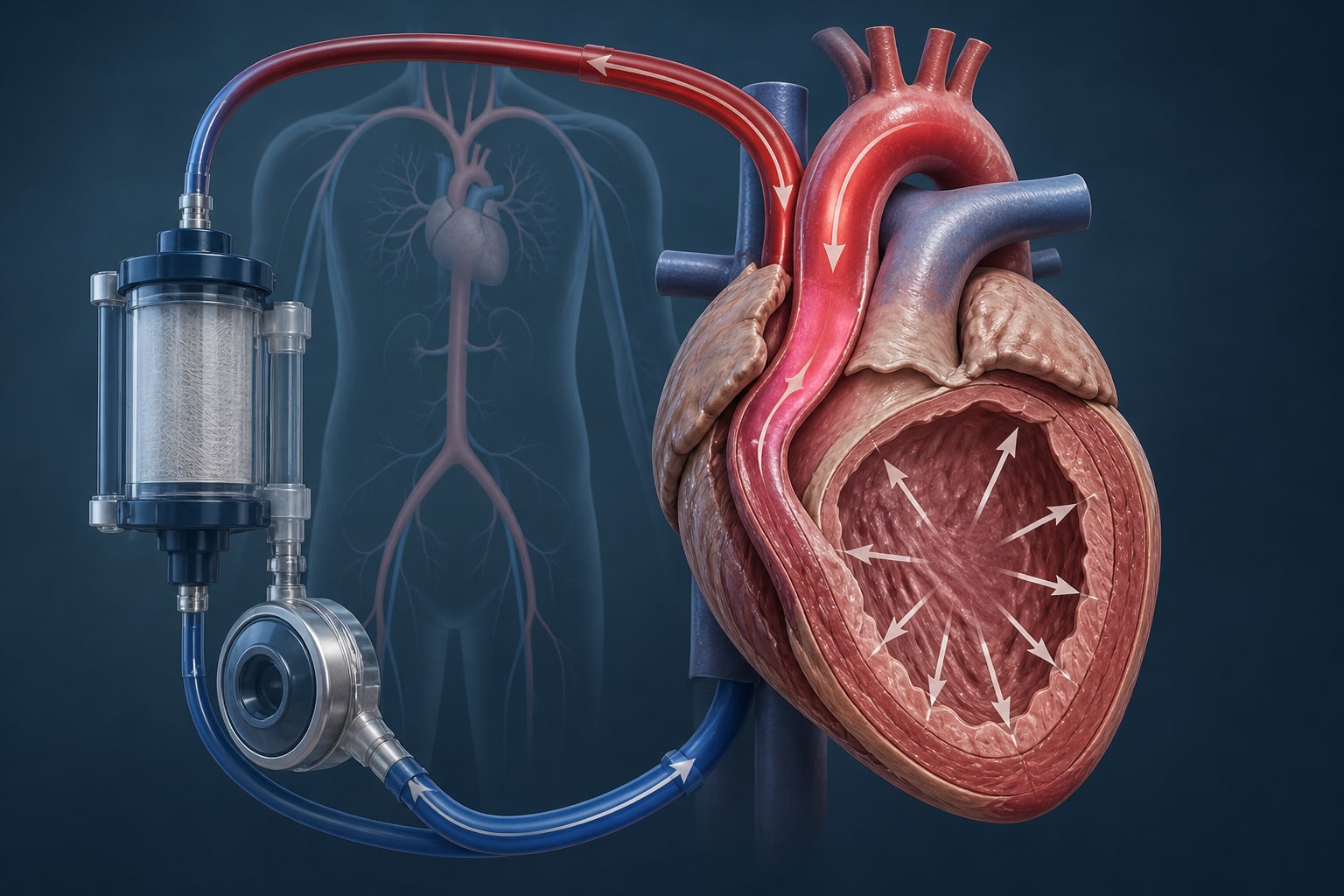
Venoarterial extracorporeal membrane oxygenation provides flow, not afterload: reframing left ventricular afterload during peripheral VA ECMO - Scorecard - MDSpire
Clinical Scorecard: Peripheral VA ECMO Restores Flow but Does Not Necessarily Increase Afterload: Rethinking Left Ventricular Loading
At a Glance
Category
Detail
Condition
Left ventricular loading during peripheral venoarterial extracorporeal membrane oxygenation (VA ECMO)
Key Mechanisms
VA ECMO adds aortic inflow; its effect on arterial pressure and LV wall stress depends on vascular resistance and tone, native–extracorporeal flow interaction, preload, and LV phenotype. Flow direction alone does not determine afterload.
Target Population
Patients receiving peripheral VA ECMO
Care Setting
Clinical haemodynamic assessment and management during VA ECMO
Key Highlights
The article estimates dynamic pressure from mean aortic flow velocity at 0.11 mmHg, small relative to the pressure needed for aortic valve opening.
Greater total aortic flow raises arterial pressure when vascular resistance remains constant, particularly when resistance rises; reduced resistance may allow increased inflow without increased pressure.
MAP is only one component of LV afterload; wall stress also depends on LV radius and wall thickness.
Pressure optimization should be considered before choosing an unloading strategy, but it does not replace established indications for mechanical unloading.
The authors recommend standardizing pressure load, such as with protocolized MAP targets, when comparing unloading strategies.
Guideline-Based Recommendations
Diagnosis
Interpret LV loading measures in context: VA ECMO alters preload, so LV end-diastolic pressure, pulmonary capillary wedge pressure, and pressure-volume area are not isolated measures of afterload.
Management
Target VA ECMO flow to support perfusion and oxygen delivery, and manage MAP according to haemodynamic requirements.
If perfusion pressure remains inadequate despite sufficient VA ECMO flow, vasopressors remain important, especially during vasoplegia.
If systemic perfusion is adequate but arterial pressure is excessive, consider weaning vasopressors or administering vasodilator therapy; use caution with poor native lung function because excessive pressure reduction may worsen differential hypoxaemia.
Optimize pressure load before selecting an unloading strategy; this does not replace mechanical unloading for established indications, including LV distension, pulmonary congestion, impaired aortic valve opening, intracardiac stasis, and absent pulsatility.
Monitoring & Follow-up
When evaluating unloading strategies in future studies, standardize pressure load, for example with protocolized MAP targets.
Risks
Excessive pressure reduction may worsen differential hypoxaemia in patients with poor native lung function.
Cannula-tip turbulence is described as relevant to shear stress and haemolysis rather than LV afterload.
Patient & Prescribing Data
Patients supported with peripheral VA ECMO; the article does not provide patient-specific prescribing regimens.
The article discusses haemodynamic targets rather than drug doses: maintain sufficient VA ECMO flow for perfusion and oxygen delivery, and adjust vasopressors or consider vasodilator therapy according to perfusion and arterial pressure.
Clinical Best Practices
Do not infer LV afterload from retrograde flow direction alone; assess the resulting pressure load and vascular conditions.
Distinguish extracorporeal flow targets from arterial pressure targets.
Interpret effective arterial elastance as a coupling index, not as a direct measure of myocardial wall stress.