Clinical Scorecard: Creation of a Risk Prediction Model for Major Adverse Cardiovascular Events Utilizing Quantitative Data from CCTA: A Proof-of-Concept Investigation
At a Glance
Category
Detail
Condition
Major Adverse Cardiovascular Events (MACE)
Key Mechanisms
Quantitative parameters derived from coronary computed tomography angiography (CCTA)
Target Population
Patients with coronary artery disease (CAD)
Care Setting
Cardiovascular imaging and risk assessment
Key Highlights
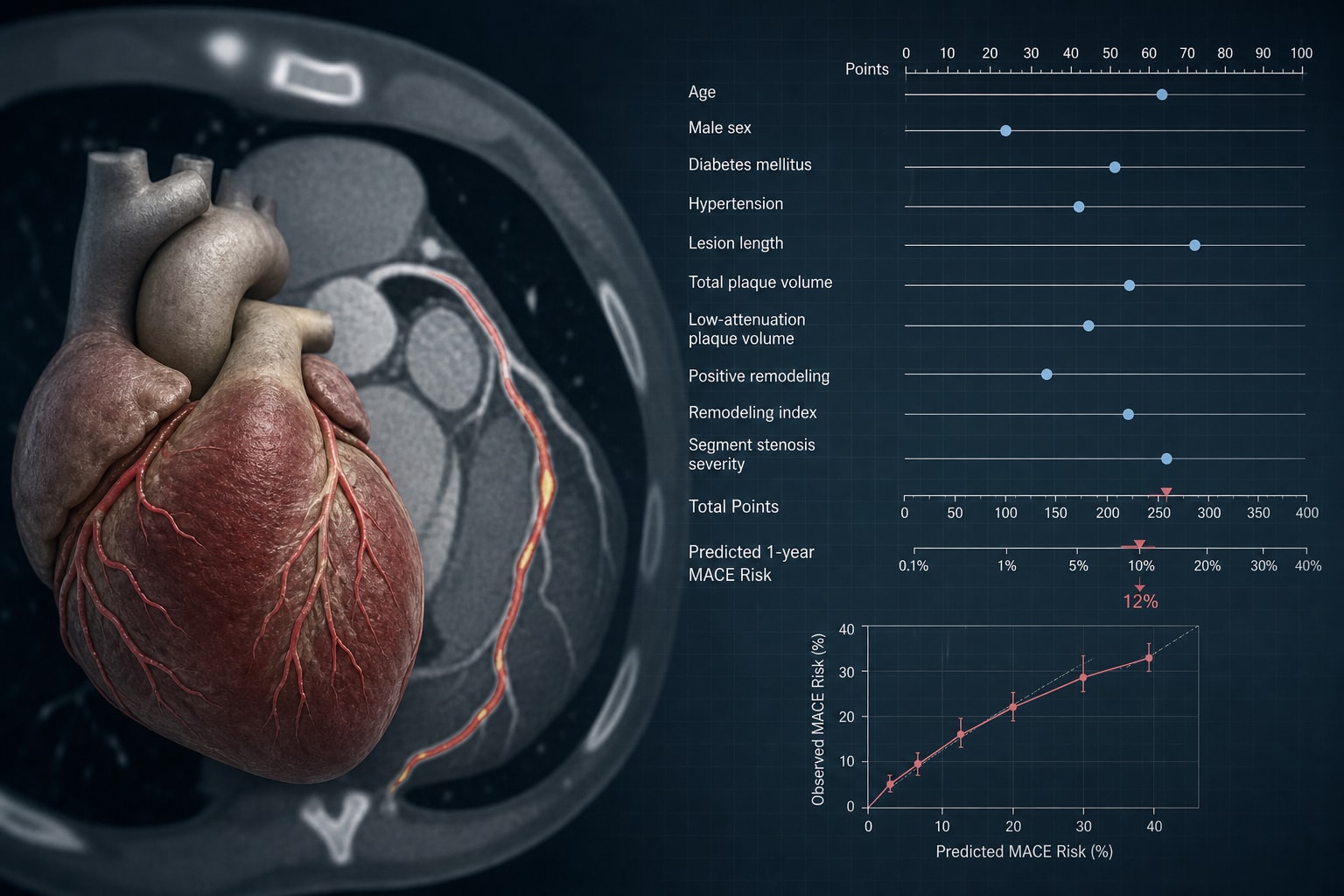
Developed a nomogram-based risk prediction model for MACE in CAD patients.
Identified independent predictors including severe stenosis, plaque length, and fibrous plaque volume.
Achieved an AUC of 0.936 for the combined model in predicting MACE.
External validation confirmed robust discrimination and excellent calibration.
Study emphasizes the importance of integrating quantitative CCTA parameters.
Guideline-Based Recommendations
Diagnosis
Utilize CCTA for comprehensive assessment of coronary plaque features.
Management
Consider the nomogram for individualized risk stratification in CAD patients.
Monitoring & Follow-up
Follow-up assessments should include evaluation of identified risk factors.
Risks
Short follow-up duration and predominance of soft endpoints should be considered.
Patient & Prescribing Data
280 CAD patients analyzed from May 2020 to December 2023.
Integration of clinical risk factors with quantitative CCTA data enhances predictive accuracy.
Clinical Best Practices
Employ a multi-parameter approach for risk assessment in CAD patients.
Regularly validate predictive models with external cohorts.