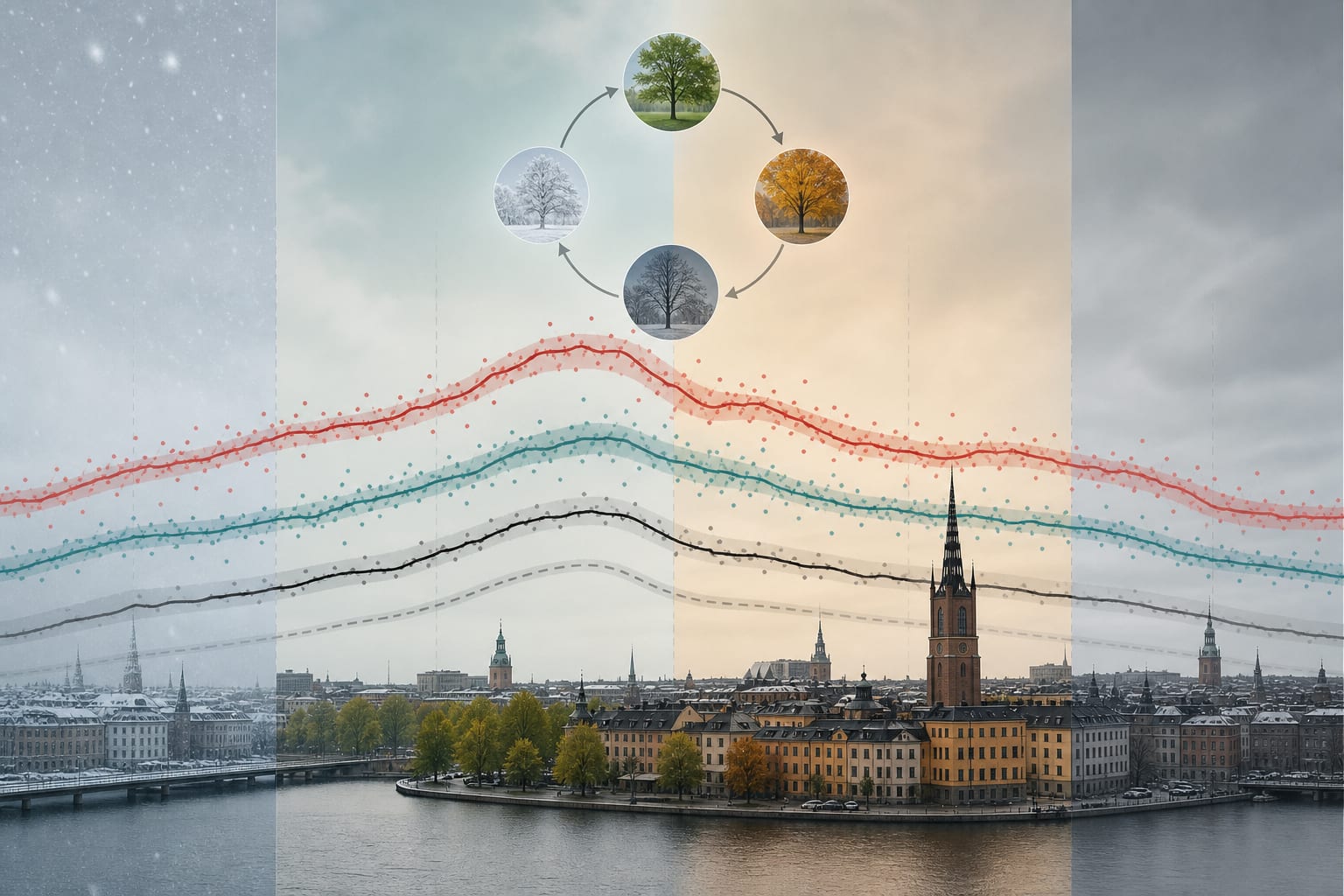
When seasonal structure dominates: rethinking causal attribution in environmental epidemiology
Clinical Scorecard: Reassessing Causal Attribution in Environmental Epidemiology: The Impact of Seasonal Patterns
At a Glance
| Category | Detail |
|---|
| Condition | Environmental Epidemiology |
| Key Mechanisms | Seasonal structure linking temperature, air pollution, and mortality. |
| Target Population | General population in urban settings, specifically Stockholm County, Sweden. |
| Care Setting | Environmental health research and epidemiological studies. |
Key Highlights
- Reproducibility in environmental epidemiology may reflect shared analytical conventions rather than unique causal effects.
- Causal interpretation is heavily dependent on the representation of seasonal structure in statistical models.
- Different seasonal adjustment methods can significantly alter estimated associations between exposures and mortality.
- Collinearity limits identifiability and can lead to model-dependent estimates.
- Empirical separability within tightly coupled seasonal systems is a central challenge in causal inference.
Guideline-Based Recommendations
Diagnosis
- Consider the impact of seasonal patterns when interpreting environmental health data.
Management
- Utilize various seasonal adjustment methods to assess the robustness of associations.
Monitoring & Follow-up
- Regularly evaluate the influence of seasonal variation on health outcomes in environmental studies.
Risks
- Be aware of the potential for misinterpretation of causal relationships due to overlapping seasonal variation.
Patient & Prescribing Data
Individuals affected by environmental exposures in urban areas.
Understanding the role of seasonal factors is crucial for accurate health risk assessments.
Clinical Best Practices
- Ensure transparency in modelling choices when conducting environmental epidemiological studies.
- Adopt sensitivity analyses to evaluate the impact of different seasonal specifications on study outcomes.
- Recognize the limitations of statistical adjustments in disentangling correlated seasonal processes.
Related Resources & Content