Comparison of early clinical and optical quality-related outcomes after SMILE using VisuMax 800 versus VisuMax 500 for myopia and low-to-moderate astigmatism in a Chinese population: a single-center retrospective study - Scorecard - MDSpire
Conexiant’s news site is now MDSpire News. Learn more
Advertisement
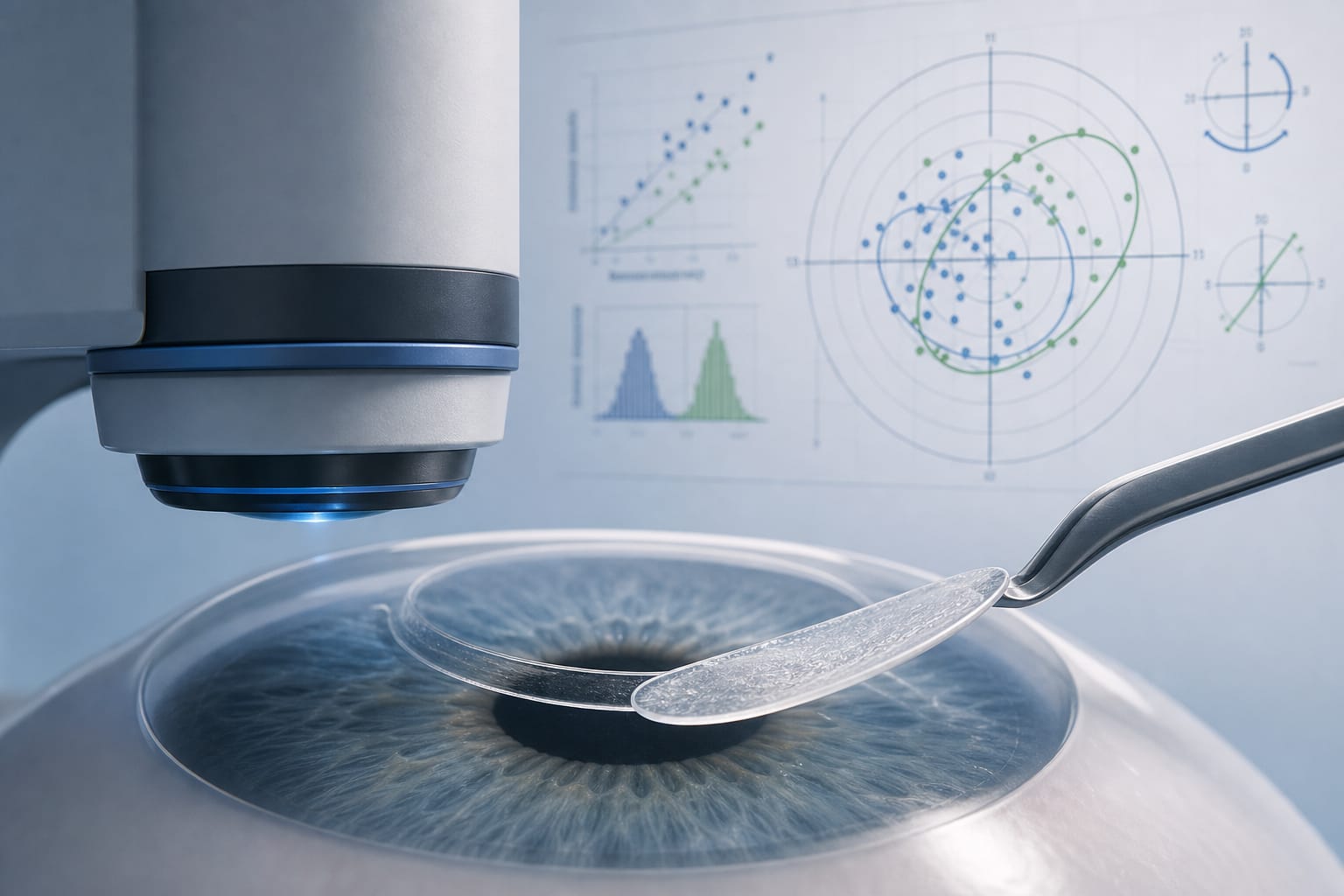
Evaluation of Initial Clinical Outcomes and Optical Quality Metrics Following SMILE with VisuMax 800 Compared to VisuMax 500 for Myopia and Low-to-Moderate Astigmatism in a Chinese Cohort: A Retrospective Single-Center Analysis
Clinical Scorecard: Evaluation of Initial Clinical Outcomes and Optical Quality Metrics Following SMILE with VisuMax 800 Compared to VisuMax 500 for Myopia and Low-to-Moderate Astigmatism in a Chinese Cohort: A Retrospective Single-Center Analysis
At a Glance
Category
Detail
Condition
Myopia and Low-to-Moderate Astigmatism
Key Mechanisms
Small incision lenticule extraction (SMILE) using femtosecond laser technology
Target Population
Chinese patients undergoing SMILE
Care Setting
Single-center, retrospective study
Key Highlights
No significant differences in visual acuity or safety between VisuMax 500 and 800 groups
SMILE Pro (VisuMax 800) showed shorter lenticule creation time
Lower optical zone decentration and postoperative vertical coma in SMILE Pro group
Lower residual cylindrical error and improved astigmatism vector outcomes with SMILE Pro
Exploratory analysis indicated associations between decentration and optical outcomes
Guideline-Based Recommendations
Diagnosis
Assess myopia and low-to-moderate astigmatism for suitability for SMILE
Management
Consider SMILE Pro (VisuMax 800) for improved centration and optical outcomes
Monitoring & Follow-up
Monitor visual acuity, refractive outcomes, and optical quality metrics postoperatively
Risks
Potential for suction loss, cap-related complications, and higher-order aberrations
Patient & Prescribing Data
200 patients with myopia and low-to-moderate astigmatism
Both platforms demonstrated favorable safety and efficacy; however, SMILE Pro showed advantages in specific optical metrics
Clinical Best Practices
Utilize the VisuMax 800 platform for enhanced centration accuracy
Perform thorough preoperative assessments to identify suitable candidates
Conduct postoperative follow-ups to evaluate visual and optical outcomes
Narrative review linked lower vitamin D levels to greater myopia risk and higher omega-3 intake to lower risk, though outdoor exposure may explain the vitamin D association.
Eric Donnenfeld, MD, FACS explains how technologies to correct astigmatism can dramatically improve patient satisfaction and uncorrected visual acuity.