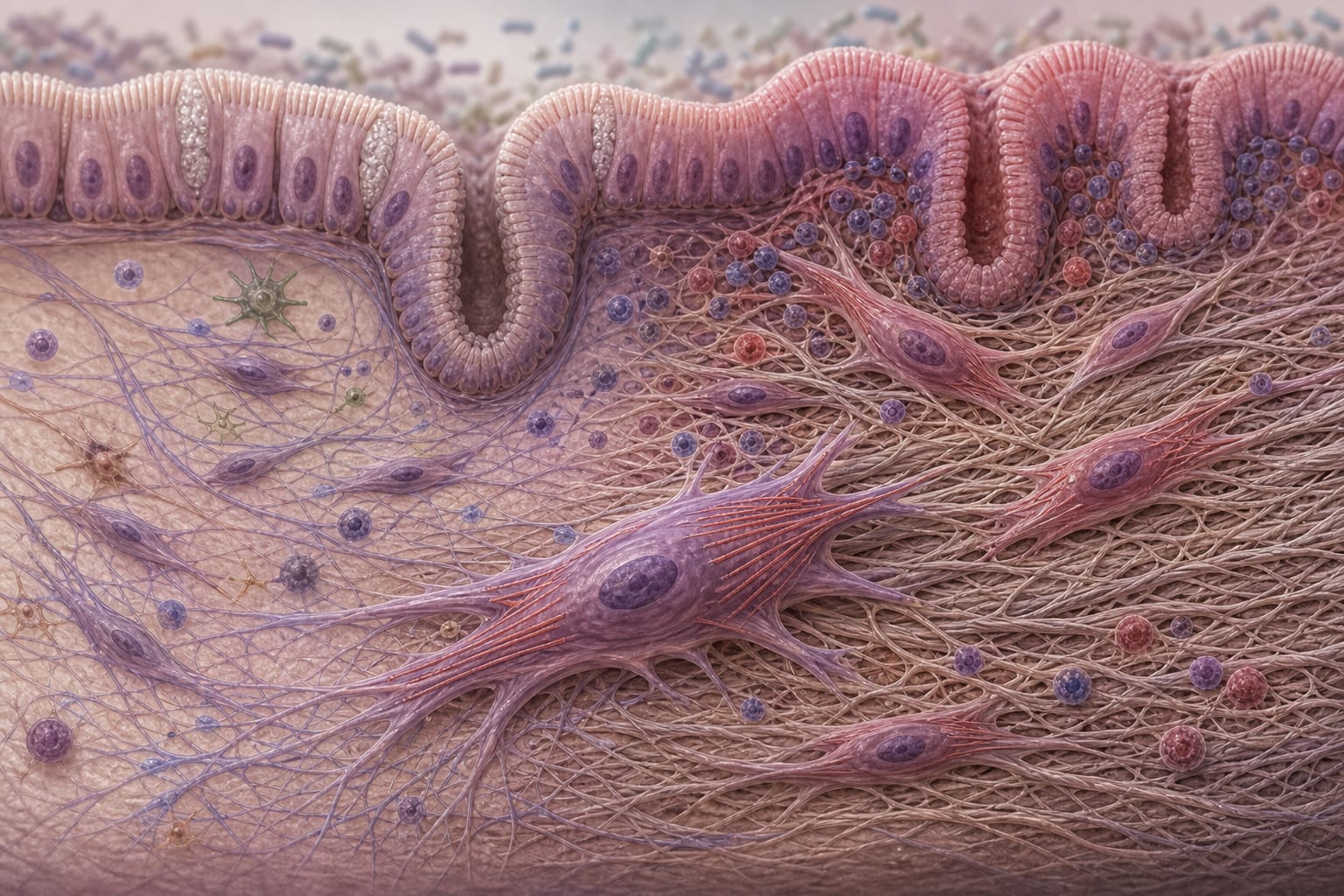
Subepithelial Myofibroblasts in the Intestine and Their Role in Inflammatory Bowel Disease: Exploring Fibroblast Diversity, Fibrosis, and Potential Therapeutic Approaches
By
Fang Li
Chao Xu
Jun Chen
Teng Lei
Xigui Tian
Yuanling Zhang
Guoqing Chen
June 24, 2026
Clinical Scorecard: Subepithelial Myofibroblasts in the Intestine and Their Role in Inflammatory Bowel Disease: Exploring Fibroblast Diversity, Fibrosis, and Potential Therapeutic Approaches
At a Glance
Category Detail
Condition Inflammatory Bowel Disease (IBD) Key Mechanisms Intestinal subepithelial myofibroblasts (ISEMFs) regulate epithelial homeostasis, mucosal repair, and extracellular matrix remodeling. Target Population Patients with Crohn's disease (CD) and ulcerative colitis (UC). Care Setting Clinical management of intestinal fibrosis in IBD.
Key Highlights
ISEMFs are central regulators of intestinal fibrosis and epithelial integrity. Persistent activation of ISEMFs leads to excessive extracellular matrix deposition. Fibroblast heterogeneity contributes to chronic inflammation and fibrogenesis. Profibrotic cytokines and immune-stromal crosstalk drive ISEMF activation. Emerging therapeutic strategies target stromal pathways and fibroblast subsets. Guideline-Based Recommendations
Diagnosis
Monitor for signs of intestinal fibrosis in patients with IBD. Management
Consider antifibrotic agents and cytokine-directed therapies for managing fibrosis. Monitoring & Follow-up
Regular assessment of bowel strictures and complications in IBD patients. Risks
Increased risk of bowel strictures and surgical intervention in patients with progressive fibrosis. Patient & Prescribing Data
Patients with chronic inflammatory bowel diseases, particularly those developing fibrosis.
Current therapies may not effectively address progressive intestinal fibrosis.
Clinical Best Practices
Integrate advances in stromal biology into clinical practice for IBD management. Utilize biomarker-guided precision approaches in treatment strategies. Related Resources & Content