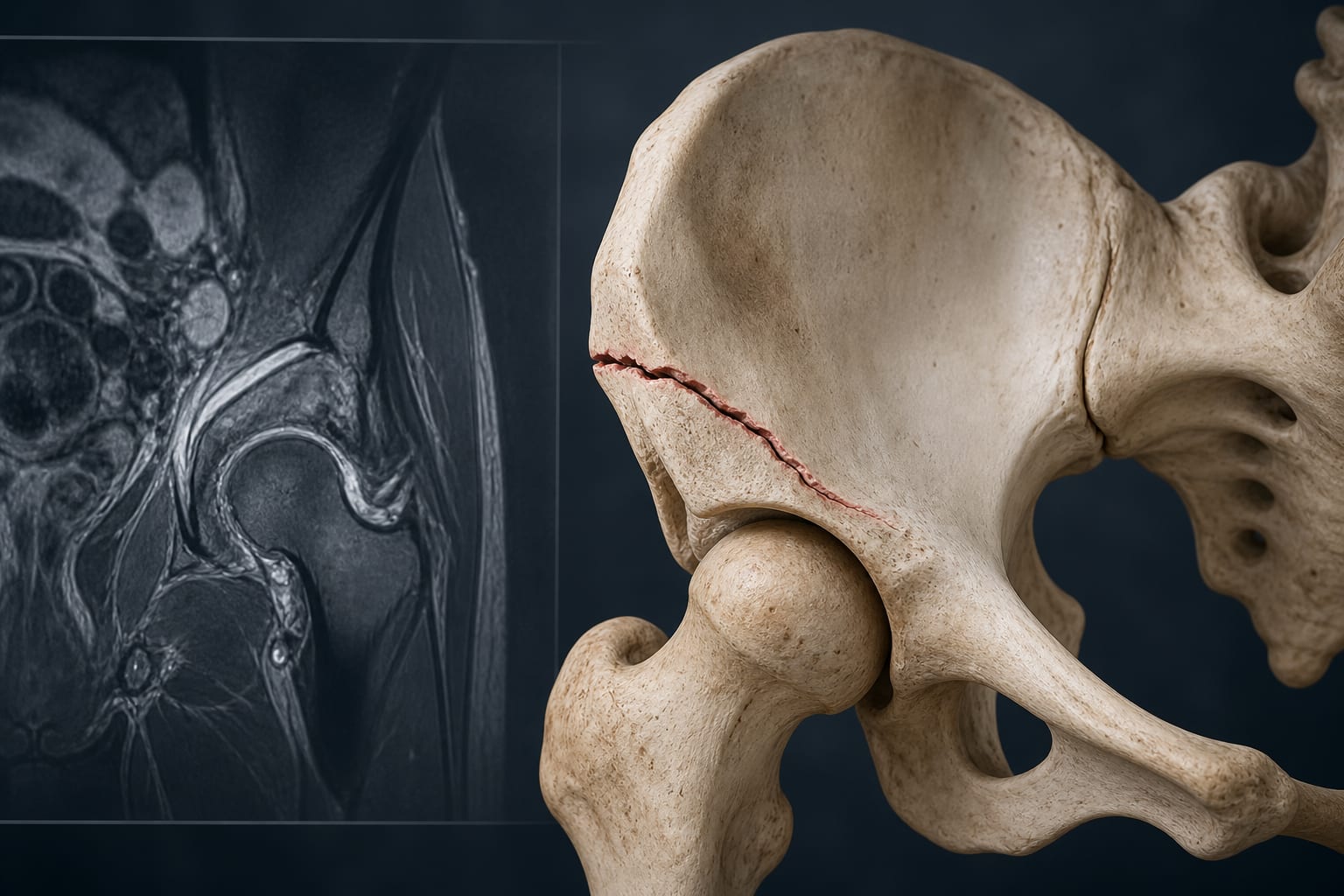
Letter to the Editor: Superior Wall Fractures of the Acetabulum as a Distinct Fracture Type
-
By
-
Martin Salášek
-
Valér Džupa
-
November 11, 2026
Clinical Scorecard: Letter to the Editor: Superior Wall Fractures of the Acetabulum as a Distinct Fracture Type
At a Glance
| Category | Detail |
|---|---|
| Condition | Clinical topic addressed by the source article: Letter to the Editor |
| Key Mechanisms | Mechanisms or clinical associations described in the source article. |
| Target Population | Patients or participants described in the source article. |
| Care Setting | Clinical assessment and imaging of pediatric pelvic-region avulsion fractures; the letter reports a multicenter analysis and discusses conservative and surgical treatment options. |
Key Highlights
- A 16-year multicenter analysis identified 9 superior acetabular-region avulsions at the reflected-head origin among pediatric pelvic avulsion fractures.
- All 9 patients were treated conservatively because displacement did not exceed 1 cm; no complications, non-union, or post-traumatic femoroacetabular impingement occurred in this small series.
- Clinical findings and plain radiography are used for diagnosis; for an initially nondisplaced avulsion projecting at the superior acetabular margin, native hip MRI demonstrates the avulsion and can identify concomitant labral injury.
- The authors state that MRI should be selected in preference to low-dose CT in pediatric patients.
- Combined pelvic-ring and superior acetabular-wall injuries are described as extremely uncommon in children; none occurred in the reported group.
Guideline-Based Recommendations
Diagnosis
- The authors describe clinical findings and plain radiographs as part of assessment for reflected-head avulsion fractures.
- For an initially nondisplaced avulsion projecting at the superior acetabular margin, the authors perform native hip MRI to demonstrate the avulsion and identify any concomitant intra-articular labral injury.
- The authors state that MRI should be selected in preference to low-dose CT in pediatric patients.
Management
- All 9 patients in the reported series were treated conservatively because displacement did not exceed 1 cm.
- The letter notes earlier recommendations for open reduction and screw fixation through a limited Smith-Petersen approach when reflected-head avulsion displacement exceeded 1 cm; the procedure was comparatively frequently followed by paraarticular calcifications and lateral femoral cutaneous nerve neuropathy.
- The letter describes an endoscopic stabilization method for fractures involving anterior inferior iliac spine and reflected-head avulsions. It reports fewer paraarticular calcifications and lateral femoral cutaneous nerve lesions; the principal advantage is the ability to treat a labral lesion concomitantly when required, while the stabilization technique has a longer learning curve.
Monitoring & Follow-up
- MRI can identify concomitant intra-articular labral injury.
- The letter reports no complications, non-union, or post-traumatic femoroacetabular impingement among the 9 isolated reflected-head avulsions in its series.
Risks
- Open reduction and screw fixation through the Smith-Petersen approach was comparatively frequently followed by paraarticular calcifications and lateral femoral cutaneous nerve neuropathy.
- The letter states that post-traumatic femoroacetabular impingement is generally linked to dislocated avulsions exceeding 1.5 cm.
- The endoscopic stabilization technique has a longer learning curve.
Patient & Prescribing Data
The multicenter analysis followed pediatric pelvic avulsion fractures over 16 years and identified 9 superior acetabular-region reflected-head avulsions. The patients participated in football (4), running (3), and other sports (2).
All 9 reflected-head avulsions were treated conservatively because displacement did not exceed 1 cm. The letter also describes earlier open fixation recommendations for displacement greater than 1 cm and a more recently described endoscopic stabilization method.
Clinical Best Practices
- The authors distinguish reflected-head avulsions from anterior inferior iliac spine avulsions because their mechanisms differ.
- For an initially nondisplaced avulsion projecting at the superior acetabular margin, the authors describe native hip MRI to assess the avulsion and any labral injury.
- The authors state that MRI should be selected in preference to low-dose CT in pediatric patients.
- The letter describes complications associated with open fixation and a longer learning curve for endoscopic stabilization.
Related Resources & Content
Based on findings from:
Letter to Editor—Acetabular superior wall fractures: a distinct acetabular fracture entity
Martin Salášek, Valér Džupa. Archives Of Orthopaedic And Trauma Surgery, 2026.
https://link.springer.com/article/10.1007/s00402-026-06483-1
This content is an AI-generated, fully rewritten summary based on a published scholarly article. It does not reproduce the original text and is not a substitute for the original publication. Readers are encouraged to consult the source for full context, data, and methodology.