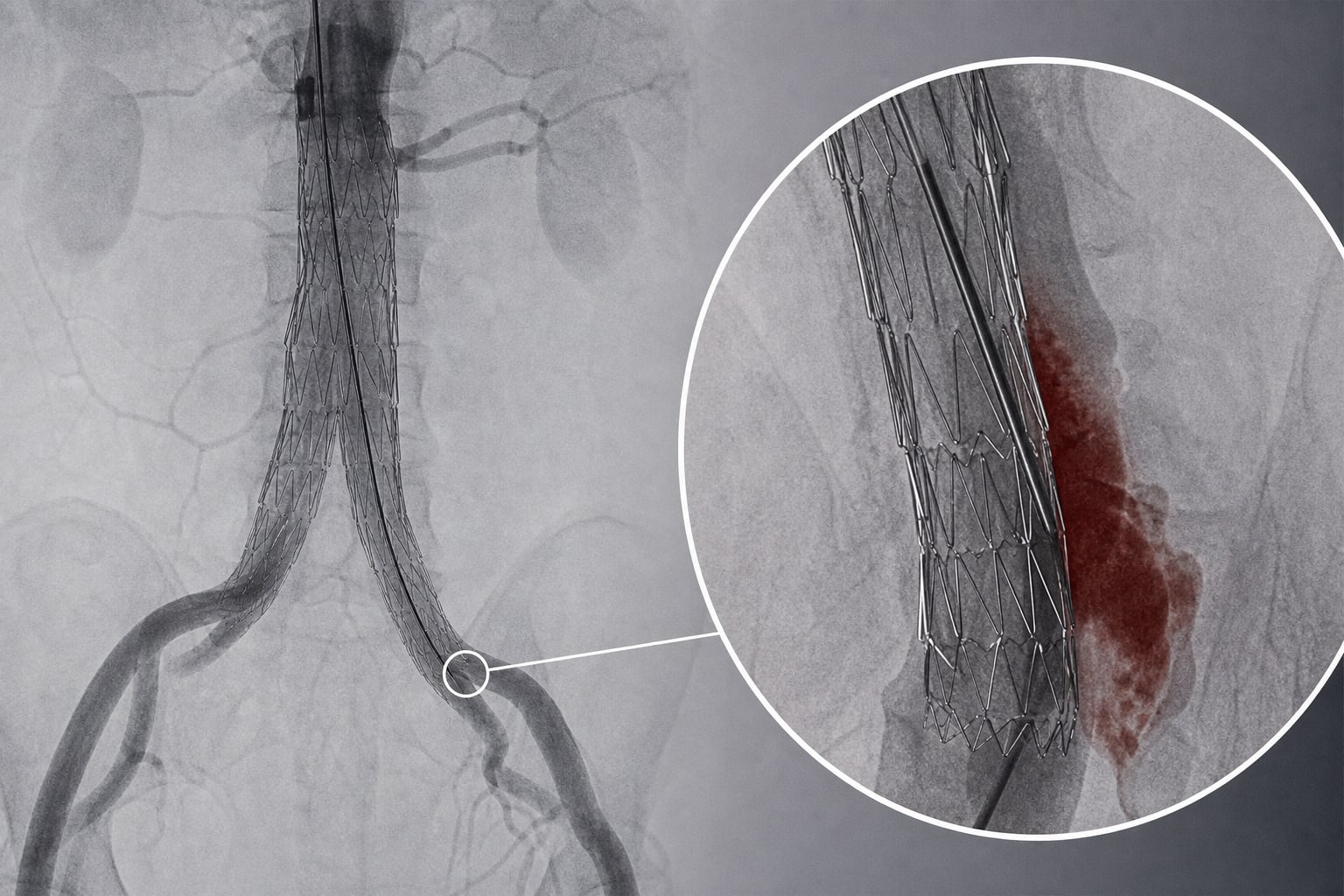
Case Report: Hidden danger of stiff guidewire retention: masking effect on distal sealing during EVAR
-
By
-
Yang Liu
-
Shengqing Wu
-
Dejie Chen
-
June 24, 2026
-
Clinical Scorecard: Case Study: The Risks of Retained Stiff Guidewires and Their Impact on Distal Sealing in Endovascular Aneurysm Repair
At a Glance
| Category | Detail |
|---|
| Condition | Endovascular Aneurysm Repair (EVAR) |
| Key Mechanisms | Retention of stiff guidewires may lead to false-negative completion angiograms and undetected type Ib endoleaks. |
| Target Population | Patients undergoing EVAR for abdominal aortic aneurysms (AAA). |
| Care Setting | Intraoperative assessment during endovascular procedures. |
Key Highlights
- Completion angiography may not always confirm successful EVAR due to potential guidewire retention.
- Type Ib endoleaks can occur despite satisfactory angiographic results.
- Intraoperative complications can arise from anatomical challenges and technical oversights.
Guideline-Based Recommendations
Diagnosis
- Utilize intraoperative completion angiography to verify device deployment and sealing.
Management
- Address type Ib endoleaks with secondary endovascular interventions as needed.
Monitoring & Follow-up
- Follow-up CTA is essential to assess for persistent endoleaks post-EVAR.
Risks
- Retention of guidewires can lead to misinterpretation of angiographic results and delayed recognition of complications.
Patient & Prescribing Data
Older adults with comorbidities undergoing EVAR.
Careful monitoring and follow-up imaging are critical for detecting complications.
Clinical Best Practices
- Ensure thorough documentation of prior interventions and device specifications.
- Perform meticulous intraoperative checks for retained devices before concluding procedures.
- Consider anatomical factors that may affect sealing and device positioning.
Related Resources & Content