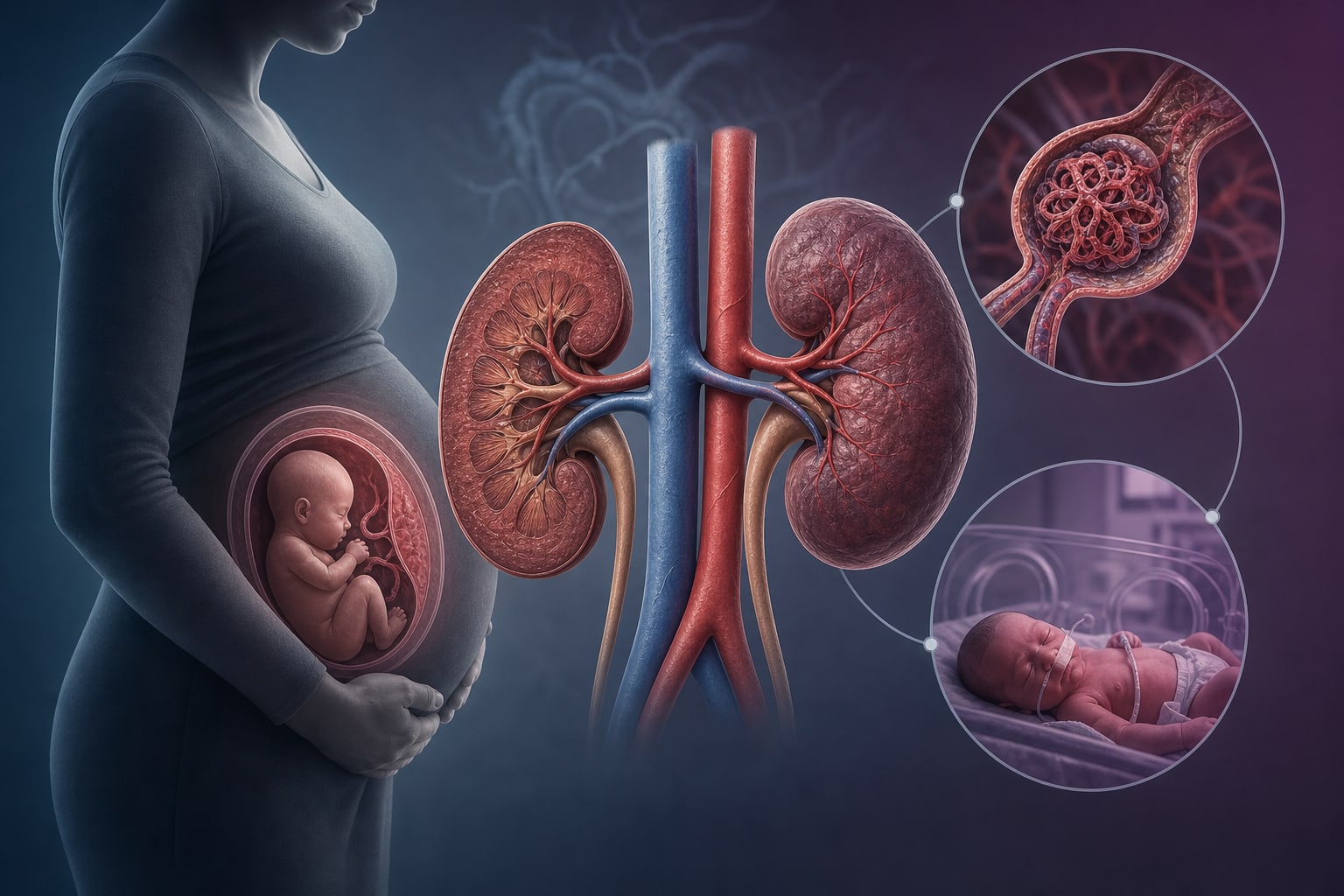
Independent factors associated with renal impairment in preeclampsia and its association with maternal and neonatal adverse outcomes
By
Zi-Xin Tao
Ai-Yue Chen
Yu Yang
Na Yang
Zhen Zeng
Yan-Ling Wu
Bei-Lan Zeng
Yu-Jie Zhang
Yang Cheng
July 8, 2026
Clinical Scorecard: Factors Independently Linked to Renal Dysfunction in Preeclampsia and Their Impact on Maternal and Neonatal Adverse Outcomes
At a Glance
Category Detail
Condition Preeclampsia with renal impairment Key Mechanisms Hemodynamic severity, biochemical markers, endothelial dysfunction, microvascular injury Target Population Women with preeclampsia Care Setting Inpatient management
Key Highlights
Higher BMI, MAP, and uric acid are associated with renal impairment in preeclampsia. Renal impairment is linked to increased odds of adverse maternal outcomes. Early-onset preeclampsia significantly raises the risk of renal impairment. Renal impairment correlates with adverse neonatal outcomes such as low birth weight and NICU admission. Routine laboratory markers like uric acid and albumin are critical for risk stratification. Guideline-Based Recommendations
Diagnosis
Assess renal function as part of the evaluation for preeclampsia. Management
Monitor hemodynamic and biochemical markers in women with preeclampsia. Monitoring & Follow-up
Intensified monitoring for patients with renal impairment. Risks
Increased risk of maternal and neonatal adverse outcomes associated with renal impairment. Patient & Prescribing Data
Women diagnosed with preeclampsia managed inpatient.
Management should focus on monitoring renal function and associated risks.
Clinical Best Practices
Incorporate renal function assessment into routine care for preeclampsia. Utilize biomarkers for risk stratification in preeclampsia management. Related Resources & Content