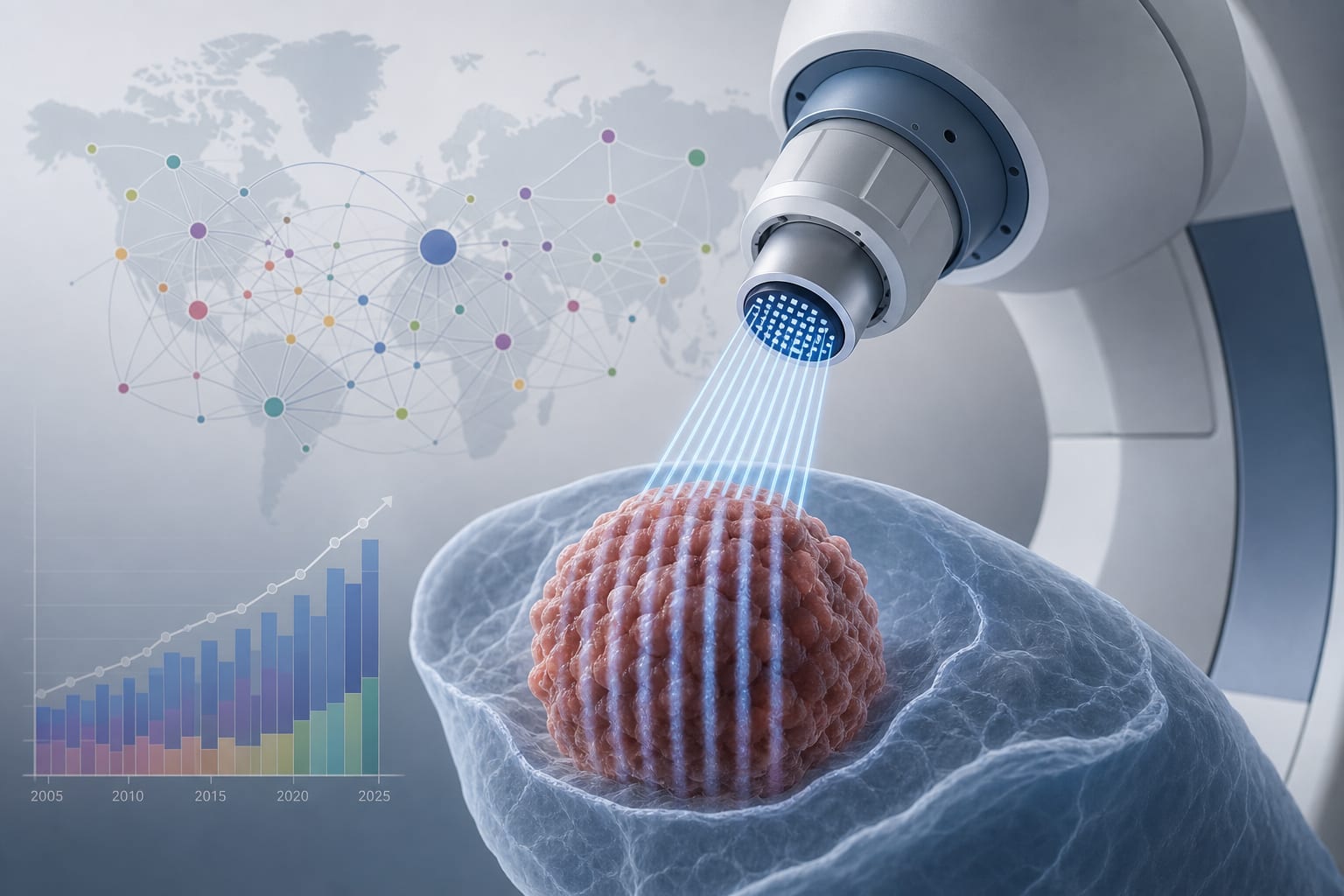
Global Research Trends in Spatially Fractionated Radiotherapy: A Bibliometric Evaluation
-
By
-
Meng, Lingling
-
Di, Yupeng
-
Ma, Lin
-
Qu, Baolin
-
April 21, 2026
Clinical Scorecard: Global Research Trends in Spatially Fractionated Radiotherapy: A Bibliometric Evaluation
At a Glance
| Category | Detail |
|---|
| Condition | Spatially Fractionated Radiotherapy (SFRT) |
| Key Mechanisms | Redistributes doses within tumor volume to optimize ablation while preserving normal tissue integrity. |
| Target Population | Patients requiring innovative radiation oncology techniques. |
| Care Setting | Radiation oncology departments and research institutions. |
Key Highlights
- Distinct three-phase evolutionary pattern in SFRT research.
- Significant increase in publications and citations from 2020 to 2025.
- United States leads in cumulative research output; France excels in institutional productivity.
- Thematic evolution includes advancements in proton minibeam therapy and computational precision.
- Need for robust biological markers and standardized protocols for clinical implementation.
Guideline-Based Recommendations
Diagnosis
- Utilize advanced imaging techniques to assess tumor characteristics.
Management
- Focus on refining delivery technologies and establishing standardized protocols.
Monitoring & Follow-up
- Conduct large-scale prospective trials to evaluate clinical feasibility.
Risks
- Consider potential impacts on normal tissue integrity during treatment.
Patient & Prescribing Data
Patients with tumors suitable for SFRT.
SFRT integrates dose heterogeneity with complex radiobiological responses.
Clinical Best Practices
- Adopt interdisciplinary approaches in SFRT research and application.
- Prioritize the identification of biological markers for treatment efficacy.
- Encourage collaboration among institutions to enhance research output.
Related Resources & Content