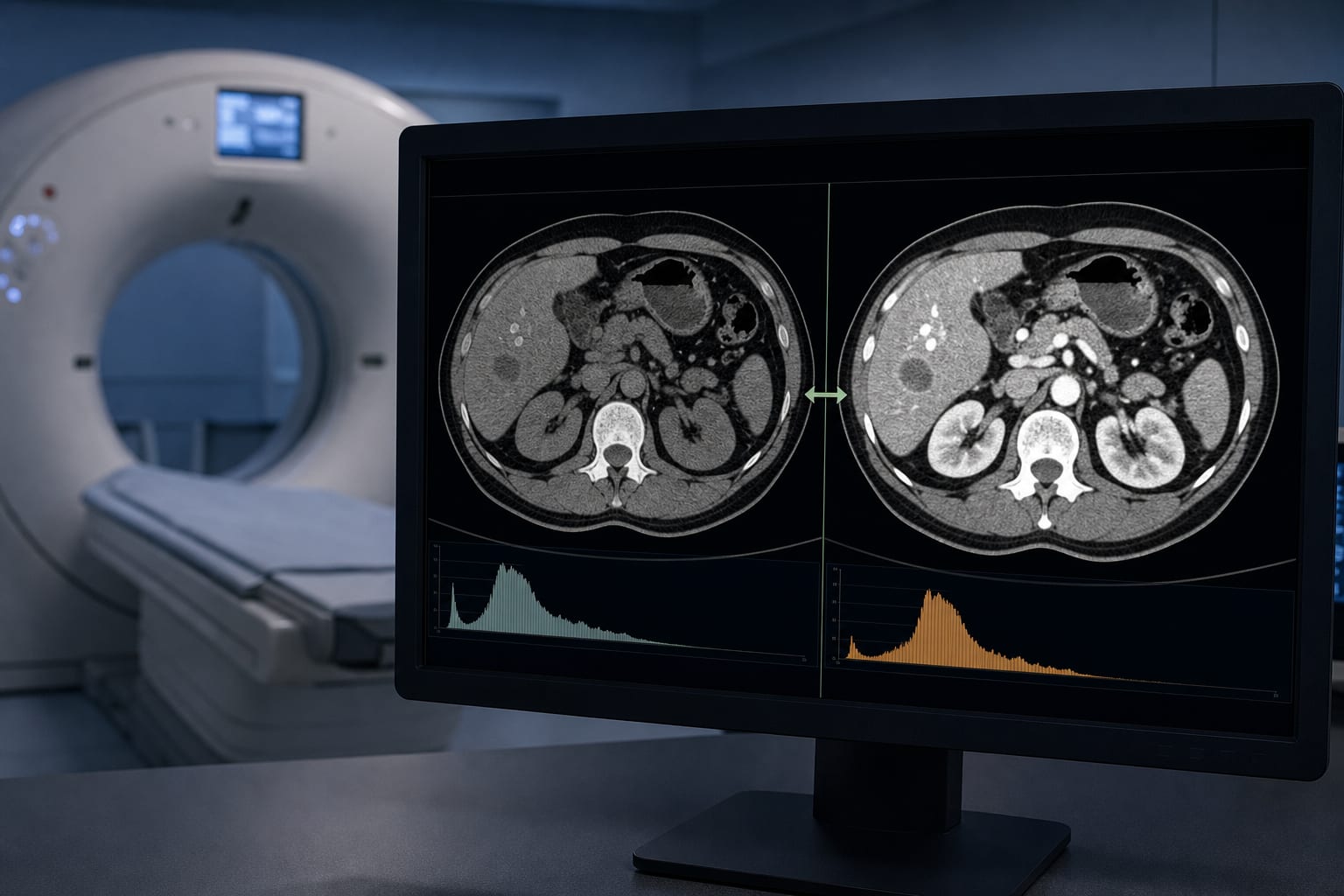
Clinical Scorecard: Evaluation of Virtual Non-Contrast Imaging from Dual-Layer Spectral CT: A Comparative Analysis with True Non-Contrast in Abdominal Structures
At a Glance
Category
Detail
Condition
Key Mechanisms
Virtual non-contrast (VNC) images generated by subtracting iodine from contrast-enhanced datasets, as described in the source.
Target Population
Care Setting
Key Highlights
VNC aims to reduce scan time and radiation exposure compared to TNC, as noted in the introduction.
DLCT technology allows robust spectral separation for abdominal imaging, based on the source material.
Study evaluates VNC's potential to replace TNC in routine protocols, as stated in the introduction.
Image quality and lesion measurement consistency are critical for oncologic follow-up, as mentioned in the source.
Previous studies show mixed results regarding VNC accuracy, as indicated in the introduction.
Guideline-Based Recommendations
Diagnosis
Use TNC for characterizing parenchymal lesions and detecting hemorrhage and calcification, as per the source.
Management
Consider VNC as a potential alternative to TNC in abdominal CT protocols, based on the source.
Monitoring & Follow-up
Ensure reliable lesion characterization and calcification assessment with VNC, as stated in the source.
Risks
Potential for inaccurate lesion detection if VNC does not adequately simulate TNC, as noted in the source.
Patient & Prescribing Data
Consecutive inpatients with clinically indicated abdominal CT
Exclusion criteria include age under 18, pregnancy, and impaired kidney function
Clinical Best Practices
Utilize model-based iterative reconstruction for image data, as described in the source.
Apply automated tube current modulation to optimize radiation dose, as mentioned in the source.
Employ dedicated bolus-tracking technique for accurate scan timing, as stated in the source.
by Domenico De Santis, Antonella Del Gaudio, Benedetta Masci, Bianca Catalano, Marta Zerunian, Michela Polici, Francesco Pucciarelli, Giuseppe Tremamunno, Tiziano Polidori, Ettore Squillaci, Cesare Maino, Davide Ippolito, Marco Francone, Damiano Caruso