Thyroid function and risk of sepsis: a population-based prospective cohort study with traditional and genetic epidemiological analyses - Scorecard - MDSpire
Conexiant’s news site is now MDSpire News. Learn more
Advertisement
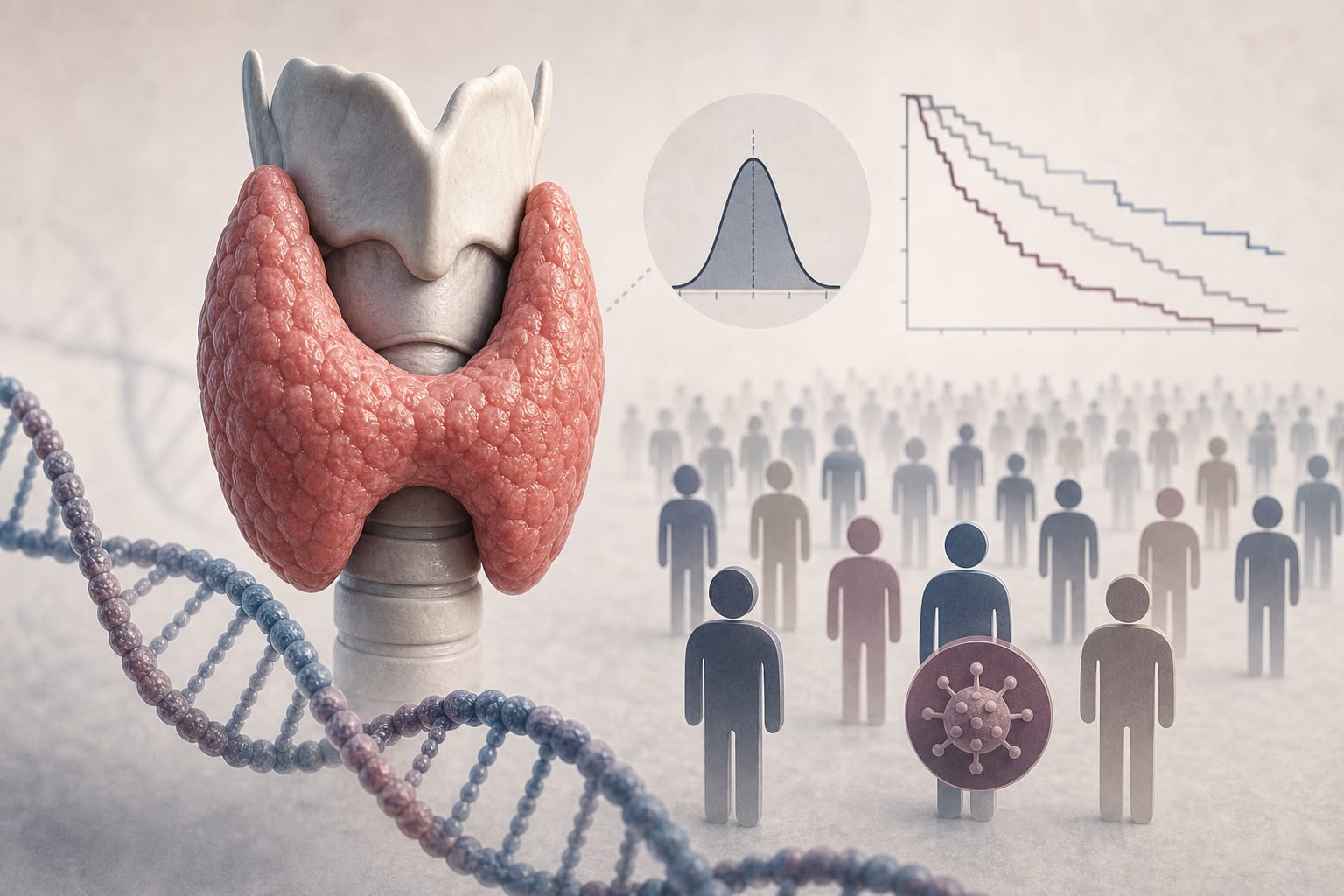
The Relationship Between Thyroid Function and Sepsis Risk: Insights from a Population-Based Prospective Cohort Study Utilizing Traditional and Genetic Epidemiological Methods
Clinical Scorecard: The Relationship Between Thyroid Function and Sepsis Risk: Insights from a Population-Based Prospective Cohort Study Utilizing Traditional and Genetic Epidemiological Methods
At a Glance
Category
Detail
Condition
Thyroid Function and Sepsis Risk
Key Mechanisms
Thyroid hormones modulate immune system cells and inflammatory signaling pathways.
Target Population
Adults over 20 years in the general population.
Care Setting
Population-based health study.
Key Highlights
No association found between normal-range TSH levels and sepsis risk.
TSH levels <0.5 mU/L associated with higher sepsis risk.
Secondary analyses showed no link between thyroid function and risk of sepsis, LRTI, or UUTI.
Study utilized both observational and Mendelian randomization analyses.
Thyroid dysfunction affects approximately 5% of the global population.
Guideline-Based Recommendations
Diagnosis
Assess TSH levels in adults to evaluate thyroid function.
Management
No specific management recommendations for thyroid function in relation to sepsis risk.
Monitoring & Follow-up
Monitor TSH levels in patients with thyroid dysfunction.
Risks
Higher sepsis risk associated with TSH levels <0.5 mU/L.
Patient & Prescribing Data
Adults over 20 years participating in the HUNT study.
Mild deviations in thyroid function unlikely to be useful targets for sepsis prevention.
Clinical Best Practices
Utilize population-based data for assessing thyroid function and infection risk.
Consider genetic epidemiological methods to clarify causal relationships.
by Marianne S. Thorkildsen, Lise T. Gustad, Bjørn O. Åsvold, Randi M. Mohus, Christina Ellervik, Alexander Teumer, Eirini Marouli, Marco Medici, Jan K. Damås, Helene M. Flatby, Tormod Rogne
Federal prosecutors allege that a Florida physician and research staff fabricated clinical trial records that were submitted into database systems used to evaluate investigational drugs.