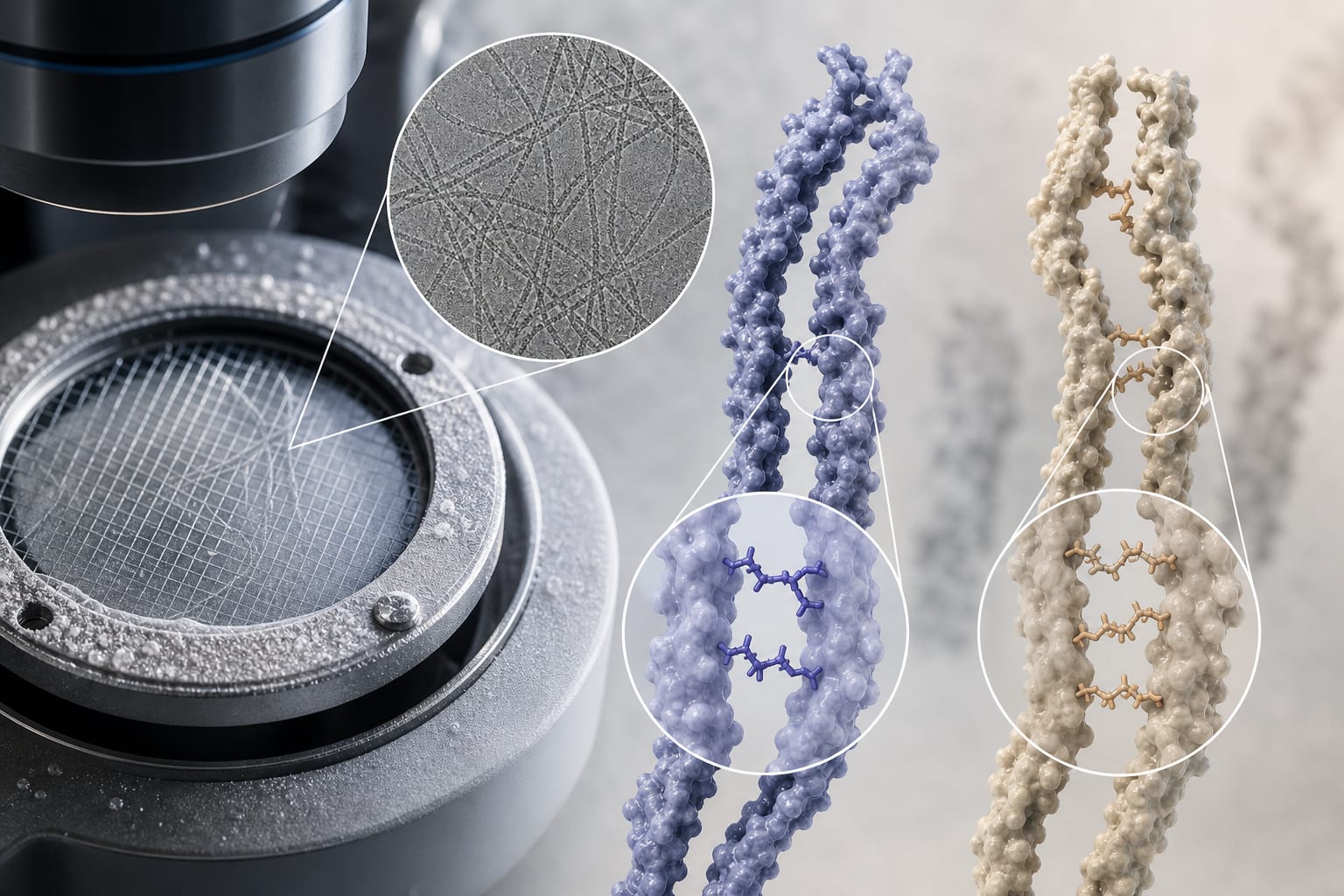
CTE-type tau filaments in Alzheimer’s disease with co-morbid LATE-NC
-
By
-
Jaimin K. Rana
-
Emile S. Pinarbasi
-
Martin G. Fernandez
-
Vikas Navratna
-
Kyle S. Conway
-
Andrew P. Lieberman
-
Sami J. Barmada
-
Shyamal Mosalaganti
-
July 7, 2026
-
Clinical Scorecard: Tau Filament Polymorphs Resembling CTE Observed in Alzheimer's Disease Accompanied by LATE-NC
At a Glance
| Category | Detail |
|---|
| Condition | Alzheimer's Disease Neuropathologic Change (ADNC) |
| Key Mechanisms | Presence of paired helical filament (PHF) and straight filament (SF) tau polymorphs, and co-morbid limbic-predominant age-related TDP-43 encephalopathy neuropathologic change (LATE-NC). |
| Target Population | Patients with Alzheimer's disease and co-morbid LATE-NC. |
| Care Setting | Neuropathological analysis and cryo-electron microscopy. |
Key Highlights
- ADNC is characterized by amyloid-β plaques and tau neurofibrillary tangles.
- Two distinct tau filament polymorphs (PHF and SF) were identified in ADNC.
- Co-morbid LATE-NC is prevalent in up to 50% of ADNC cases.
- CTE-fold tau was observed in AD + LATE-NC cases, indicating potential diagnostic challenges.
- CTE-NC lesions were identified in one case, despite no history of head injury.
Guideline-Based Recommendations
Diagnosis
- Consensus criteria for CTE-NC require identification of cortical CTE lesions.
Management
Monitoring & Follow-up
Risks
- Co-morbid neuropathologies complicate the diagnosis and understanding of tau pathology.
Patient & Prescribing Data
Patients with Alzheimer's disease and LATE-NC.
No specific treatment insights provided in the study.
Clinical Best Practices
- Consider co-morbid pathologies when diagnosing ADNC.
- Utilize cryo-electron microscopy for detailed structural analysis of tau filaments.
Related Resources & Content