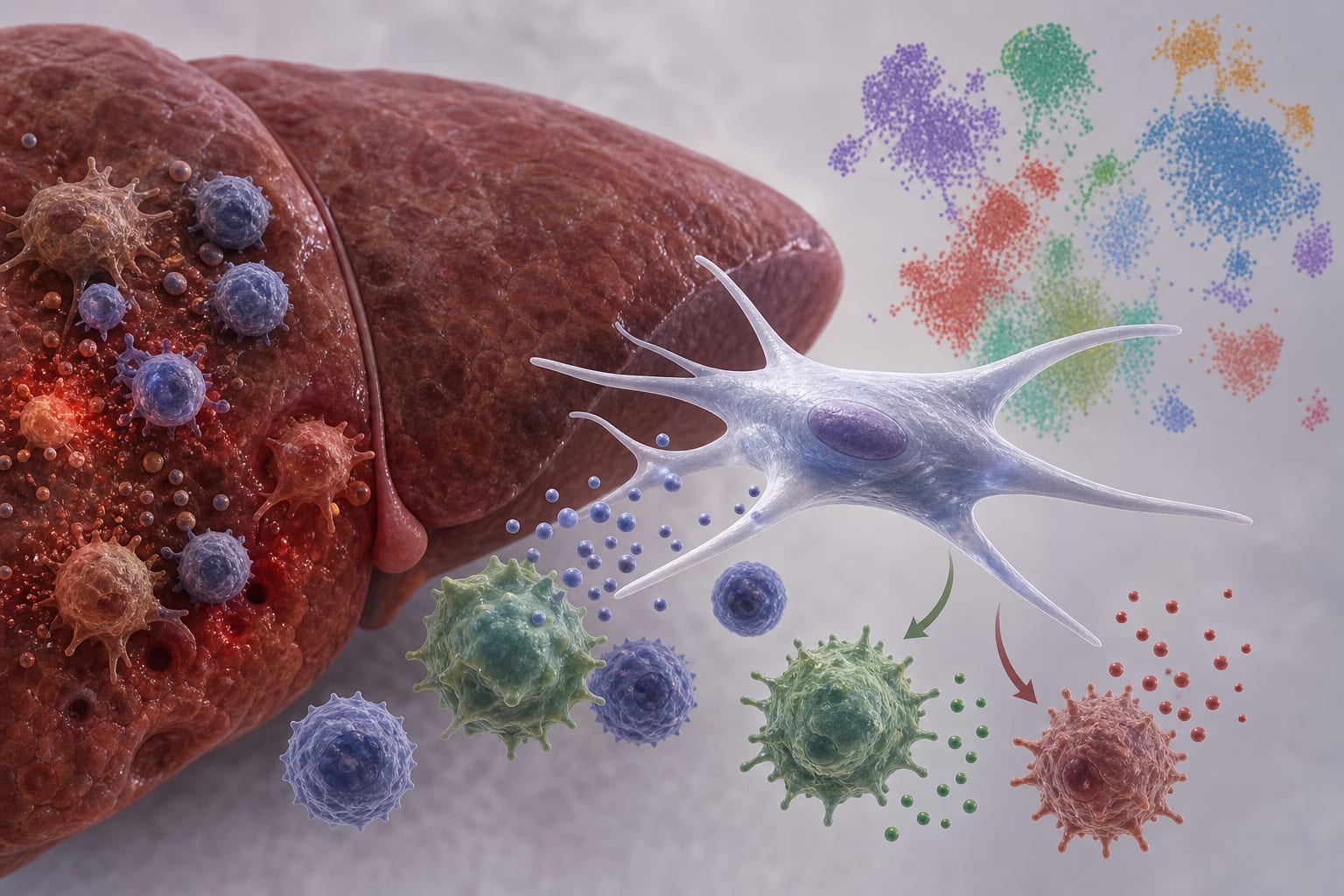
Mesenchymal stem cell alleviate concanavalin A-induced hepatitis via immune reprogramming and complement regulation
-
By
-
Hanpeng Luo
-
Bing Liu
-
Yaqin Li
-
Peng Cui
-
Tao Zhou
-
Cai Ye
-
Can Wu
-
Junchang Wu
-
Yu Wang
-
Wei V. Zheng
-
May 13, 2026
Clinical Scorecard: Mesenchymal Stem Cells Mitigate Concanavalin A-Induced Hepatitis Through Immune Modulation and Complement System Regulation
At a Glance
| Category | Detail |
|---|
| Condition | Concanavalin A-induced acute hepatitis |
| Key Mechanisms | Immune modulation, complement system regulation, macrophage polarization |
| Target Population | Mice with immune-mediated liver injury |
| Care Setting | Preclinical research |
Key Highlights
- MSCs significantly mitigate ConA-induced acute hepatic injury.
- MSC treatment alters immune cell composition, enhancing monocyte-derived macrophages.
- Key signaling pathways involve complement-related interactions.
- MSCs promote anti-inflammatory macrophage polarization.
- Single-cell RNA sequencing reveals detailed immune microenvironment changes.
Guideline-Based Recommendations
Diagnosis
- Utilize ConA-induced hepatitis model for studying immune-mediated liver damage.
Management
- Consider MSC therapy as a novel approach for immune-mediated liver injury.
Monitoring & Follow-up
- Assess immune cell composition and cytokine levels post-MSC treatment.
Risks
- Traditional immunosuppressive treatments carry risks of systemic adverse effects.
Patient & Prescribing Data
Murine models of immune-mediated liver injury.
MSCs provide immunomodulatory effects without broad immune suppression.
Clinical Best Practices
- Integrate single-cell transcriptomic analyses to understand immune responses.
- Focus on macrophage-state composition in therapeutic strategies.
- Evaluate the role of complement signaling in immune modulation.
Related Resources & Content