Combination of Yaobitong capsules and lumbar oblique pull manipulation for moderate pain in lumbar disc herniation with radiculopathy: a multicenter, randomized, three-arm, parallel-group controlled trial - Scorecard - MDSpire

Combination of Yaobitong capsules and lumbar oblique pull manipulation for moderate pain in lumbar disc herniation with radiculopathy: a multicenter, randomized, three-arm, parallel-group controlled trial

  • By

  • Guangqi Lu

  • Minghui Zhuang

  • Bin Tang

  • Jirong Zhao

  • Shaofeng Yang

  • Jiayi Guo

  • Ping Wang

  • Yikai Li

  • Shaojun Li

  • Bolai Chen

  • Puwei Yuan

  • Hong Jiang

  • Yusong Jia

  • Bin Shi

  • Xuefeng Guan

  • Yanming Xie

  • Minshan Feng

  • Zhefeng Jin

  • Jinjing Wang

  • Zelong Zhao

  • Jiawen Zhan

  • Xunlu Yin

  • He Yin

  • Ming Chen

  • Kai Sun

  • Xin Chen

  • Jie Yu

  • Liguo Zhu

  • June 26, 2026

  • 0 min

Share

Clinical Scorecard: Efficacy of Yaobitong Capsules Combined with Lumbar Oblique Pull Manipulation for Moderate Lumbar Disc Herniation Pain with Radiculopathy: A Multicenter, Randomized, Three-Arm Controlled Trial

At a Glance

CategoryDetail
ConditionLumbar disc herniation with radiculopathy (LDHR)
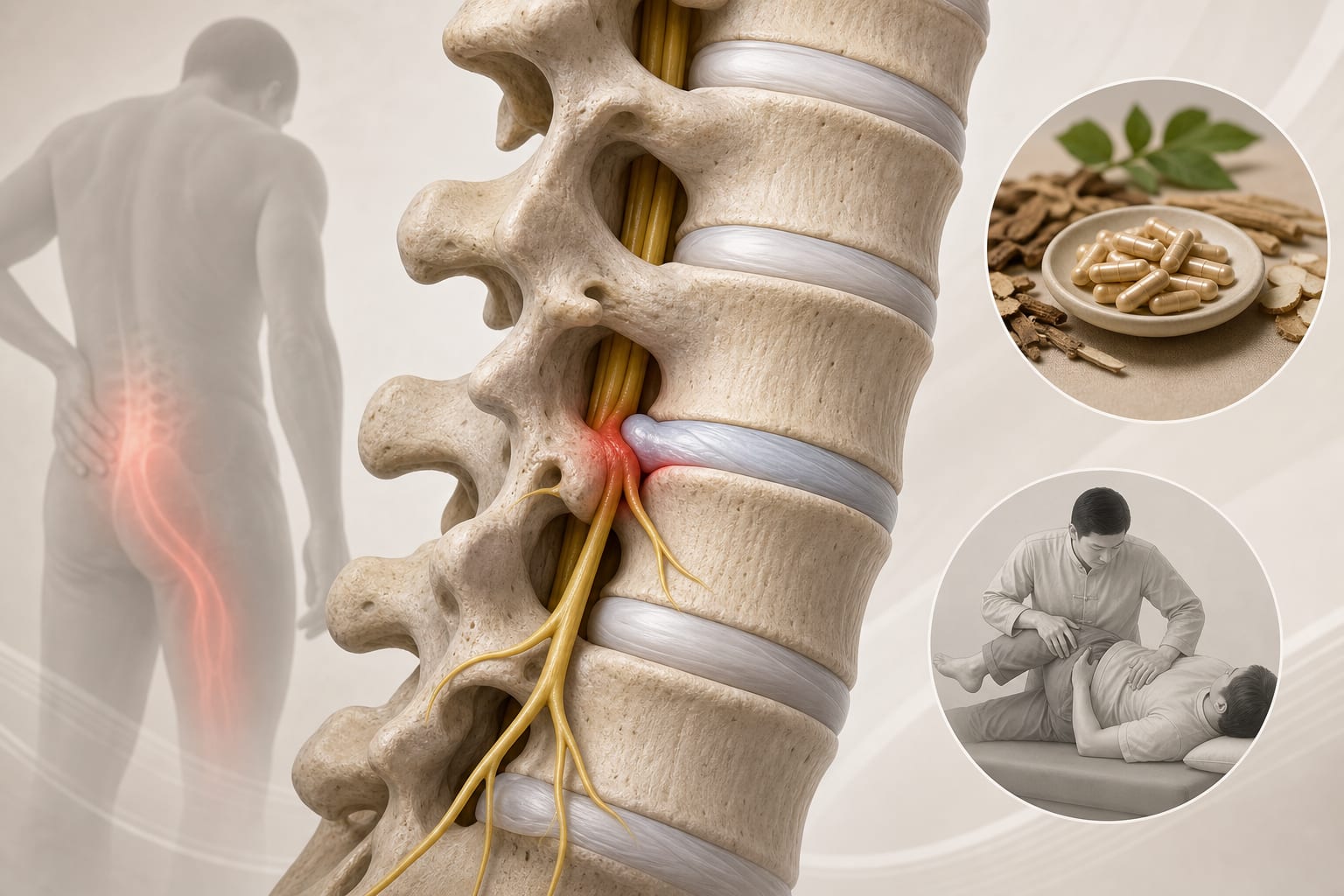
Key MechanismsCombination of Traditional Chinese Medicine (Yaobitong capsules) and manual therapy (lumbar oblique pull manipulation)
Target PopulationAdults aged 18 to 65 years with moderate pain (VAS score ≥ 4 to < 7)
Care SettingMulticenter trial conducted in 13 tertiary hospitals in China

Key Highlights

  • 426 patients with moderate LDHR were randomized into three groups: YBT alone, LOPM alone, and combination therapy.
  • No statistically significant differences in ODI reduction or secondary outcomes between treatment groups at any follow-up time point.
  • The combination therapy was not superior to either monotherapy in improving functional disability, pain, or quality of life.

Guideline-Based Recommendations

Diagnosis

  • Diagnosis of LDHR requires imaging evidence (MRI/CT) and correlating clinical symptoms consistent with nerve root compression.

Management

  • Conservative management is recommended as the first-line strategy for LDHR, especially within the first six weeks.

Monitoring & Follow-up

  • Outcome measurements assessed at baseline, 3 days, 1 week, 2 weeks, 6 weeks, 14 weeks, and 26 weeks.

Risks

  • Surgical interventions carry considerable expenses and inherent risks.

Patient & Prescribing Data

Adults aged 18 to 65 years with moderate low back or leg pain due to LDHR.

Yaobitong capsules and lumbar oblique pull manipulation are commonly used in clinical practice but lack evidence of superior efficacy when combined.

Clinical Best Practices

  • Utilize conservative management strategies for LDHR before considering surgical options.
  • Monitor patients' pain and functional status regularly using validated scales.

Related Resources & Content

Original Source(s)

Related Content