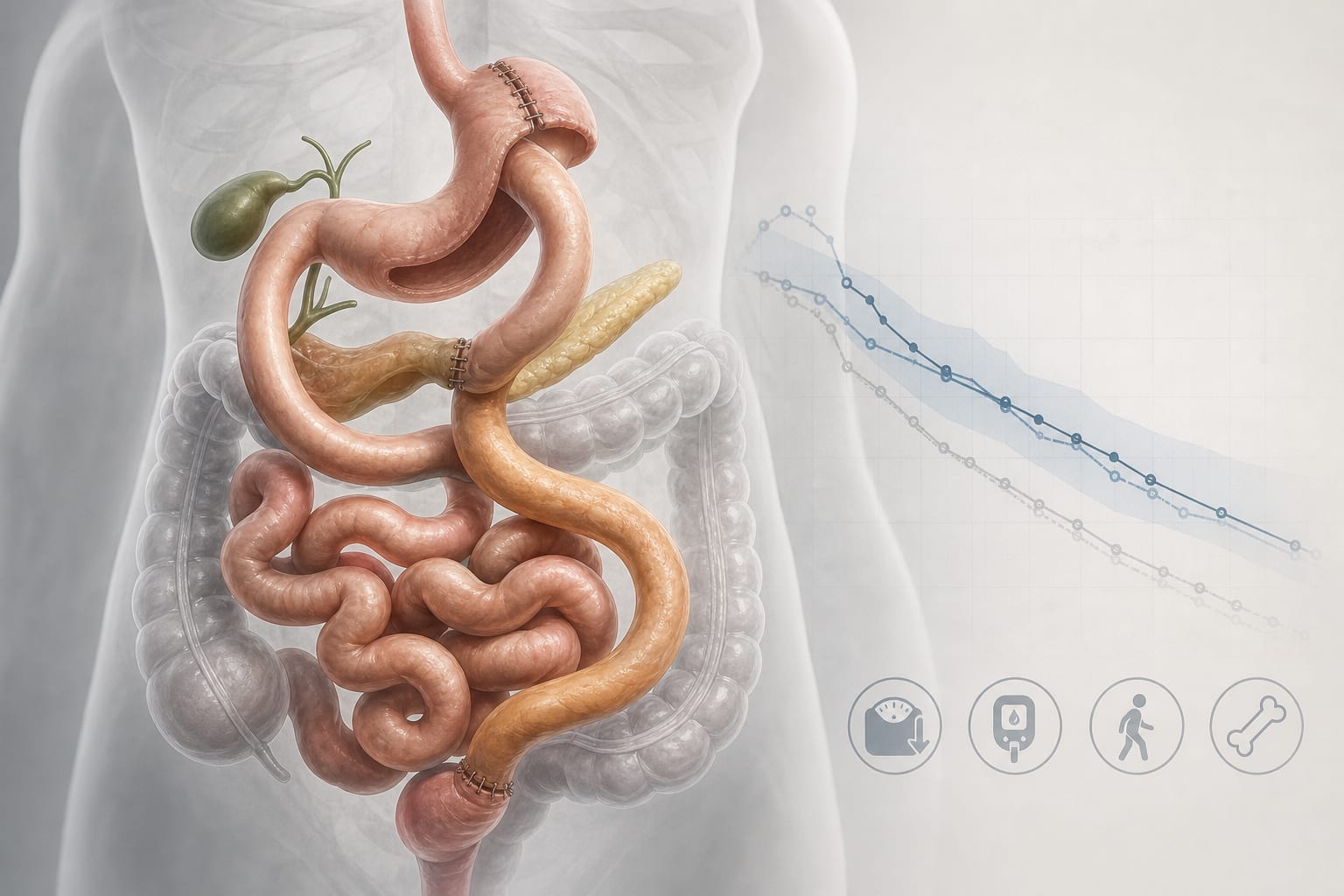
Clinical Scorecard: Evaluating the Viability and Results of Robotic Surgery for Colorectal Cancer in Patients with Elevated Body Mass Index
At a Glance
Category
Detail
Condition
Colorectal cancer in patients with elevated BMI (obesity)
Key Mechanisms
Robotic-assisted surgery provides enhanced 3D visualization, improved dexterity with articulating instruments, and a stable platform facilitating precise dissection in confined pelvic spaces, potentially overcoming technical challenges posed by obesity during minimally invasive colorectal surgery.
Target Population
Patients with colorectal cancer and elevated BMI (≥30 kg/m2), including Class I, II, and III obesity
Care Setting
Specialist colorectal surgical centers with accredited robotic surgery programs and multidisciplinary teams
Key Highlights
Robotic colorectal surgery offers technical advantages in obese patients by improving pelvic access and visualization compared to laparoscopic surgery.
Obesity increases surgical complexity and anaesthetic risks, particularly related to prolonged steep Trendelenburg positioning during robotic procedures.
Careful patient selection, multidisciplinary assessment, and institutional protocols including planned critical care admission optimize perioperative safety in high-BMI patients undergoing robotic colorectal surgery.
Guideline-Based Recommendations
Diagnosis
Assess BMI and obesity class as part of preoperative evaluation for colorectal cancer surgery.
Use multidisciplinary assessment to determine suitability for minimally invasive robotic surgery versus open surgery.
Management
Prefer robotic-assisted colorectal surgery in obese patients when minimally invasive surgery is feasible to leverage enhanced visualization and instrument dexterity.
Reserve open surgery for patients with contraindications to pneumoperitoneum or Trendelenburg positioning or extensive adhesions.
Employ enhanced recovery after surgery (ERAS) protocols and standard postoperative thromboprophylaxis.
Monitoring & Follow-up
Preoperative nurse-led and consultant anaesthetist assessments for optimization and planning of elective critical care admission.
Intraoperative monitoring of operative time, robot docking time, degree and duration of Trendelenburg positioning, and hemodynamic parameters.
Postoperative monitoring for complications using Clavien-Dindo grading and planned critical care support for high-BMI patients.
Risks
Prolonged steep Trendelenburg positioning may cause reduced pulmonary compliance, impaired ventilation, increased intracranial and intraocular pressures, airway edema, and hemodynamic instability, risks amplified in obese patients.
Potential for longer operative times and anaesthetic complications in robotic surgery for obese patients.
Patient & Prescribing Data
Obese patients undergoing colorectal cancer resection with BMI ≥30 kg/m2
Robotic colorectal surgery performed by experienced accredited surgeons (>100 prior robotic resections) is feasible and safe with planned perioperative care, including critical care admission and multimodal analgesia.
Clinical Best Practices
Select surgical approach based on multidisciplinary assessment prioritizing physiological suitability over tumor complexity.
Perform robotic procedures exclusively by accredited robotic colorectal surgeons with extensive experience.
Utilize transversus abdominis plane (TAP) blocks as standard regional analgesia adjunct.
Implement institutional ERAS pathways and 28-day postoperative thromboprophylaxis with low-molecular-weight heparin.
Plan elective critical care admission for high-BMI patients undergoing robotic colorectal surgery.
Ahead of HPLC 2026, Eli Lilly’s Sarah O’Keeffe reflects on leadership, collaboration, and the analytical advances helping bring increasingly complex medicines to patients