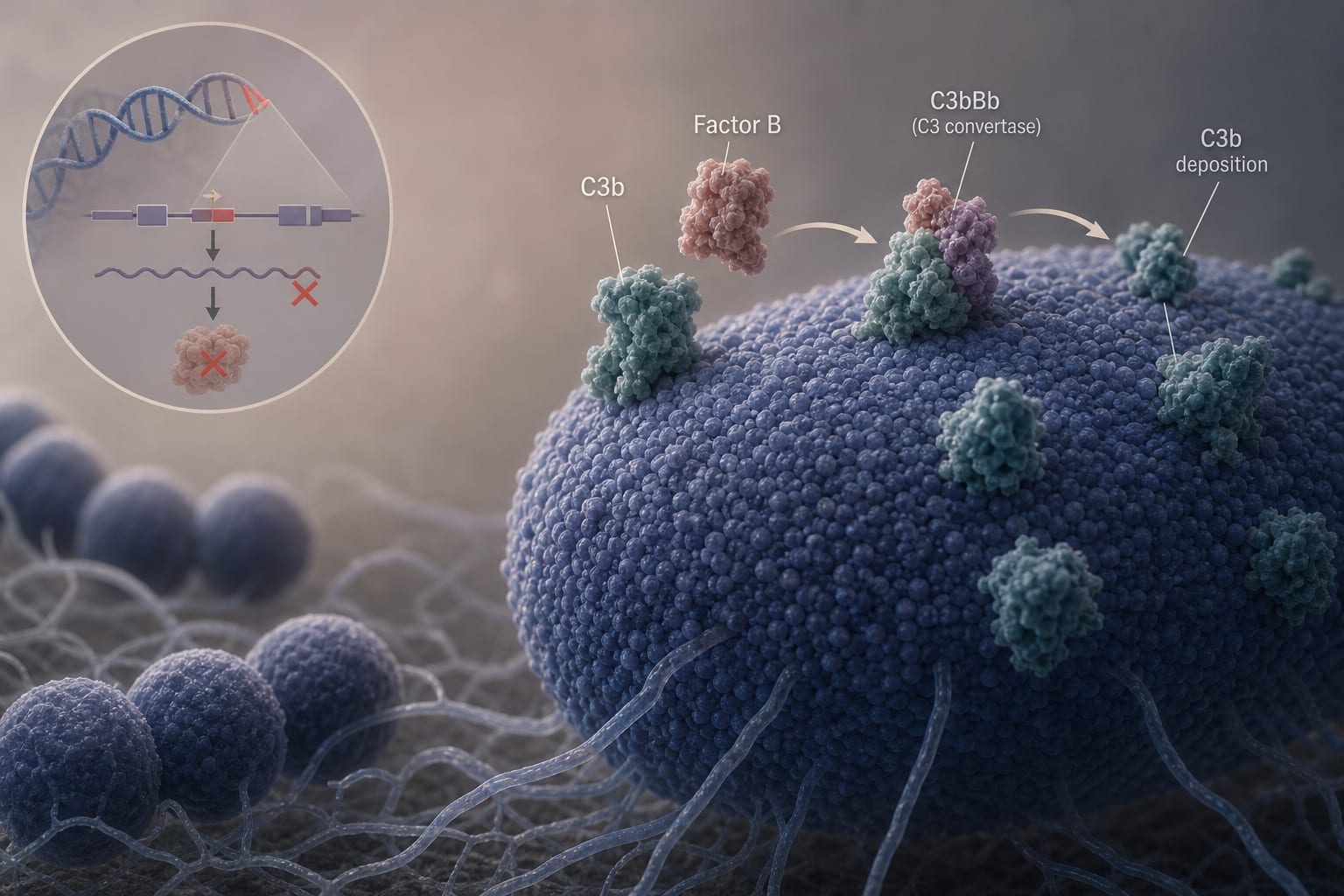
To describe a case of autosomal recessive complement factor B (FB) deficiency and identify associated genetic variants, emphasizing the clinical implications.
Key Findings:
The patient exhibited absent alternative pathway activity with preserved classical and lectin pathway function.
Two CFB variants were identified: c.898-2A>C and c.1168 + 10G>T, both causing aberrant splicing.
Functional assays confirmed that AP activity could be restored with recombinant FB, and the patient's clinical outcomes highlight the importance of these findings.
Interpretation:
This case expands the genetic spectrum of FB deficiency to include non-coding variants and emphasizes the importance of integrating functional assays with genomic analyses for diagnosis, with implications for future research.
Limitations:
The study is based on a single case, limiting generalizability; larger cohort studies are needed.
Long-term outcomes and the full impact of the identified variants on immune function require further investigation.
Conclusion:
The findings highlight the critical role of advanced genomic and immunological analyses in diagnosing rare inborn errors of immunity.
by J. Barbieur, E. D’haenens, T. Jarayseh, L. Hoste, J. Smet, S. Lambrecht, E. Schiettecatte, P. Schelstraete, M. De Bruyne, F. Haerynck, S. J. Tavernier