Harmonization and standardization for selection of high-trueness estradiol assay kits in serum and evaluation of estradiol levels relative to follicle diameters on trigger days - Summary - MDSpire
Advertisement
Harmonization and standardization for selection of high-trueness estradiol assay kits in serum and evaluation of estradiol levels relative to follicle diameters on trigger days
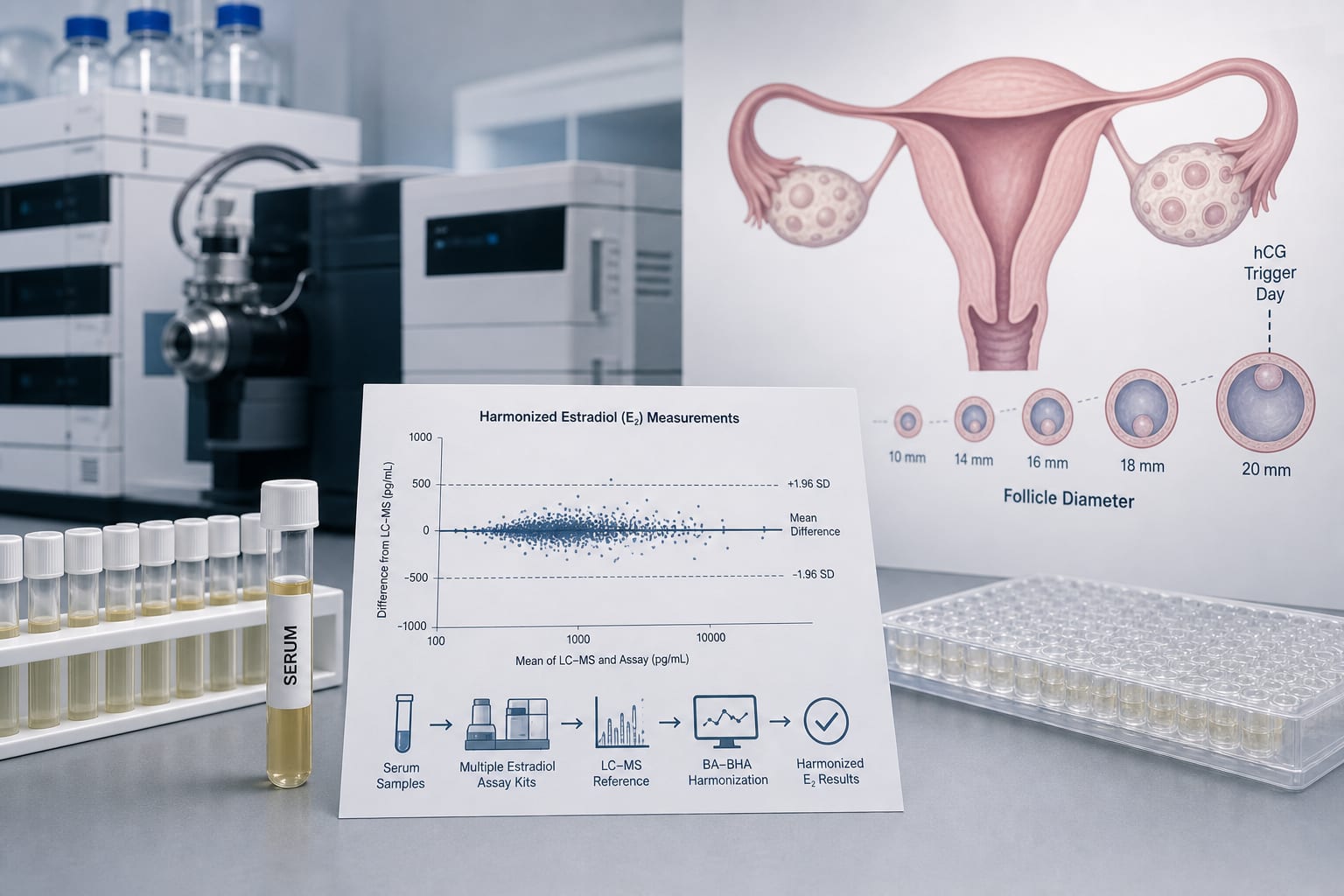
To evaluate estradiol (E2) assay standardization, assess the trueness of harmonized E2 results across platforms, and investigate the relationship between estimated E2 levels and follicle diameters on hCG trigger days.
Approach:
Sample Analysis: Serum samples from 90 individuals were analyzed using assays from four manufacturers and LC-MS as the reference method.
Harmonization Algorithm: A Bland-Altman plot-based harmonization algorithm (BA-BHA) was applied to harmonize E2 results.
Trueness Assessment: Trueness was assessed by mean percent difference and 95% limits of agreement (LoA).
Correlation Analysis: Multiple linear regression was applied to establish the relationship between harmonized E2 levels and follicle diameters.
Key Findings:
Before harmonization, mean percent differences from LC-MS ranged from −2.3% to 17.4%.
LiCA-E2 demonstrated the best performance with a mean percent difference of 0.1% post-harmonization.
A positive correlation was found between estimated E2 levels and follicle diameters, with LiCA showing the strongest correlation (r = 0.8077).
Interpretation:
Harmonization effectively improves E2 assay comparability, with LiCA's superior performance providing a reliable tool for predicting follicle maturation.
Limitations:
The study was limited to a specific population undergoing ART, which may affect generalizability.
The sample size for correlation analysis was limited to 237 serum samples.
Conclusion:
Harmonization of E2 assays enhances comparability and supports clinical decision-making in ART.