Case Study: Demyelination Associated with Tumor Necrosis Factor Inhibitors in Neuro-Behçet Disease
-
By
-
Eloise Norman
-
Gabor Major
-
September 24, 2026
Objective:
To report a case of a patient with Neuro-Behçet disease who developed demyelination after initiation of TNF inhibitors.
Approach:
- Patient Presentation: A 34-year-old woman with recurrent oligoarthritis, mucosal ulcers, and lower limb nodules presented with headaches and facial paresthesia.
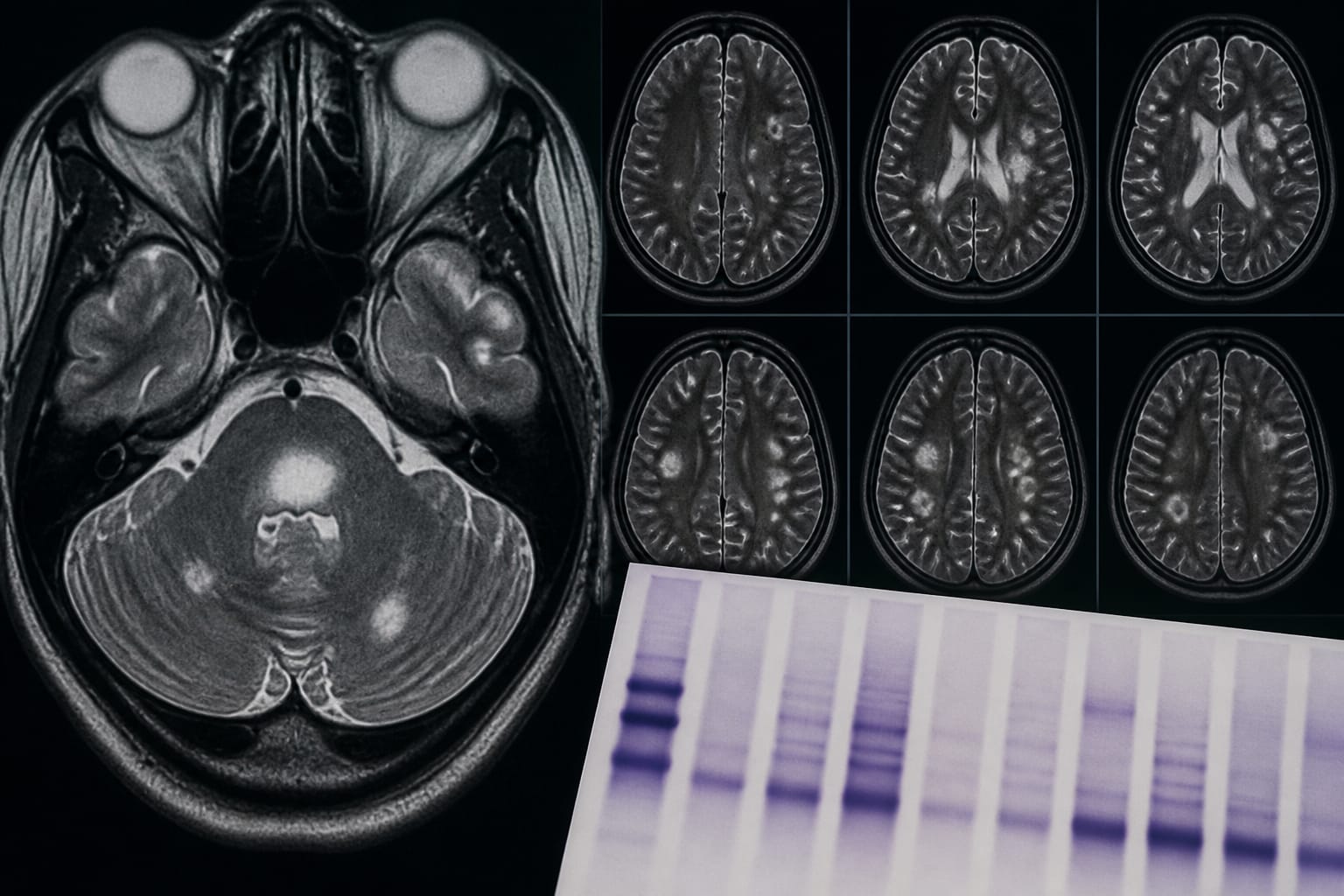
- Diagnostic Imaging: T2-weighted MRI showed hyperintense lesions in the pons, cerebellum, and basal ganglia.
- CSF Analysis: Cerebrospinal fluid analysis revealed pleocytosis, with negative infection testing and oligoclonal-band assessment.
- Diagnosis and Treatment: Neuro-Behçet disease was diagnosed, and adalimumab was initiated.
- Follow-Up: After one year, new paresthesia and MRI changes indicated progression to demyelination.
Key Findings:
- The patient developed new neurological symptoms and MRI changes after starting TNF inhibitors, with a temporal association noted.
- Positive oligoclonal bands were found in repeat CSF testing three years later.
- MRI identified new lesions in white matter, subcortical, periventricular, and spinal cord regions, with negative results for anti-MOG, anti-NMDA receptor, and anti-AQP4 antibodies.
Interpretation:
The emergence of new neurological symptoms and demyelinating MRI lesions after adalimumab treatment raises the possibility of TNF inhibitor-associated demyelination in a patient with Neuro-Behçet disease. However, the temporal association does not establish causality, and distinguishing treatment-associated demyelination from neurological progression or an overlapping demyelinating disorder may be challenging. The later detection of oligoclonal bands and lesions in multiple central nervous system regions supports further evaluation for demyelinating disease.
Limitations:
- The underlying pathophysiology of TNF inhibitor-associated demyelination remains unclear.
- The incidence of TNF inhibitor-associated demyelination is low, complicating generalization.
Conclusion:
New neurological symptoms in patients receiving TNF inhibitors warrant prompt clinical assessment and appropriate investigation, including neurological examination, MRI, and CSF testing when indicated. Clinicians should consider demyelinating disease in the differential diagnosis, while recognizing that a single case cannot establish that TNF inhibitor treatment caused the demyelination.
Sources:
Based on findings from:
Clinical Images: Tumor necrosis factor inhibitor–associated demyelination in a case of neuro-Behçet disease
Eloise Norman, Gabor Major. Acr Open Rheumatology, 2026.
https://acrjournals.onlinelibrary.wiley.com/doi/10.1002/acr2.90159
This content is an AI-generated, fully rewritten summary based on a published scholarly article. It does not reproduce the original text and is not a substitute for the original publication. Readers are encouraged to consult the source for full context, data, and methodology.