Short-term quantitative CT changes in synchronous ground-glass nodules during immune checkpoint inhibitor therapy in patients with lung cancer - Summary - MDSpire
Advertisement
Short-term quantitative CT changes in synchronous ground-glass nodules during immune checkpoint inhibitor therapy in patients with lung cancer
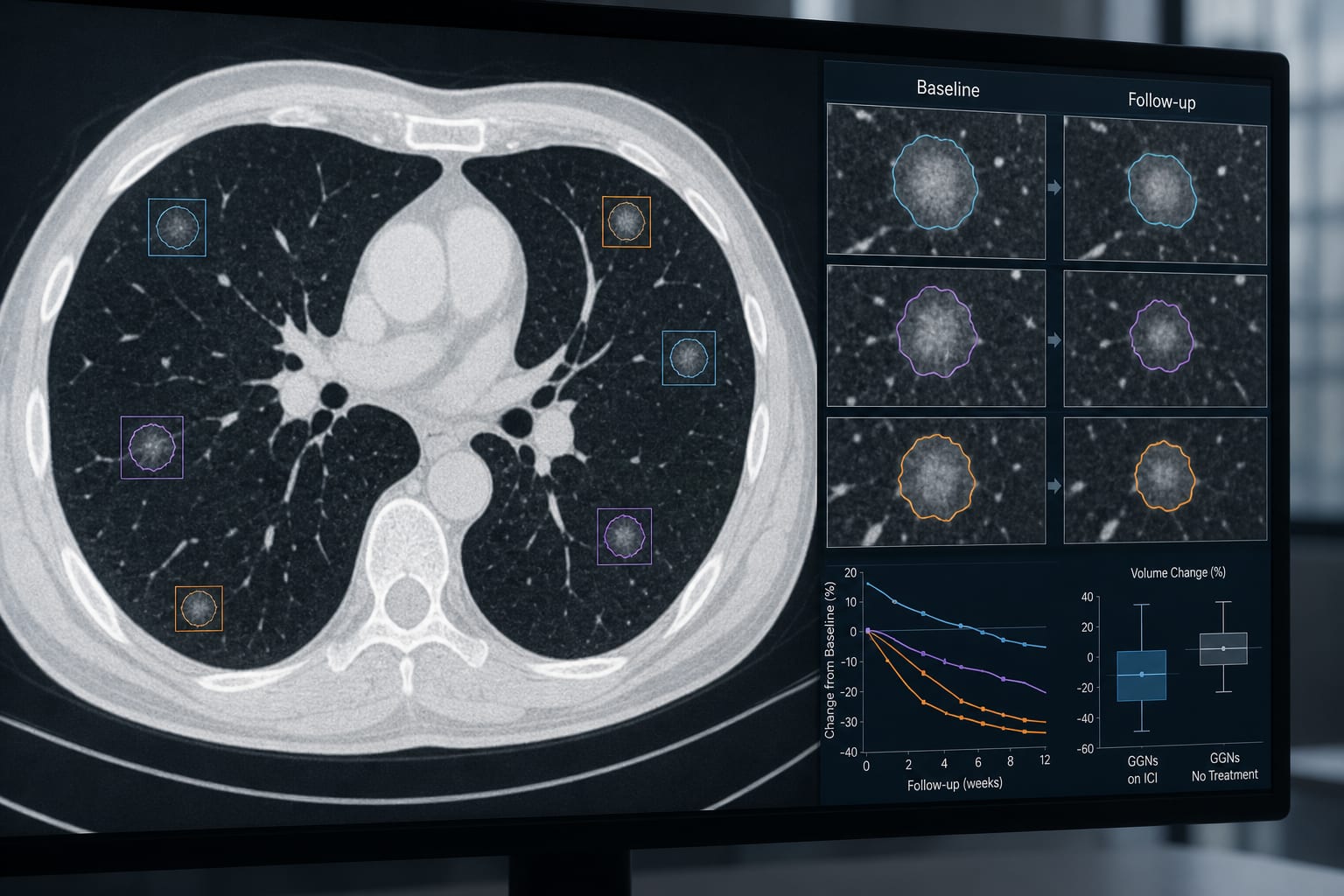
To evaluate short-term longitudinal quantitative CT changes of synchronous ground-glass nodules (GGNs) in lung cancer patients receiving immune checkpoint inhibitor (ICI) therapy.
Approach:
Study Design: Retrospective matched cohort study involving 90 lung cancer patients with 110 synchronous GGNs receiving 3–4 cycles of ICIs, compared to a matched cohort of incidentally detected pulmonary GGNs without therapy, matched for age, sex, and nodule characteristics.
Key Findings:
Nodules in the ICI group showed regression more frequently than those in the control group (23.6% vs. 1.8%, p< 0.001), based on volume change proportion (VCP).
Improvement in Lung-RADS category was more common in the ICI group (8.2% vs 1.8%; p = 0.018).
Nodules in the ICI group had significantly lower monthly increases in diameter, volume, surface area, and mass compared to controls.
Part-solid nodules (PSNs) showed larger volume reduction than pure GGNs.
Interpretation:
Synchronous GGNs in lung cancer patients receiving ICIs exhibited attenuated longitudinal CT growth patterns, with favorable shifts in VCP and Lung-RADS categories.
Limitations:
Retrospective design may introduce selection bias.
Limited to patients receiving ICI therapy, findings may not generalize to other treatments.
Conclusion:
Synchronous GGNs in lung cancer patients receiving ICIs showed reduced growth patterns and improved imaging characteristics, particularly in PSNs.
Each year, the American Society of Clinical Oncology Annual Meeting brings together cancer specialists from around the world to share the research most likely to shape the next chapter of cancer care. This year’s major updates point to several important themes: more precise treatment, smarter use of surgery and chemotherapy, new approaches for difficult-to-treat cancers and a growing recognition that supportive care, including exercise, can be part of cancer treatment planning.