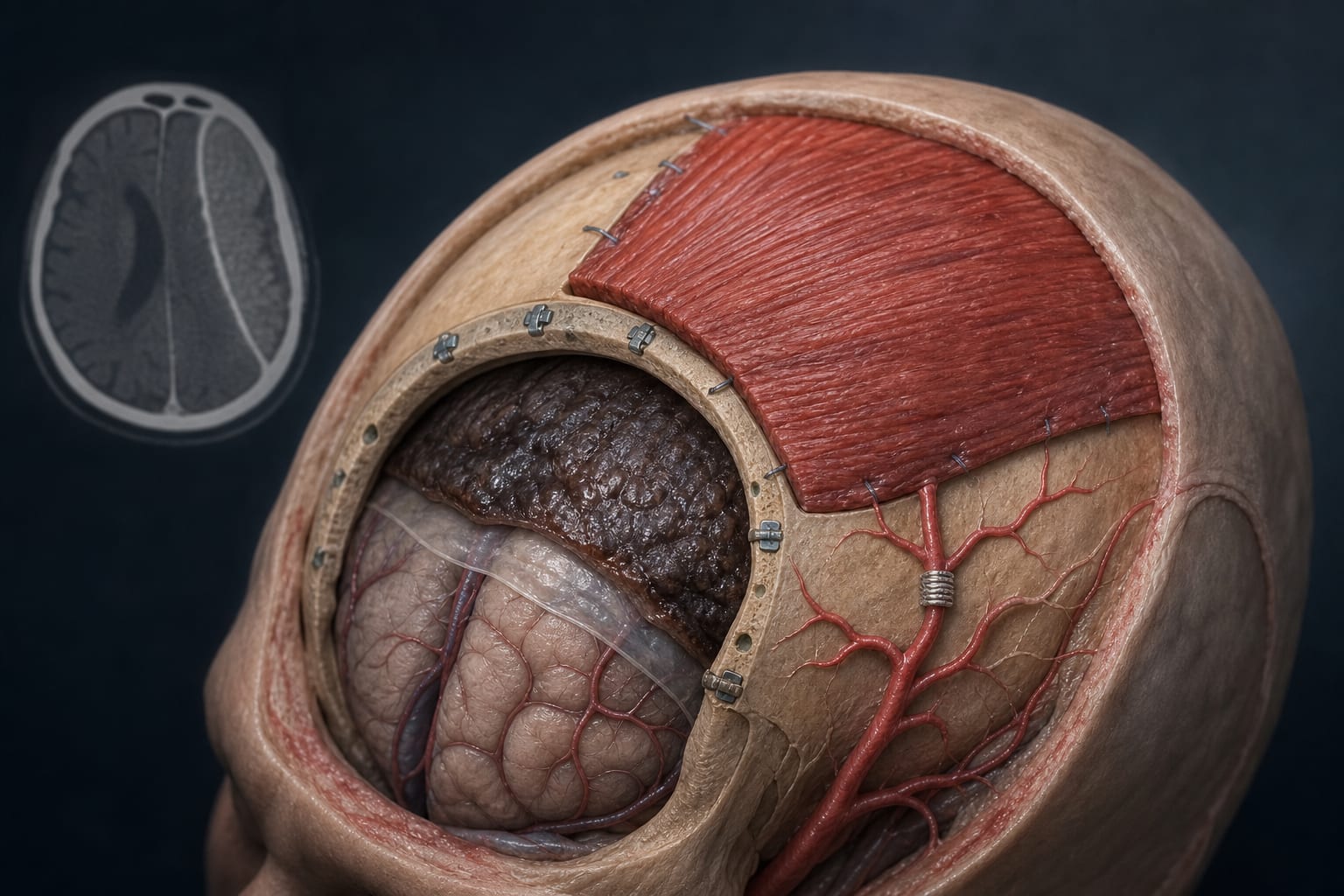
To preliminarily evaluate the safety, neurological improvement, and recurrence control of craniotomy for hematoma evacuation combined with middle meningeal artery occlusion and temporalis muscle grafting in the treatment of recurrent organized CSDH.
Approach:
Assessment Methods: Neurological function was assessed using the Glasgow Coma Scale (GCS), modified Rankin Scale (mRS), Markwalder grading system, and Glasgow Outcome Scale (GOS). Postoperative complications and recurrence were monitored during follow-up.
Key Findings:
Complete hematoma evacuation was achieved in all patients.
Improvement in neurological function postoperatively as indicated by GCS, mRS, Markwalder grade, and GOS scores.
Postoperative complications occurred in 5 patients (29.41%), resolving with conservative management.
No recurrence was observed according to the 90-day postoperative criteria.
Interpretation:
The modified craniotomy technique appears feasible and reasonably safe for highly selected patients with recurrent organized CSDH, with encouraging short-term neurological improvement.
Limitations:
Small sample size and single-center study.
Uncontrolled retrospective case series.
Results should be interpreted as preliminary safety and feasibility data.
Conclusion:
Further large-scale controlled studies are warranted to validate clinical utility.
Acidic gum beat sugar-free at cranking out nitric oxide from beetroot juice — exactly backward from what test-tube studies predicted. Also this week: a sleep gene that ignores amyloid, and jackfruit sap moonlighting as a bone-building drug delivery system.