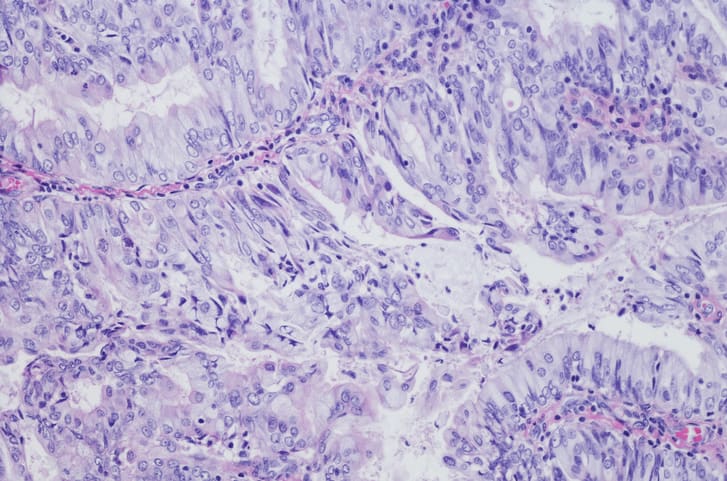
To evaluate the effectiveness of ataxia telangiectasia–mutated immunohistochemistry (ATM IHC) in identifying endometrial carcinomas with polymerase-epsilon (POLE) variants, which are significant for patient prognosis and treatment.
Approach:
Key Findings:
ATM IHC achieved 97% specificity and 80% accuracy for detecting POLE variants, indicating its potential as a reliable screening tool.
96% of POLE variant cases exhibited nondiffuse ATM staining patterns, suggesting a distinct biomarker profile.
Tumors with POLE variants had a median of 158.6 mutations per Mb, indicating a higher tumor mutational burden (TMB) that may influence treatment decisions.
ATM alterations were found in 82% of POLE-mutated endometrial cancers, with truncating variants correlating with loss of ATM protein expression, highlighting a potential therapeutic target.
Interpretation:
ATM IHC is a promising screening tool for identifying patients with POLE variants, particularly in those without mismatch repair deficiency or p53 abnormalities, which could guide personalized treatment strategies.
Limitations:
Single-center design may limit generalizability, suggesting the need for multi-center studies.
Modest sample size may affect the robustness of the findings.
Inclusion of only endometrioid histology limits applicability to other endometrial cancer types.
Conclusion:
ATM IHC provides a cost-effective method to identify patients who may benefit from further molecular testing, underscoring the need for additional research to validate these findings.
A structured framework of diagnostic classifications, reporting frameworks, staging systems, coding resources, and molecular pathology tools used in practice.