Clinical features and treatment challenges of HER2-positive primary breast squamous cell carcinoma: a case report and literature review - Summary - MDSpire
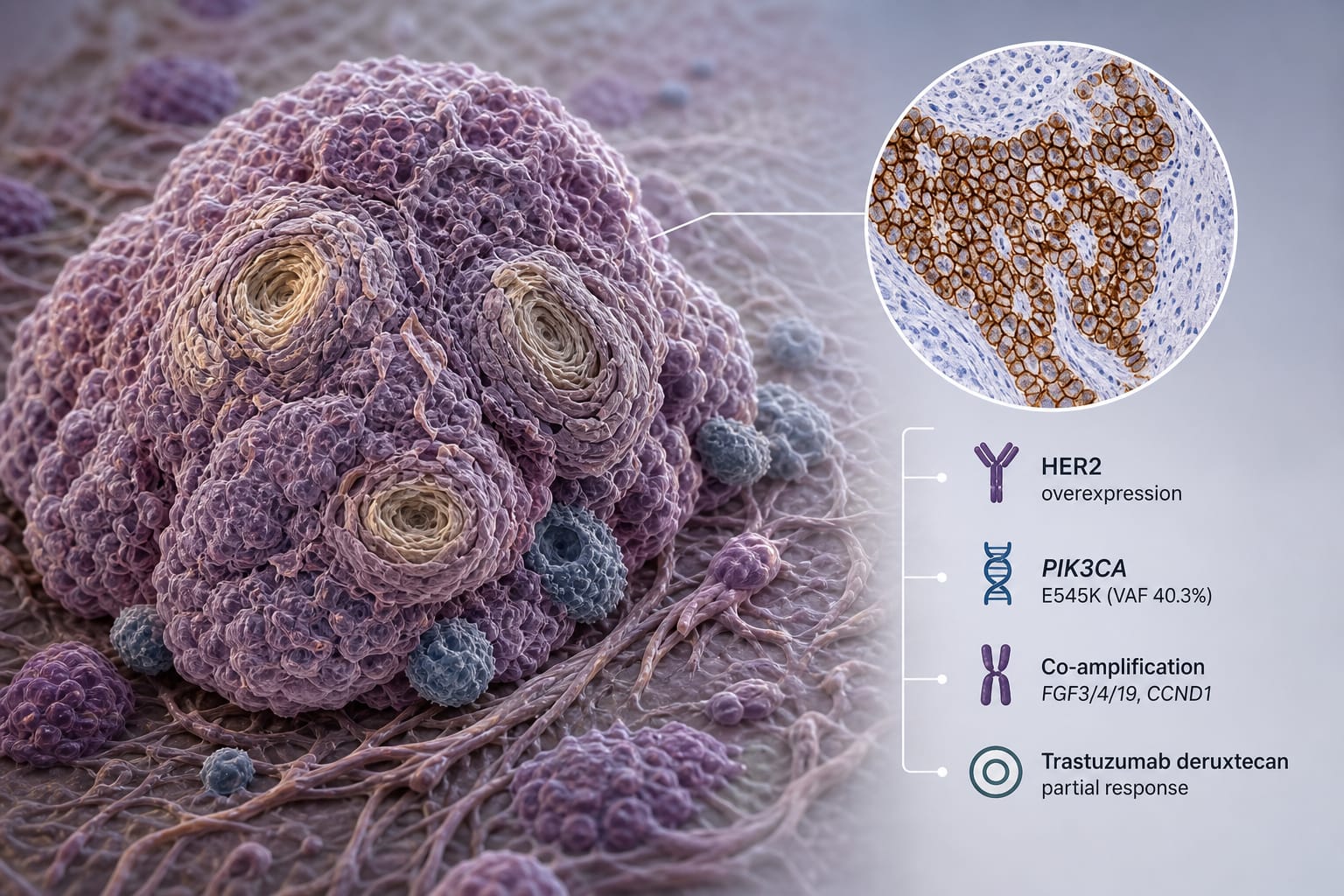
To illuminate the clinical decision-making challenges posed by HER2-positive primary breast squamous cell carcinoma (PBSCC) and provide insights into managing therapeutic resistance based on a case study.
Approach:
Case Report: A comprehensive longitudinal analysis of a 43-year-old woman with HER2-positive PBSCC, tracing the molecular evolution of the disease across multiple lines of therapy.
Literature Review: Review of existing literature on HER2-positive PBSCC to highlight treatment challenges and outcomes.
Key Findings:
HER2-positive PBSCC is extremely rare, with fewer than 100 cases reported globally.
The pathological complete response rate to standard HER2-targeted therapy in HER2-positive PBSCC is only 12.5%, based on the largest available case series.
The patient exhibited a Miller-Payne grade 2 response to neoadjuvant TCHP therapy and experienced local recurrence shortly after mastectomy.
Molecular profiling revealed a PIK3CA E545K mutation and HER2 downregulation as mechanisms of resistance.
Interpretation:
The case highlights the necessity for a shift towards molecularly-guided precision therapy following the failure of HER2-targeted treatments, particularly in cases of HER2 antigen loss.
Limitations:
The rarity of HER2-positive PBSCC limits the availability of standardized treatment guidelines and clinical trial enrollment.
Clinical experience is primarily based on isolated case reports, resulting in a lack of robust data to inform treatment decisions.
Conclusion:
Following the failure of HER2-targeted therapy with HER2 antigen loss, treatment strategies should prioritize targeting identified molecular alterations.
he U.S. Food and Drug Administration (FDA) has approved daraxonrasib, an oral multi-selective RAS(ON) inhibitor, for adults with metastatic pancreatic adenocarcinoma who have received at least one prior systemic therapy or are not candidates for multiagent systemic therapy.