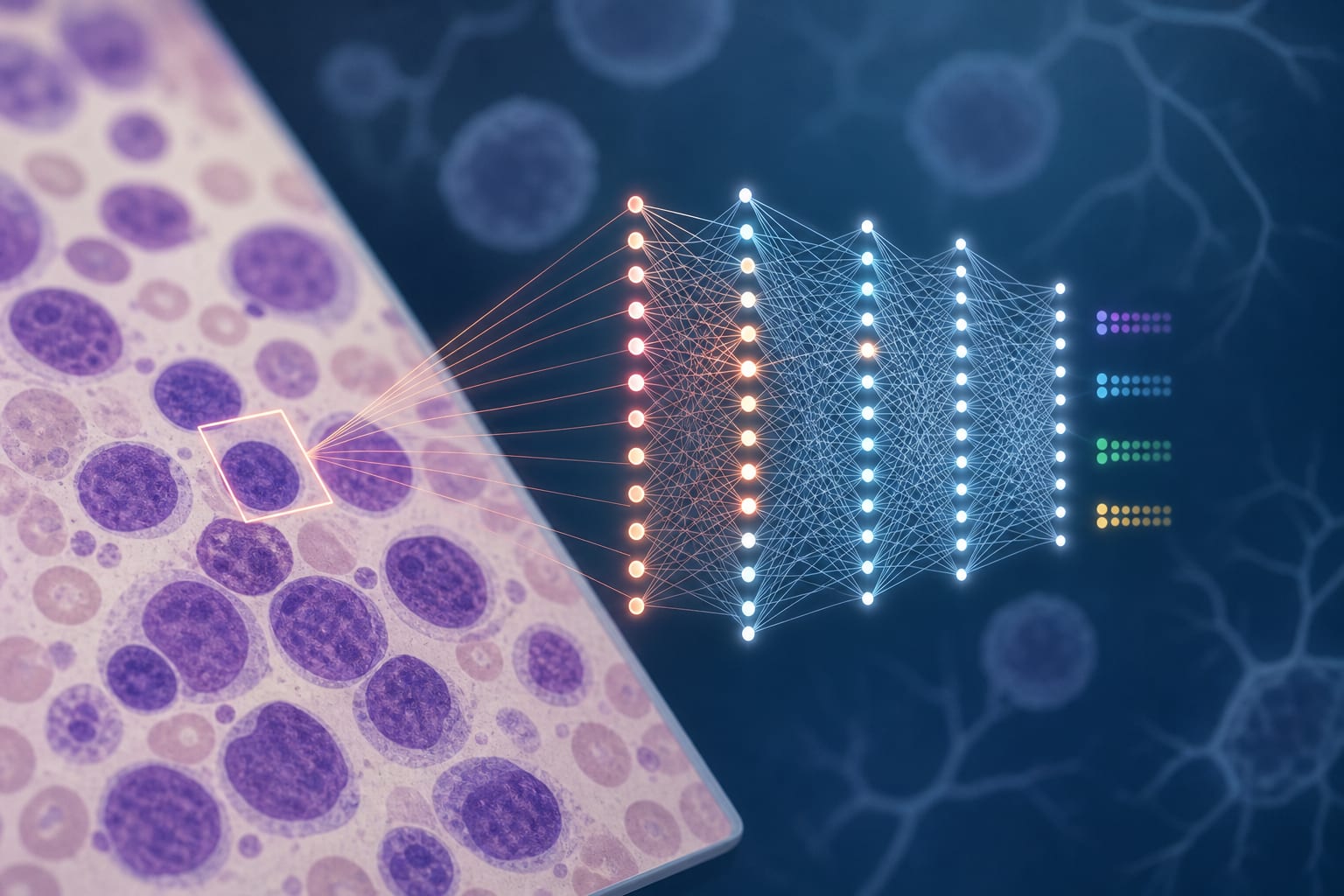
To propose NeurALLNet, a memory-efficient convolutional spiking neural network for the multi-class classification of Acute Lymphoblastic Leukemia (ALL) subtypes, addressing the urgent need for reliable diagnostic tools.
Approach:
NeurALLNet Architecture: A refined, memory-efficient convolutional spiking neural network architecture utilizing approximately 0.3M trainable parameters and a minimal footprint of 1.35 MB.
Squeeze-and-Excitation Attention: Integration of a Squeeze-and-Excitation (SE) attention mechanism to enable adaptive channel-wise recalibration across temporal spike steps.
Robustness Analysis: Comprehensive evaluation of model resilience under various noise and distortion conditions.
Clinical Validation: Validation of the model’s generalizability on an external dataset of 3,242 images with bootstrapped 95% Confidence Intervals.
Key Findings:
NeurALLNet achieves real-time inference latencies on both CPU and GPU hardware.
The removal of the SE attention mechanism resulted in a greater than 30% accuracy drop.
The model demonstrated robustness against Gaussian noise, salt-and-pepper noise, Gaussian blur, random occlusion, rotation, and illumination variation.
Interpretation:
NeurALLNet addresses the computational limitations of traditional CNNs while maintaining high classification accuracy for ALL subtypes.
Limitations:
The study does not address the performance of NeurALLNet in clinical practice outside of the evaluated datasets.
Potential biases in the external dataset used for validation are not discussed.
Conclusion:
NeurALLNet represents a significant advancement in the automated classification of ALL, combining efficiency and accuracy.