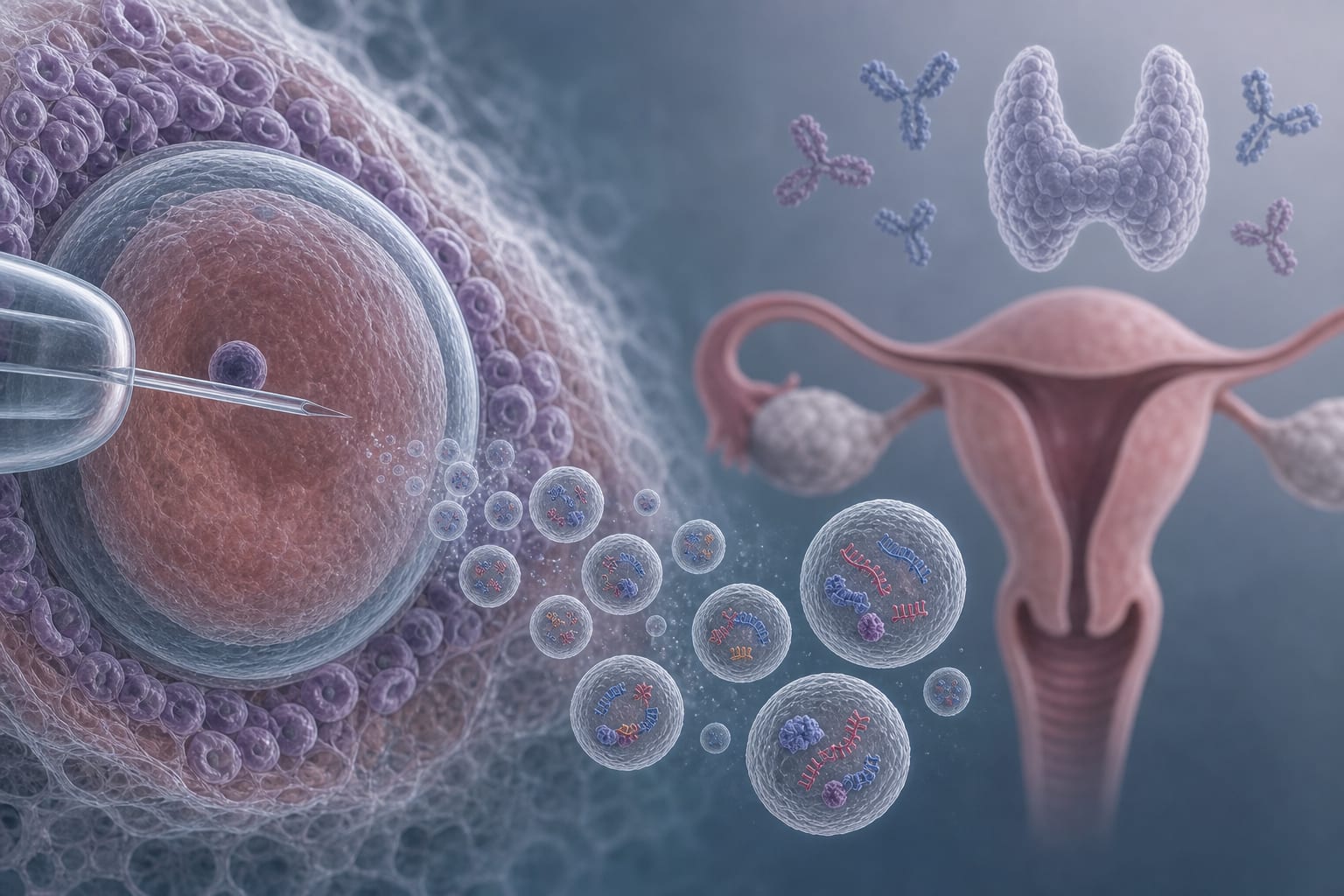
Thyroid autoimmunity is associated with fertilization impairment and follicular fluid exosomal miRNA alterations in euthyroid women undergoing IVF-ET - Summary - MDSpire
Advertisement
Thyroid autoimmunity is associated with fertilization impairment and follicular fluid exosomal miRNA alterations in euthyroid women undergoing IVF-ET
To investigate the impact of thyroid autoimmunity (TAI) on fertilization outcomes in euthyroid infertile women undergoing in vitro fertilization–embryo transfer (IVF-ET), and to identify key follicular fluid exosomal miRNAs associated with TAI.
Approach:
Study Design: Retrospective analysis of 4,332 infertile women aged 20–40 years undergoing IVF-ET.
TAI Definition: TAI defined as TPOAb >34 IU/mL and/or TgAb >115 IU/mL.
Statistical Analysis: Fertilization rates compared using Wilcoxon rank-sum test; generalized linear models assessed TAI's association with outcomes.
miRNA Sequencing: Follicular fluid samples from 10 TAI-positive and 10 TAI-negative women analyzed for exosomal miRNA sequencing.
miRNA Identification: Differential expression analysis and machine learning techniques (LASSO, SVM) used to identify key miRNAs.
Key Findings:
Among the 4,332 infertile women, 565 were TAI-positive and 3,767 were TAI-negative. TAI-positive women had significantly lower fertilization rates compared to TAI-negative women (p 0.7).
Interpretation:
The study found that TAI is associated with impaired fertilization outcomes in euthyroid infertile women undergoing IVF-ET, linked to altered exosomal miRNA profiles in follicular fluid.
Limitations:
Retrospective design may introduce selection bias.
Study conducted at a single center, limiting generalizability.
Conclusion:
The study indicates that TAI is associated with impaired fertilization outcomes and altered miRNA expression in follicular fluid.