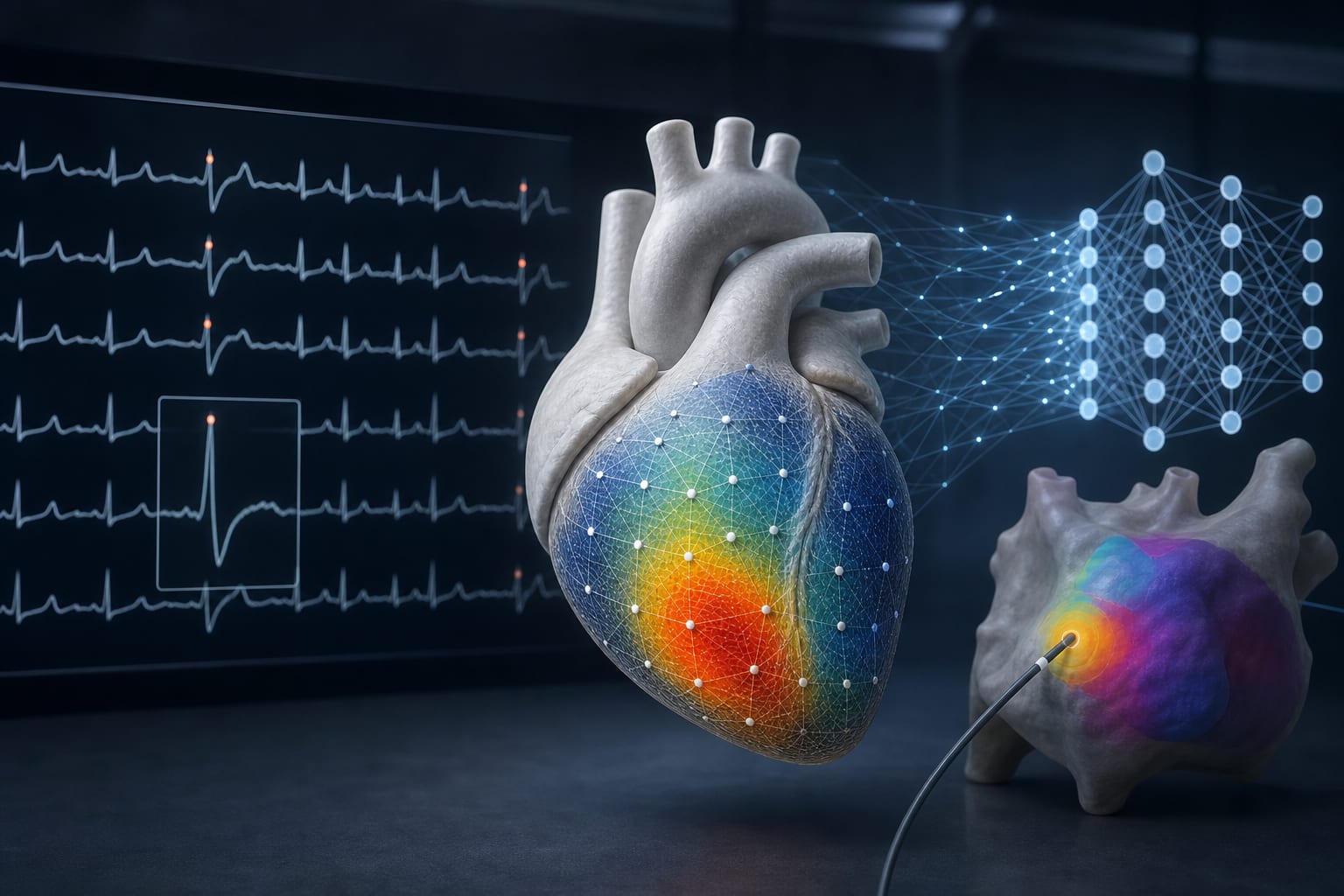
To review the application of artificial intelligence (AI) in localizing the origins of premature ventricular contractions (PVCs) based on 12-lead ECG data.
Approach:
AI in PVC Localization: The review discusses the evolution of ECG-based PVC localization criteria and summarizes recent advances in AI algorithm models for identifying PVC origins.
Key Findings:
AI-based approaches improve the efficiency and accuracy of PVC origin identification by extracting high-dimensional features from ECG data and enabling automated classification of different origin sites.
Traditional ECG-based analysis methods are subjective and inefficient, which can hinder clinical precision treatment.
Machine learning (ML) and deep learning (DL) can automatically extract discriminative features from large-scale ECG datasets, enhancing the identification process.
Interpretation:
AI methods enhance the accuracy and efficiency of PVC origin localization, providing a systematic framework for analyzing complex ECG data.
Limitations:
Traditional ECG localization methods are time-consuming and have limited coverage of anatomical variations.
Manual algorithms may not account for all anatomical and physiological variations affecting predictive performance.
Conclusion:
This review provides a theoretical foundation and practical guidance for the clinical translation of AI-based PVC origin localization.