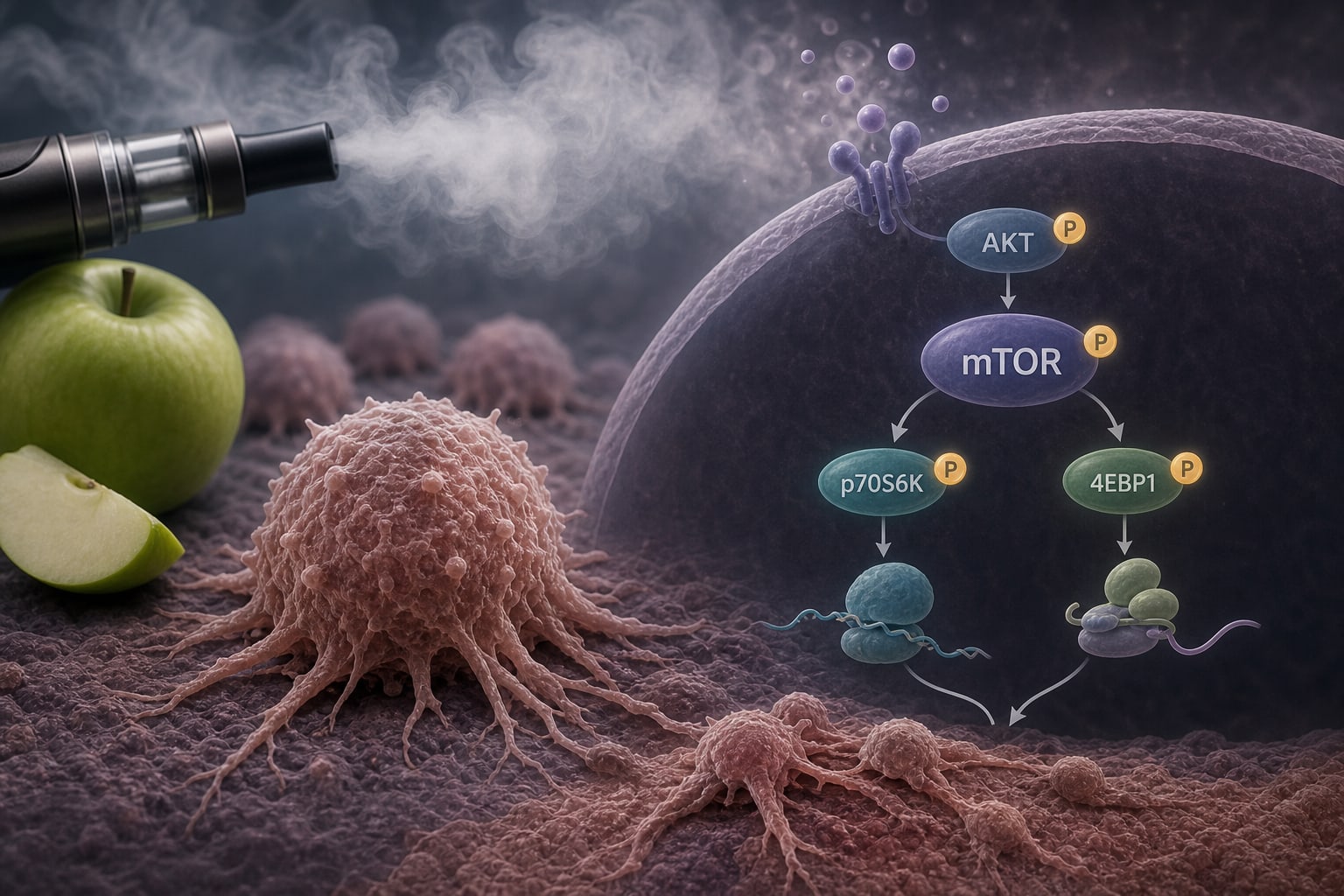
To investigate the effects of Sweet Apple e-cigarette vapor extract, with and without nicotine, on mTOR pathway activation in OSCC cell lines Ca9–22 and Cal 27.
Approach:
Cell Exposure: Cells were exposed for 6 hours to 10% Apple EVE with or without nicotine (6 mg), with untreated cells as controls.
Assessment Methods: Phosphorylation levels of mTOR pathway components were assessed by Western blot and quantified by densitometry normalized to β-actin. Cell invasion was evaluated using a Matrigel-coated real-time xCELLigence assay.
Data Analysis: Data were analyzed using the Mann–Whitney U test (p < 0.05).
Key Findings:
Nicotine-containing Apple EVE significantly increased p-mTOR in both Ca9–22 and Cal 27 cell lines.
In Ca9–22 cells, nicotine-containing Apple EVE decreased p-p70S6K and p-4EBP1.
In Cal 27 cells, nicotine-containing Apple EVE increased p-AKT.
Apple EVE without nicotine induced more modest and variable effects across both cell lines.
No significant changes in cell invasion were observed in either cell line.
Interpretation:
Apple EVE, particularly when combined with nicotine, modulates mTOR signaling in a cell line-specific manner in OSCC cells.
Limitations:
Nicotine quantification in the vapor extract was not analytically measured.
The exposure is defined by the puff protocol and media volume without independent setting of device output power.
Conclusion:
These findings demonstrate the effects of flavored e-cigarette aerosols on cancer-related pathways.