To systematically characterize vascular features that influence AI-based endovascular navigation difficulty during mechanical thrombectomy (MT).
Approach:
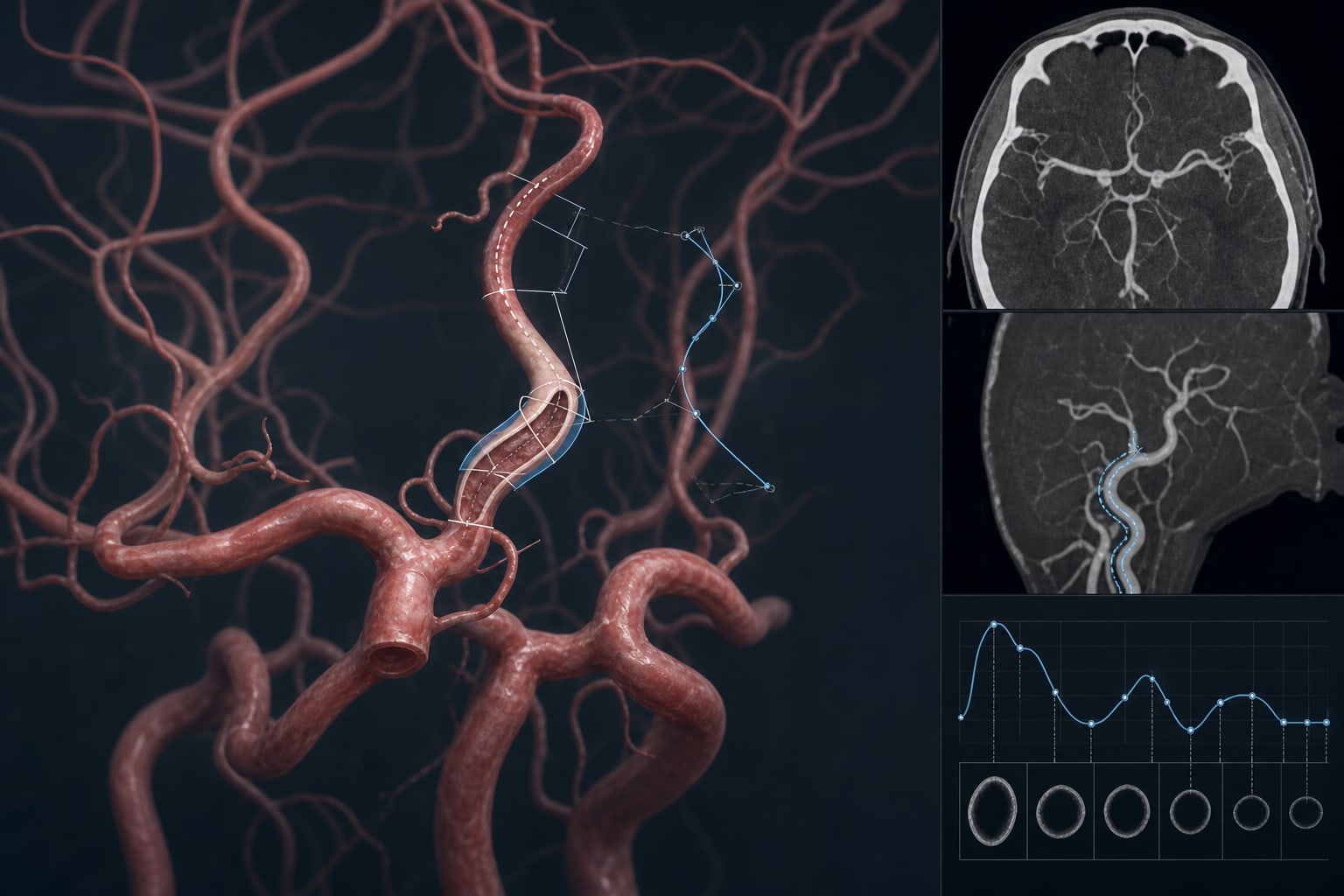
Vasculature Segmentation: Patient vasculature was segmented from CTA scans using 3D Slicer and the Vascular Modeling Toolkit.
Metric Extraction: An automated pipeline was developed to quantify vascular morphological and geometrical metrics from CTA-derived centerlines.
Simulation of Navigation: Autonomous endovascular navigation was simulated using Soft Actor-Critic reinforcement learning agents.
Statistical Analysis: Mixed linear regression models were employed to analyze associations between vascular features and navigation performance outcomes.
Key Findings:
The study introduces a pipeline for extracting reproducible vascular features from CTA-derived centerlines.
Eight vascular metrics were identified as significant for predicting navigation performance, including tortuosity and vessel radii.
The analysis was conducted on a dataset of 61 CTA-derived real patient vasculatures used for autonomous endovascular navigation.
Interpretation:
Limitations:
Current open-source benchmarks rely on simplified vessel geometries, limiting the applicability of findings.
Publicly available datasets incorporating real patient vasculatures are scarce, hindering research progress.
Limited evidence exists regarding specific vascular features associated with navigation difficulty, complicating model training.
Conclusion:
The establishment of an automated and standardized vascular geometry quantification pipeline is essential for advancing RL-assisted MT research.
Federal prosecutors allege that a Florida physician and research staff fabricated clinical trial records that were submitted into database systems used to evaluate investigational drugs.
New findings from CREST-2 are providing important evidence on the role of carotid artery stenting (CAS) in patients with severe asymptomatic carotid stenosis — while underscoring the importance of operator experience, patient selection and procedural technique in achieving favorable outcomes.