Evaluation of the Learning Curve Associated with Neuroendoscopic Evacuation for Basal Ganglia Hemorrhage
By
Xuqiang Wang
Fei Gao
Qiang Zhu
Yunfeng Jia
Ganggang She
June 23, 2026
Objective: To evaluate the learning curve of neuroendoscopic evacuation for basal ganglia hemorrhage and to determine the number of cases required to achieve technical proficiency.
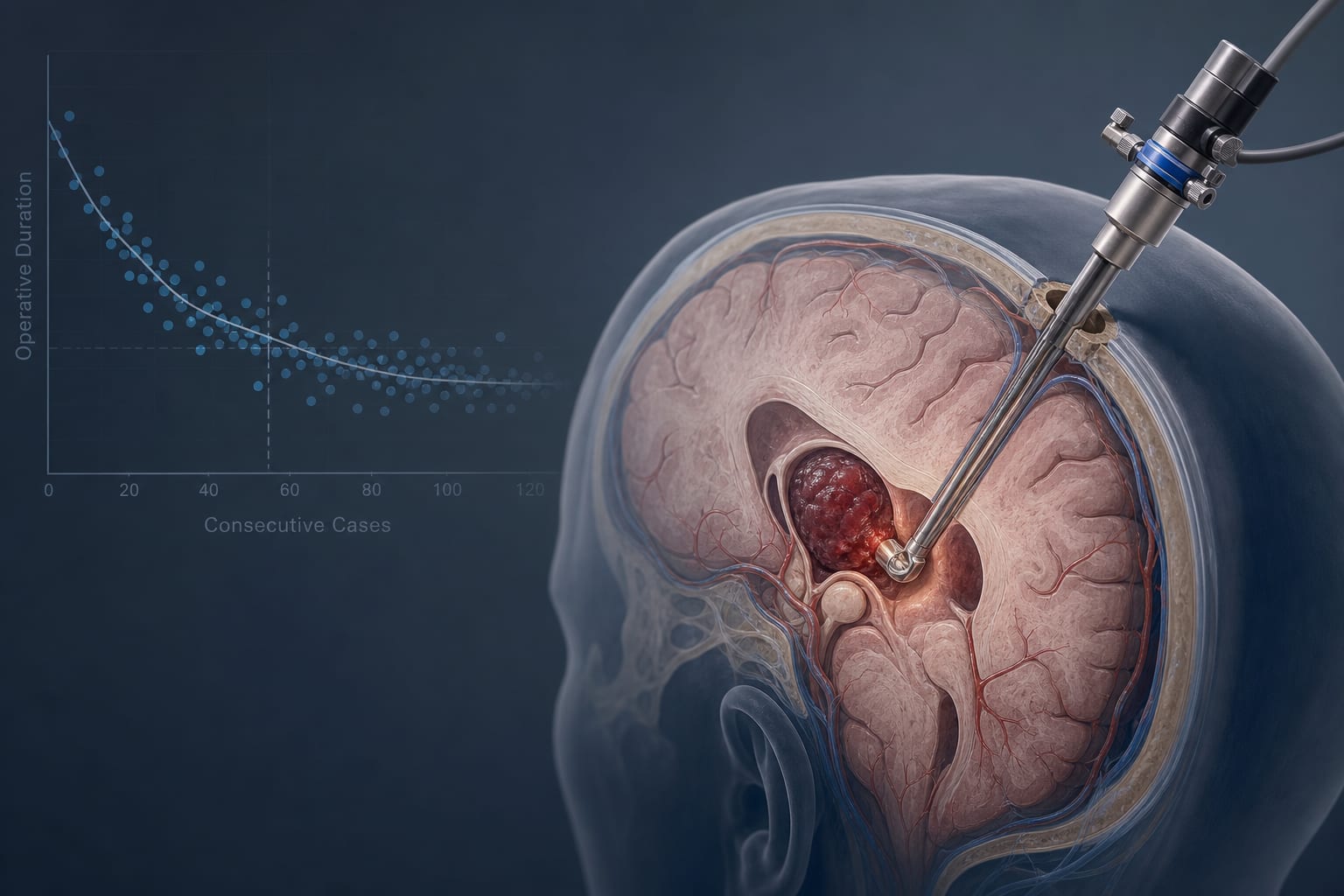
Approach: Key Findings: CUSUManalysisidentifiedalearninginflectionpointatapproximatelythe25thcase.Operativetimedecreasedsignificantlyacrossphases(1.77±0.47hvs.1.28±0.40hvs.1.23±0.42h,P<0.01).Hematomaevacuationrateincreasedsignificantly(84.90%±3.59%vs.93.27%±3.65%vs.92.92%±3.41%,P<0.01).Mostsurgicalperformanceindicatorsimprovedsignificantlybetweentheinitialandproficiencyphases,withnosignificantdifferencesobservedbetweenthelaterphases,indicatingperformancestabilization.Additionally,theuseofelectrocoagulationandhemostaticmaterialsdecreasedsignificantly,accompaniedbyimprovementsinpostoperativeimagingindicatorsandareductioninoverallcomplicationrates(P=0.005). Interpretation: Significant differences exist in neuroendoscopic evacuation of basal ganglia hematomas across different learning phases.
Limitations: The study is limited to a single center and a single experienced surgeon, which may affect generalizability. The retrospective nature of the study may introduce biases. Conclusion: These findings can provide guiding value for clinicians to improve surgical efficiency and quality.