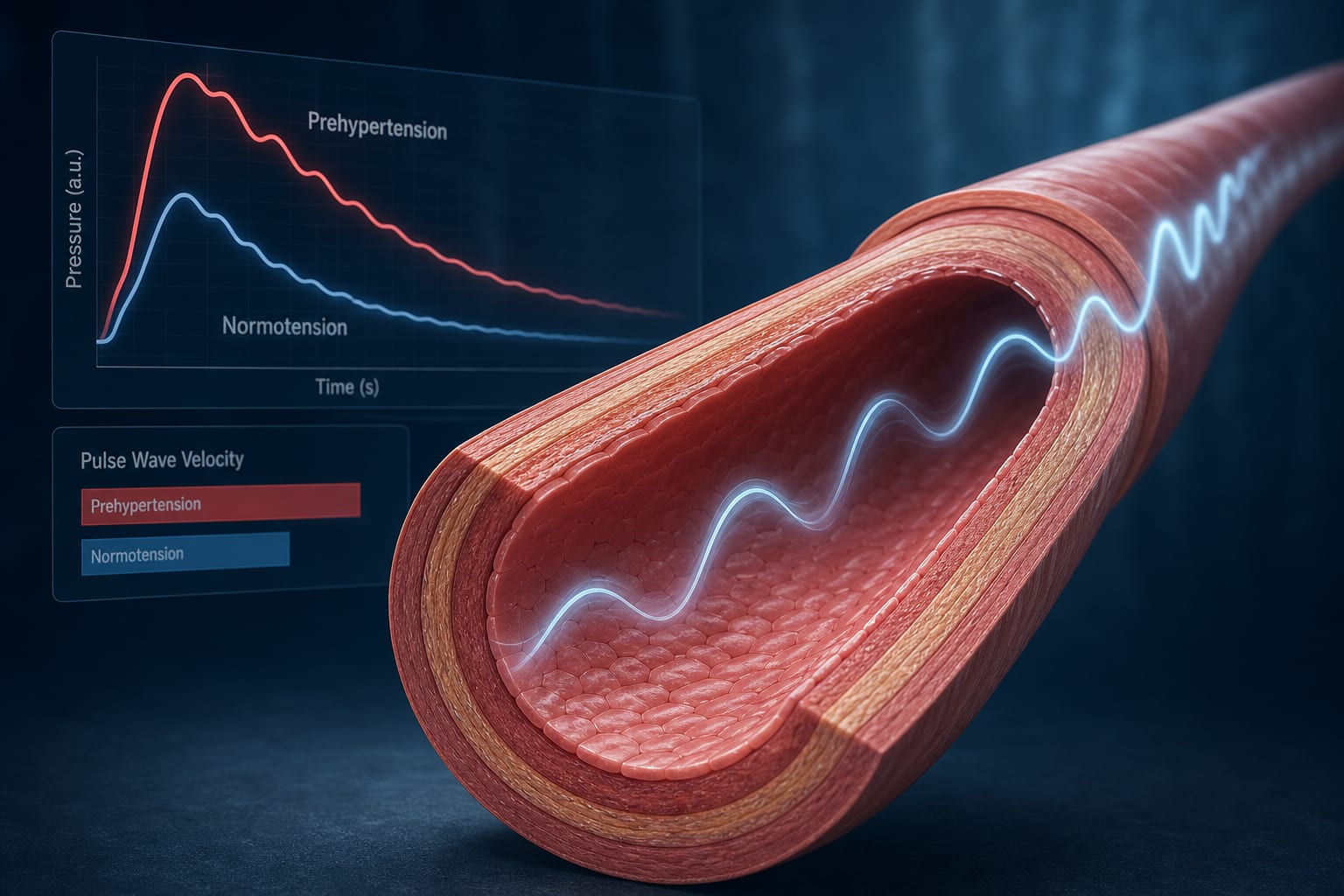
To investigate early vascular alterations in young, physically active adults with prehypertension and assess their impact on exercise intensity recommendations.
Approach:
Participants: 51 recreationally active young adults (age, 24.5 ± 2.6 years) categorized as normotensive (n = 26) or prehypertensive (n = 25).
Methods: Central and peripheral hemodynamics were assessed using oscillometric pulse wave analysis and pulse wave velocity. A maximal cardiopulmonary exercise test was performed to determine maximal oxygen uptake and ventilatory thresholds.
Evaluation of Exercise Intensity: Fixed relative intensity anchors based on percentage of maximal heart rate, heart rate reserve, and maximal oxygen uptake were evaluated for their accuracy in estimating exercise-intensity domains.
Key Findings:
Prehypertensive participants exhibited higher aortic pulse pressure and carotid–femoral pulse wave velocity (both p < 0.001).
Aerobic capacity and ventilatory thresholds were comparable between normotensive and prehypertensive groups (p > 0.05).
Fixed relative intensity anchors showed limited accuracy in approximating exercise-intensity domains, especially at the first ventilatory threshold (VT1).
Population-derived % anchors had the lowest estimation error at VT1, while %HRmax anchors showed the best agreement at VT2.
Interpretation:
Prehypertension in young adults is linked to early central vascular changes without affecting aerobic capacity, indicating a need for individualized exercise prescription methods.
Limitations:
The study's sample size was relatively small, which may limit the generalizability of the findings.
The findings may not be applicable to all young adults or those with varying levels of physical activity.
Conclusion:
Prehypertension is associated with early vascular alterations in young adults, and commonly used exercise intensity anchors may not accurately reflect physiological exercise-intensity domains.
Narrative review describes how physiologic stressors accumulate from induction through postintubation care and may contribute to cardiovascular deterioration during airway management.