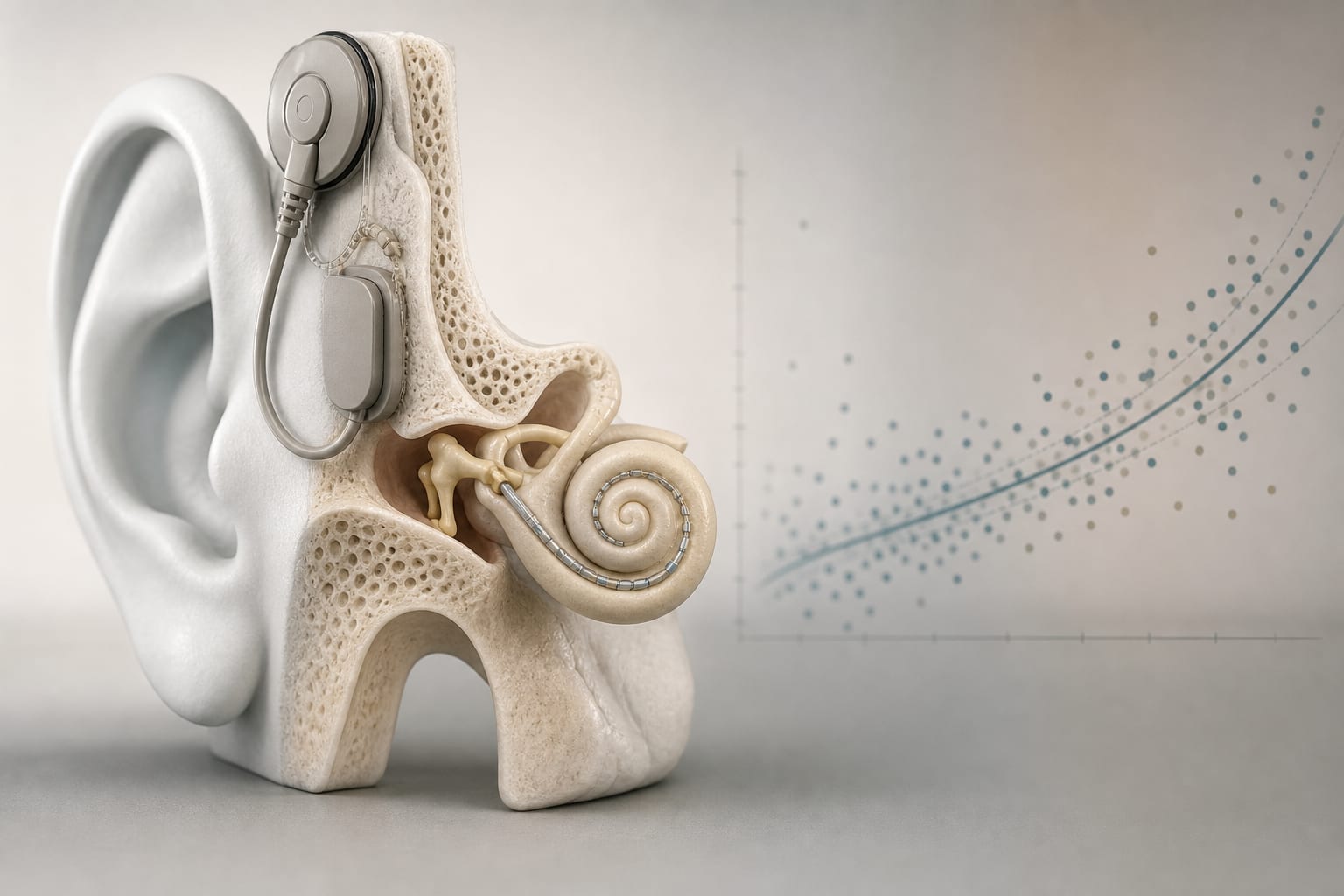
To develop a predictive model for preoperative estimation of cochlear implant (CI) operative duration by identifying independent clinical and procedural factors that significantly influence surgical time.
Approach:
Study Design: Single-centre retrospective observational study conducted at King Abdullah Ear Specialist Center (KAESC).
Participants: 216 cochlear implant patients enrolled between 2019 and 2025.
Data Analysis: Statistical analysis using SPSS version 26 and R version 4.2.2, employing univariate and multivariate generalized linear models.
Key Findings:
Surgical time was longer in females (180 vs. 150 min, p = 0.015) and in bilateral (190 min, p < 0.00001) and primary/revision cases (240 min, p = 0.003).
The round window approach (p = 0.036) and sealing the insertion route (p = 0.025) were associated with shorter surgical times.
In multivariate analysis, male gender reduced time by 16.6 min (p = 0.0464), unilateral implantation reduced time by 62 min (p < 0.00001), and the round window technique reduced time by 28.5 min (p = 0.0445).
Older age increased time by 0.13 min (p = 0.0034), and a Consultant/Fellow/Resident team added 43 min (p = 0.0090).
Interpretation:
The predictive model developed may assist in improving operating room management and customizing care plans in various CI practice environments.
Limitations:
The sample size of 216 patients was lower than the recommended target of approximately 300 due to pandemic-related surgical volume reductions, which may affect the robustness of the findings.
The study was conducted at a single center, which may limit generalizability.
Conclusion:
The model offers a simple, internally validated, and consistent alternative to complex machine-learning approaches.
A cross-sectional metagenomic study found greater oral microbiome richness among adults with chronic rhinosinusitis, particularly nonallergic chronic rhinosinusitis, while associations with asthma, airway inflammation, and most lung-function measures were inconsistent.