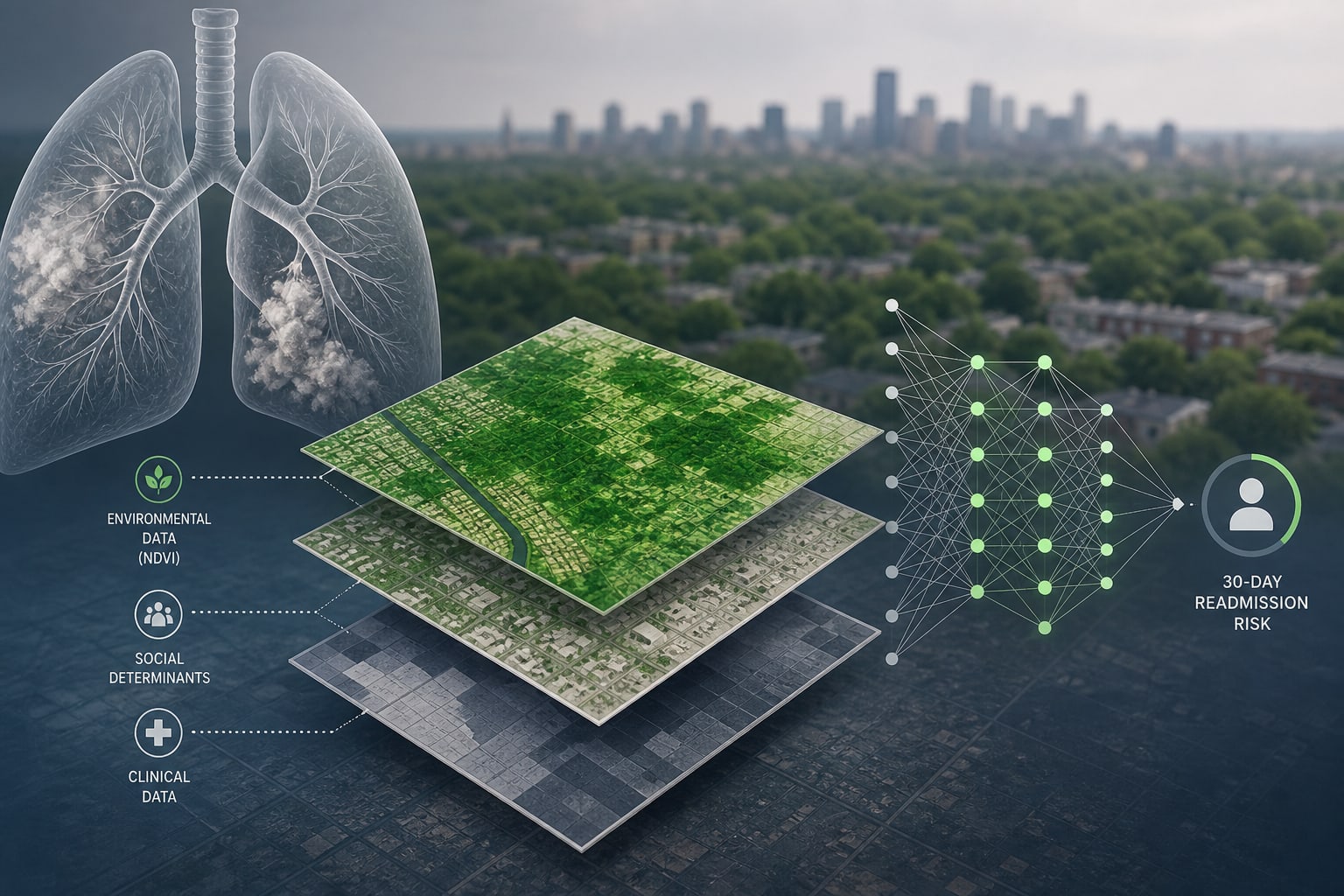
To discuss the integration of residential greenness, quantified as NDVI, into machine learning models for predicting 30-day pneumonia readmissions, highlighting its potential impact on health outcomes.
Approach:
Key Findings:
NDVI survived a rigorous feature selection process and was included in the predictive model, indicating its relevance.
Permutation importance analysis provides insights into the model's reliance on NDVI but does not replace the need for ablation analysis to quantify its contribution.
NDVI may improve predictive performance for marginalized groups whose health data is often incomplete, suggesting a potential for reducing health disparities.
Interpretation:
The integration of NDVI into predictive models represents a significant advancement, with potential implications for health equity, particularly in addressing disparities in health outcomes.
Limitations:
The study does not yet include ablation analysis to quantify the performance gain from NDVI integration, which limits understanding of its true impact.
Further research is needed to explore the differential impact of NDVI across sociodemographic subgroups, which is crucial for equitable health predictions.
Conclusion:
Future research should focus on evaluating the equity-promoting potential of NDVI in predictive models, particularly its ability to enhance performance for marginalized populations.
Research highlights expanding diagnostic capabilities but persistent gaps in antiviral therapy and vaccine coverage for pediatric enterovirus infections.