Editorial: Advances in Targeted Nanomaterial-Based Drug Delivery
-
By
-
Mandeep Kaur Marwah
-
November 20, 2026
Objective:
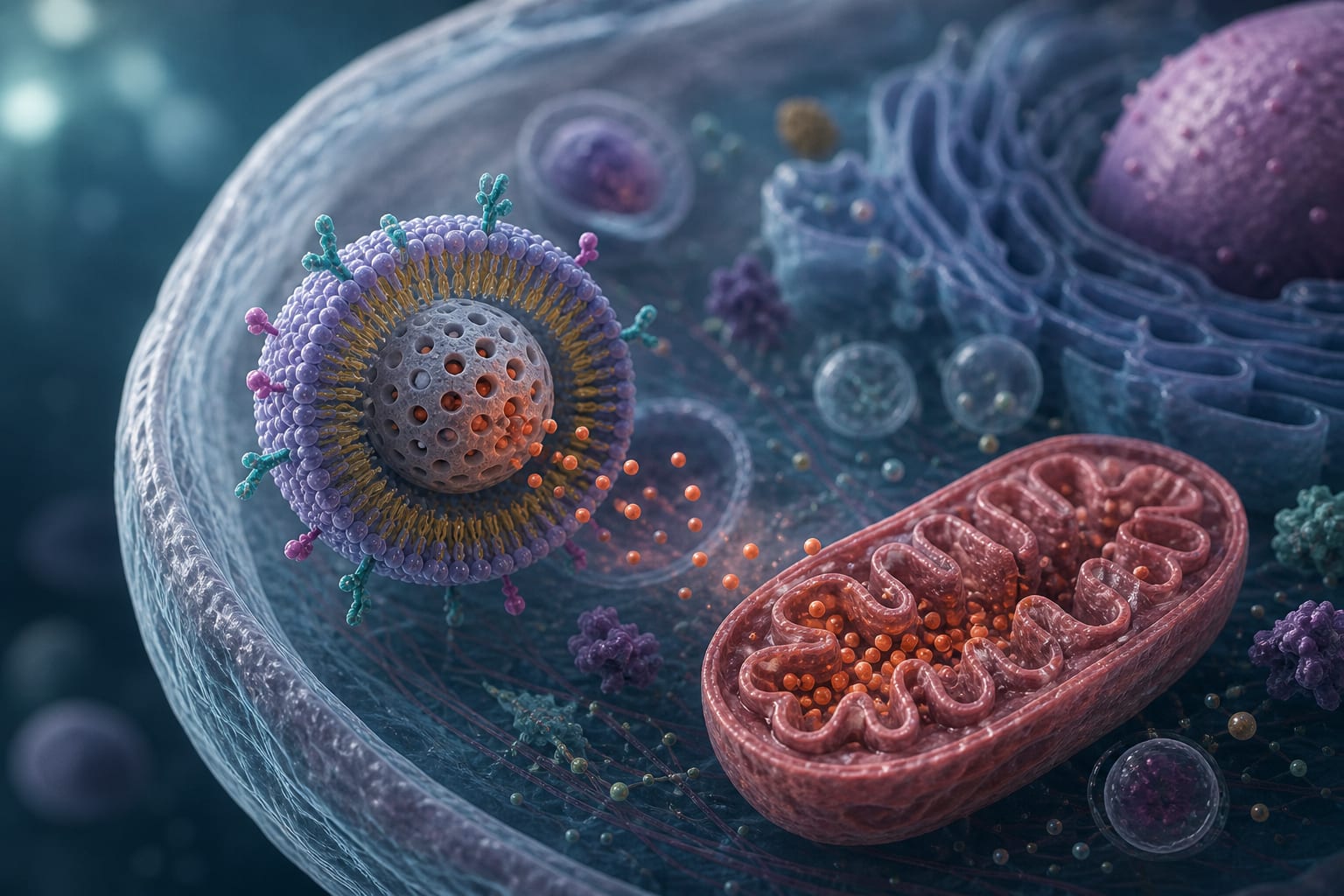
To introduce a six-article collection on nanomaterial design and formulation for targeted drug delivery, including carrier stability, biological interactions, biocompatibility, and toxicity.
Approach:
- Reviews: Two reviews discuss mitochondria-targeted delivery using porous carriers, especially mesoporous silica, and carbon quantum dots, including their properties and translational barriers.
- Original research: Four studies examine protein loading into silica, cefdinir amorphisation and storage stability, tabletting of silica microparticles, and topical withaferin A liposomal gels.
Key Findings:
- Mesoporous silica loading depended on protein size and solvent: octreotide recovery reached 71% from methanol, while albumin recovery reached at most 32% from water and remained predominantly at the particle surface.
- Cefdinir solid-dispersion and co-amorphous formulations dissolved most rapidly but lost approximately 50% of drug content during six months of accelerated humid storage. The silica formulation dissolved more slowly, retained more than 95% of its drug content, and remained amorphous under every storage condition.
- Under compression, SYLOID fragmented, with mean particle size falling from 117 to 35 µm. Higher silica content increased tablet porosity while reducing tensile strength and slowing disintegration; a binder and superdisintegrant were required to meet friability and disintegration limits.
- Withaferin A liposomal gel released drug more slowly than solution or plain gel. In TNF-α-stimulated endothelial cells and dermal fibroblasts, it decreased IL-6 secretion and intracellular reactive oxygen species; fibroblast MMP-9 secretion also decreased.
- The carbon quantum dot review identifies batch variability, limited long-term toxicity and biodistribution evidence, lack of standardised characterisation, and case-by-case regulatory evaluation as translational barriers.
Interpretation:
The editorial emphasizes that delivery performance depends on formulation choices as well as the carrier, and that trade-offs occur between properties such as dissolution, stability, porosity, and mechanical strength. It notes that most original investigations are in vitro and identifies further testing, including ex vivo permeation and retention studies for the topical formulation, as a next step.
Limitations:
- The editorial states that ex vivo permeation and retention studies for the withaferin A liposomal gel remain to be conducted.
Sources:
Based on findings from:
Editorial: Insights into targeting nanomaterials for drug delivery
Mandeep Kaur Marwah. British Journal Of Biomedical Science, 2026.
https://www.frontierspartnerships.org/journals/british-journal-of-biomedical-science/articles/10.3389/bjbs.2026.18080/full
This content is an AI-generated, fully rewritten summary based on a published scholarly article. It does not reproduce the original text and is not a substitute for the original publication. Readers are encouraged to consult the source for full context, data, and methodology.