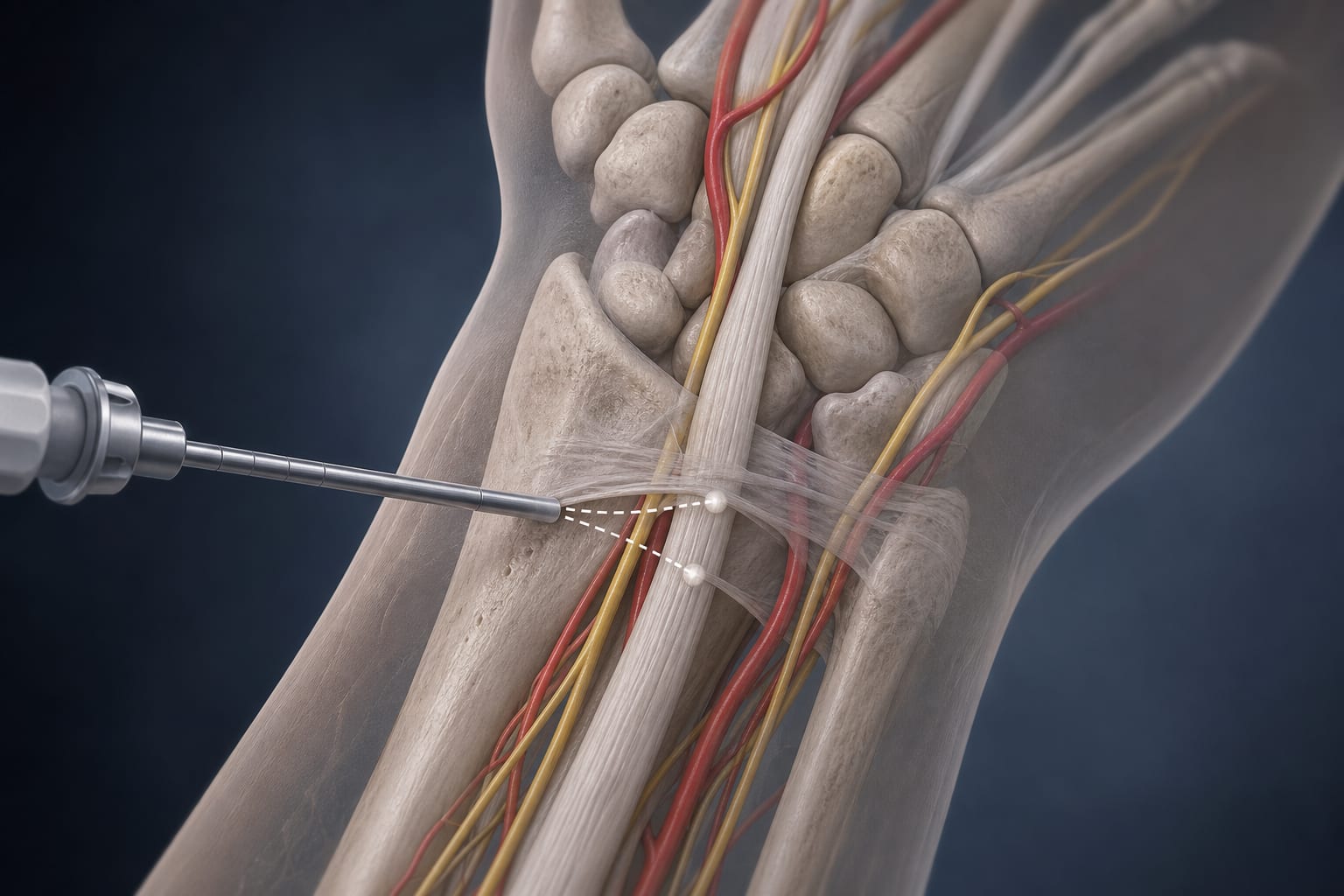
To evaluate the feasibility and safety of the Kiss-in method for VRMC and VRRC portals in wrist arthroscopy using 3D CT reconstructions.
Approach:
Study Design: A retrospective imaging study analyzing 64 adults (32M/32F) using 3D CT imaging to quantify anatomical parameters and identify gender-specific risks.
Key Findings:
No statistically significant differences were found between most parameters of the two portals, except for dTP and dTF.
Female dTP values were less than the trocar's length of 45 mm, while male values exceeded 45 mm in a significant number of cases.
The frequency of the 'risky zone' was significantly higher in the VRRC portals.
Interpretation:
The study supports the theoretical feasibility of the Kiss-in method for establishing radial volar portals, suggesting potential safety benefits for the VRRC portal and indicating that the standard trocar length may be more adequate for female patients.
Limitations:
The study is based on an anatomical simulation model, and conclusions are theoretical.
The cohort was limited to individuals with right-hand dominance and specific inclusion criteria.
Conclusion:
The determination of aTTR and aSTR has significance for the practical application of the Kiss-in method.