Development and application of a prognostic model based on radiomics and artificial intelligence for patients with lung adenocarcinoma brain metastasis - Summary - MDSpire
Conexiant’s news site is now MDSpire News. Learn more
Advertisement
Creation and utilization of a prognostic framework incorporating radiomics and artificial intelligence for lung adenocarcinoma patients with brain metastases
To develop an integrated radiomics-clinical model to improve survival prediction in lung adenocarcinoma patients with brain metastasis.
Approach:
Patient Cohort: A cohort of 176 patients with lung cancer brain metastasis (LCBM) was randomly divided into a training set (n=123) and a test set (n=53).
Risk Factor Identification: Clinical risk factors were identified using univariate and multivariate logistic regression analyses.
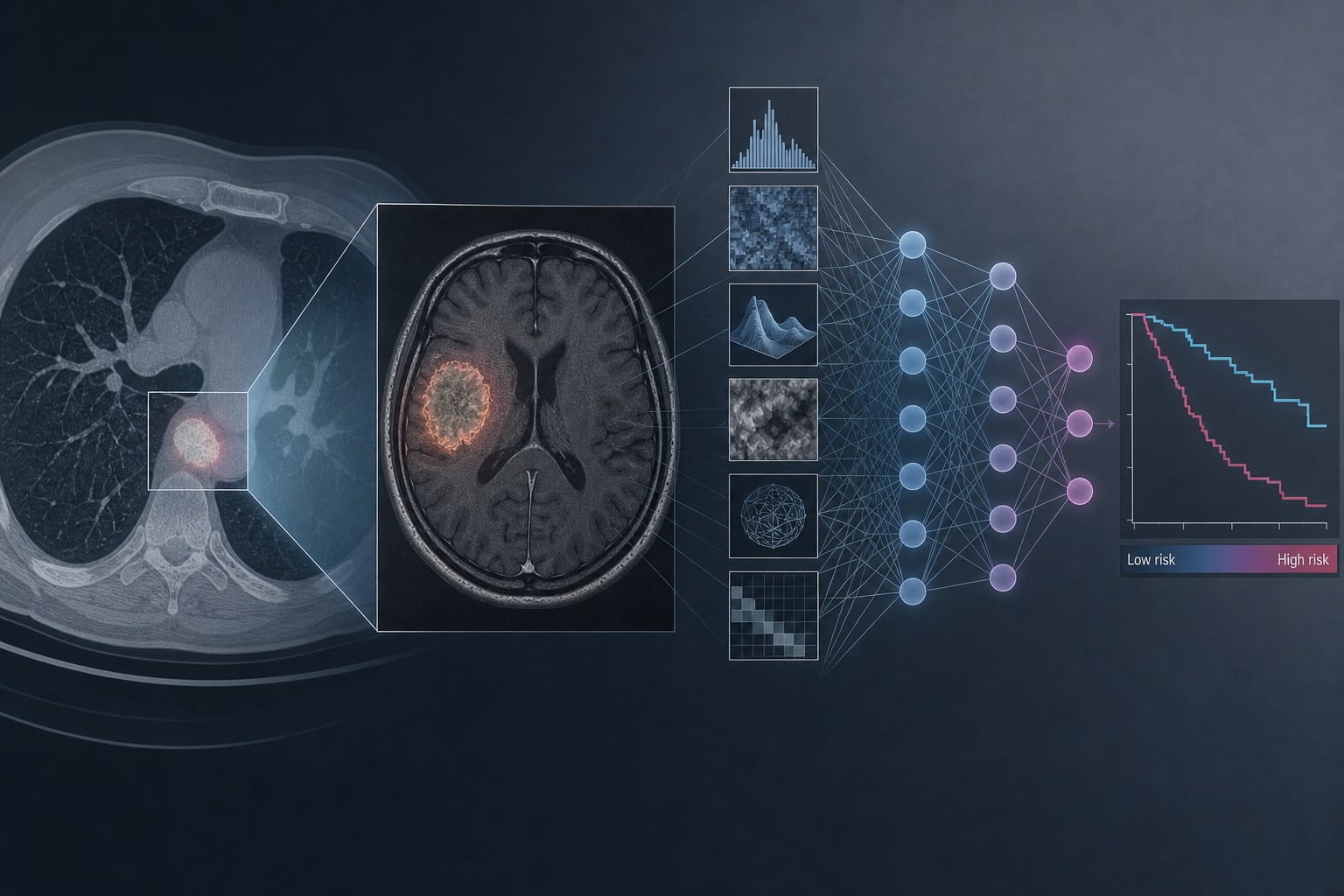
Radiomics Model Development: A radiomics model was developed based on features extracted from preoperative MRI, selected using LASSO regression.
Performance Evaluation: The combined nomogram's performance was evaluated using AUC, calibration, and decision curve analyses.
Key Findings:
EGFR mutation status, number of brain metastases, and Lung-molGPA score were identified as independent prognostic determinants.
The radiomics model achieved AUCs of 0.862 in the training set and 0.829 in the test set.
The combined nomogram demonstrated superior predictive performance with AUC values of 0.904 and 0.874 in the training and test sets, respectively.
Interpretation:
The integration of radiomics with clinical parameters enhances prognostic accuracy, aiding in personalized treatment stratification for LCBM.
Limitations:
The study is retrospective and may be subject to selection bias.
The cohort size may limit the generalizability of the findings.
Conclusion:
The study presents a reliable predictive tool for guiding treatment selection in patients with LCBM.
he U.S. Food and Drug Administration (FDA) has approved daraxonrasib, an oral multi-selective RAS(ON) inhibitor, for adults with metastatic pancreatic adenocarcinoma who have received at least one prior systemic therapy or are not candidates for multiagent systemic therapy.